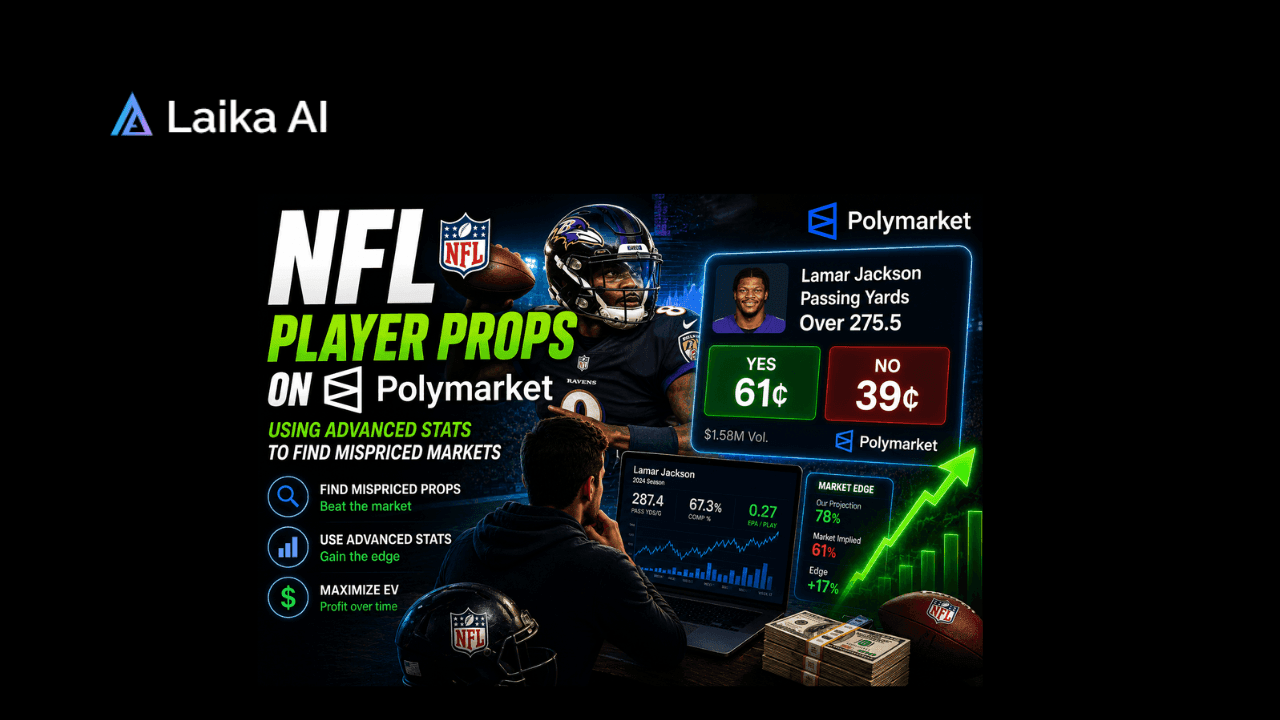
Polymarket NFL player prop markets are mispriced more consistently and more significantly than any other sports market category on the platform. The reason is not that the crowd is uninformed about football. It is that the crowd uses the wrong information. Most retail traders evaluate player prop contracts based on narrative: who had a big game last week, who is playing a weak defense, who the media is talking about. Advanced NFL statistics tell a different story, and the gap between the narrative-driven market price and the statistically grounded true probability is where the edge lives.
The NFL prediction market on Polymarket has grown substantially in the 2025 to 2026 season as the platform expanded its player-level contracts beyond simple game moneylines. Passing yards over/under, receiving touchdowns, rushing attempts, and target share thresholds are now available on major matchups, and the contracts attract enough volume on high-profile games to be genuinely tradeable at meaningful position sizes. For the foundational framework on how sports markets work across the full platform before going into NFL-specific tactics, the complete guide to trading sports markets on Polymarket covers every category.
Why NFL Player Props Are Mispriced More Often Than Game Markets
Game markets attract the most sophisticated traders. The NFL moneyline on a prime-time game between two playoff contenders has the attention of every serious prediction market participant simultaneously. When the most informed capital in the market is concentrated on a single contract, the mispricing opportunities are smallest.
Player prop markets do not attract the same concentration of sophisticated capital. They are lower volume, more specific, and require analytical work that most retail traders are not doing. A wide receiver's target share over a threshold does not generate the same media coverage as the game moneyline, which means the crowd pricing that contract is smaller, less analytically rigorous, and more anchored to narrative than to statistics.
Three specific characteristics of NFL player prop markets create consistent mispricing opportunities.
Regression to the mean is systematically underpriced. When a receiver has back-to-back 120-yard games, the market prices their next performance as if the hot streak is signal rather than noise. Advanced statistics show that game-to-game receiving yard variance is extremely high and that the best predictor of a receiver's output in any given game is their season-long target share and air yards metrics, not their performance in the last two games. Markets that price hot streak momentum above these stable metrics are consistently wrong in a predictable direction.
Defensive matchup quality is inconsistently priced. Some player prop markets correctly adjust for the opposing defense's coverage quality. Many do not, particularly on matchups that receive less media attention. A receiver who is ranked in the top quartile of the league by target share but is facing a top-five coverage unit should be priced differently than the same receiver facing a bottom-quartile coverage unit. Markets that do not make this adjustment create a clear category of trades where the analytical work is both straightforward and reliably rewarded.
Snap count uncertainty creates opportunity around injuries and roster changes. When a player returns from injury, the market prices their statistical output based on their pre-injury performance rather than the realistic snap count ceiling a returning player faces. A receiver who averaged 90 yards per game before a two-game absence may play 35 snaps in their return game rather than 65. The market priced at their pre-injury pace is systematically wrong in a way that is obvious from snap count analysis.
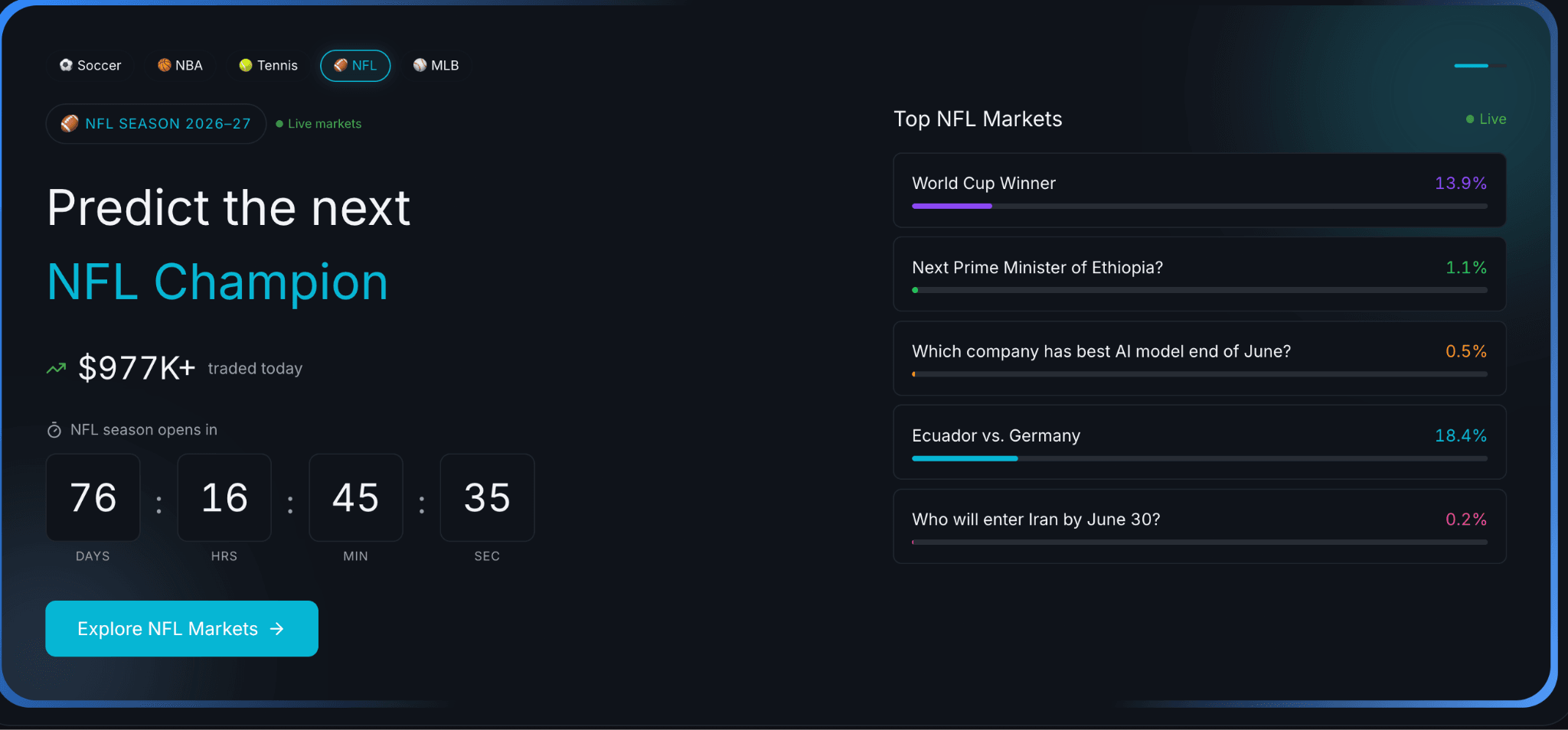
Stay ahead of the market with live NFL prediction contracts, real-time odds, and data-driven insights. Explore the biggest NFL markets and find your next trading opportunity before the crowd.
The Advanced Stats That Actually Matter
Not all advanced NFL statistics are equally useful for prediction market trading. The ones that matter are the ones that are stable across games, predictive of future performance, and systematically underweighted by the retail crowd. Target share is the percentage of a team's passing attempts directed at a specific receiver. It is the single most stable indicator of a receiver's role in an offense and the most predictive metric for game-to-game receiving volume. A receiver with a 28% target share will average more targets per game than a receiver with a 15% target share regardless of what happened in any specific game.
Target share matters for Polymarket NFL props because receiving yard markets are priced more on recent game performance than on season-long target share. A receiver who had three targets last week but maintains a 26% season-long target share is underpriced in the next game. A receiver who had 12 targets in an anomalous high-volume game but maintains a 14% season-long target share is overpriced.
The trade: when a player's recent target count diverges from their season-long target share in either direction, the market price on their next game's statistical output is likely to be mispriced in the direction of the recent anomaly. Season-long target share is the anchor. Recent games are noisy.
Air yards and depth of target
Air yards measure how far downfield a pass travels to reach a receiver. Average depth of target, or aDOT, is the average air yards per target for a specific receiver. These metrics matter for Polymarket player prop trading because they predict not just volume but big-play probability, which is what drives performance above statistical thresholds.
A receiver with a high aDOT and a favorable matchup against a safety who struggles in deep coverage has a higher probability of a 100-plus yard game than their target share alone would suggest, because a single deep reception can account for 30 to 50 percent of a game's total receiving output. Markets that price receiving yard thresholds based on volume metrics alone without accounting for big-play probability are systematically miscalibrated on high-aDOT receivers in favorable matchups.
Snap count percentage
Snap count percentage is the most underutilized metric in retail NFL prop analysis and one of the most important for Polymarket trading. A player who is on the field for 85 percent of offensive snaps has dramatically more opportunity to accumulate statistics than one on the field for 55 percent, regardless of their individual talent level.
Snap count changes are the fastest-moving information in the NFL statistical environment. When a starting running back is limited to 60 percent of snaps after an injury, the backup's receiving opportunity increases immediately. When a tight end's snap count jumps from 45 to 70 percent after a receiver injury, their target share follows. Markets that price statistical outputs based on pre-snap-change baselines are wrong in a predictable direction.
Snap count data is published after each game and is available before the next game's Polymarket prop markets have been fully priced. Traders who check snap count data immediately after each game and cross-reference it against upcoming game prop markets are systematically ahead of the crowd on this metric.
DVOA: Defense-adjusted Value Over Average
DVOA, published by Football Outsiders, measures a defense's performance against league-average expectations after adjusting for opponent quality. Pass defense DVOA and run defense DVOA are separate metrics that allow you to assess specifically how well a defense stops passing versus rushing and to compare that performance against season-long league averages.
For Polymarket NFL player prop trading, DVOA matters because it provides a statistically grounded matchup quality adjustment that the retail crowd consistently underweights. A receiver facing a defense in the bottom quartile of pass defense DVOA should be priced above their season-average performance in receiving yard markets. A running back facing a defense in the top quartile of run defense DVOA should be priced below their season average. Markets that do not make this adjustment are offering exploitable edges on both sides.
How to Cross-Reference Stats Against Polymarket Prices to Find Edges
The analytical process for finding mispriced NFL player prop markets on Polymarket follows a consistent methodology regardless of the specific metric being used.
Step 1: Build a baseline probability estimate
Before looking at any Polymarket price, build your own estimate of the probability that a player exceeds a specific statistical threshold. Use season-long target share, aDOT, snap count percentage, and DVOA-adjusted matchup quality as your inputs. The probability estimate should reflect the full distribution of possible outcomes, not just the most likely outcome.
A useful shortcut for receiving yard over/under markets: multiply the player's season-long targets per game by their yards per target average to get an expected receiving yard output. Then use the variance in their weekly receiving yard numbers to build a distribution around that expectation. The probability that their output exceeds any specific threshold follows directly from that distribution.
Step 2: Compare your estimate to the Polymarket price
The Polymarket contract price is the market's implied probability. If your baseline estimate is 58% and the market is priced at $0.45, you have identified a 13-point gap. That gap needs to be evaluated for robustness before you act on it.
A gap is more likely to be genuine edge when your estimate is based on stable metrics like season-long target share and DVOA matchup adjustment, when the specific player has not been widely discussed in media coverage this week, and when the market volume on the specific contract is low enough to suggest the sophisticated money has not yet concentrated on it. For the full mechanics of how Polymarket prices are constructed and what the spread between your estimate and the market price represents, Polymarket explained: how prediction markets work covers the framework.
Step 3: Check for information the market may have already priced
Before entering any position based on a statistical edge, verify that the market has not already incorporated information you have not yet processed. Check whether the player's injury status has changed since the last official report. Check whether the team's offensive coordinator has publicly discussed any scheme changes for this week. Check whether a key blocking lineman or complementary receiver is listed as questionable.
Markets can appear to show statistical gaps because the crowd has already priced non-statistical information that your baseline estimate has not yet incorporated. Ruling out this explanation before entering a position is the difference between capturing a genuine statistical edge and trading against information the market already has.
Step 4: Assess resolution criteria before entering
Every Polymarket player prop contract has specific resolution criteria that must be read before entering any position. A receiving yards market may resolve on official game statistics, on NFL.com box score data, or on a third-party statistical provider. A rushing attempts market may resolve on rushing attempts excluding kneeldowns or including them. These differences can change whether your statistical analysis maps correctly to the contract's resolution condition.
For the comparison of how NFL player prop market depth compares between Polymarket and Kalshi and which platform is better for specific contract types, Kalshi vs Polymarket: which is better for sports covers the head-to-head analysis. For the equivalent live trading tactics applied to the highest-volume sports market of the year, World Cup 2026 live trading on Polymarket covers the knockout stage framework.
Position Sizing and Exit Rules for NFL Props
NFL player prop markets resolve within hours of the game ending, which makes position sizing logic different from long-duration futures markets. The short resolution timeline means you cannot average down over multiple weeks. Every position sizing decision is final in the sense that you are committing capital to a binary outcome that will be known within the same day.
Size based on edge quality, not conviction level
The most common position sizing mistake in NFL prop trading is sizing based on how confident you feel rather than on the statistical quality of the edge. A feeling of high conviction that is based on a hot streak narrative rather than stable metrics should produce a small position. A statistically grounded edge of 10 percentage points based on target share, DVOA matchup adjustment, and snap count data should produce a larger position.
A reasonable starting framework: allocate 2 to 4 percent of your total Polymarket sports budget to any single player prop contract where your statistical analysis shows a gap of 8 percentage points or more. Reduce that allocation to 1 to 2 percent on contracts where the gap is 5 to 8 percentage points. Do not enter contracts where the gap is below 5 percentage points because execution costs and forecast uncertainty consume the available edge.
Exit rules for in-game price movements
NFL player prop markets update in real time during games as player statistics accumulate. A receiver who catches two passes for 45 yards in the first quarter on a contract with an 80-yard threshold will see their contract price move up significantly as the threshold becomes more likely. A receiver who is not targeted through the first quarter on the same contract will see their price drop.
The in-game exit decision requires separating signal from noise in the same way the pre-game entry decision does. A player who is one target away from pace on their season-average and is not targeted in the first quarter has not shown you anything meaningful about their final output. A player who is only seeing snap counts of 40 percent when their baseline was 75 percent has shown you a real change in their opportunity that warrants a reconsideration of the position.
The rule: exit in-game only when you observe a genuine change in the underlying statistical inputs, not when the first 15 minutes of a game differ from your expectations. NFL games are high variance. Patience on solid statistical edges is consistently rewarded more than reactive exits based on small sample in-game observations.
For the complete framework on managing capital across multiple NFL prop positions including correlation risk and weekly budget allocation, prediction market bankroll management guide covers the methodology in detail.
Frequently Asked Questions
What NFL player prop markets are available on Polymarket?
Polymarket runs player prop contracts on major NFL matchups including passing yards over/under thresholds, receiving yards over/under thresholds, rushing yards over/under thresholds, receiving touchdowns, and passing touchdowns. Availability varies by game based on matchup significance and expected trading volume. Major prime-time games and playoff matchups typically have the deepest prop menu. Check the live NFL markets page at polymarket.com for the current active contracts before each game week.
How do you find mispriced NFL markets on Polymarket?
Build a probability estimate for the specific player output threshold using stable metrics including season-long target share, aDOT, snap count percentage, and DVOA matchup adjustment. Compare that estimate to the current Polymarket contract price. When the gap between your estimate and the market price exceeds 8 percentage points and cannot be explained by information the market has already priced that you have not yet processed, you have identified a potential edge worth trading.
What advanced stats are most useful for trading NFL on Polymarket?
Target share is the most stable and most predictive metric for receiving yard prop markets. Snap count percentage identifies opportunity changes that the market consistently underweights. DVOA provides a statistically grounded matchup quality adjustment that retail traders systematically ignore. Air yards and aDOT predict big-play probability that affects the distribution of outcomes around statistical thresholds in ways that volume metrics alone cannot capture. All four metrics together provide a significantly better probability estimate than the narrative-driven inputs that most retail traders use.
Is trading NFL player props on Polymarket legal in the US?
Polymarket US launched in December 2025 under CFTC oversight and is accessible to residents of most US states. NFL player prop markets are available on the US platform. Nine states have active restrictions: Arizona, Illinois, Massachusetts, Maryland, Michigan, Montana, New Jersey, Nevada, and Ohio. For the community discussion of NFL prop trading strategies and market analysis, polymarket NFL reddit discussions in the prediction markets subreddit cover active season analysis and specific game week edges that traders are evaluating.
The Bottom Line
Polymarket NFL player prop markets offer genuine statistical edge for traders willing to do the analytical work that the retail crowd is not doing. Target share, snap count percentage, DVOA matchup adjustment, and air yards are stable, predictive metrics that the market consistently underweights in favor of narrative and recent game performance. The gap between narrative-driven market prices and statistically grounded probability estimates is the edge, and it appears reliably enough across the NFL season to be treated as a systematic opportunity rather than occasional luck.
The methodology is consistent: build your own probability estimate before looking at the market price, compare it against the Polymarket contract, verify the gap cannot be explained by information the market already has, check the resolution criteria, and size the position based on the statistical quality of the edge rather than the emotional conviction you feel about the player.
Track how NFL player prop prices move in real time across every active Polymarket contract with Polymetric by Laika AI. Live market intelligence for traders who want to see the statistical edge windows before the crowd closes them.