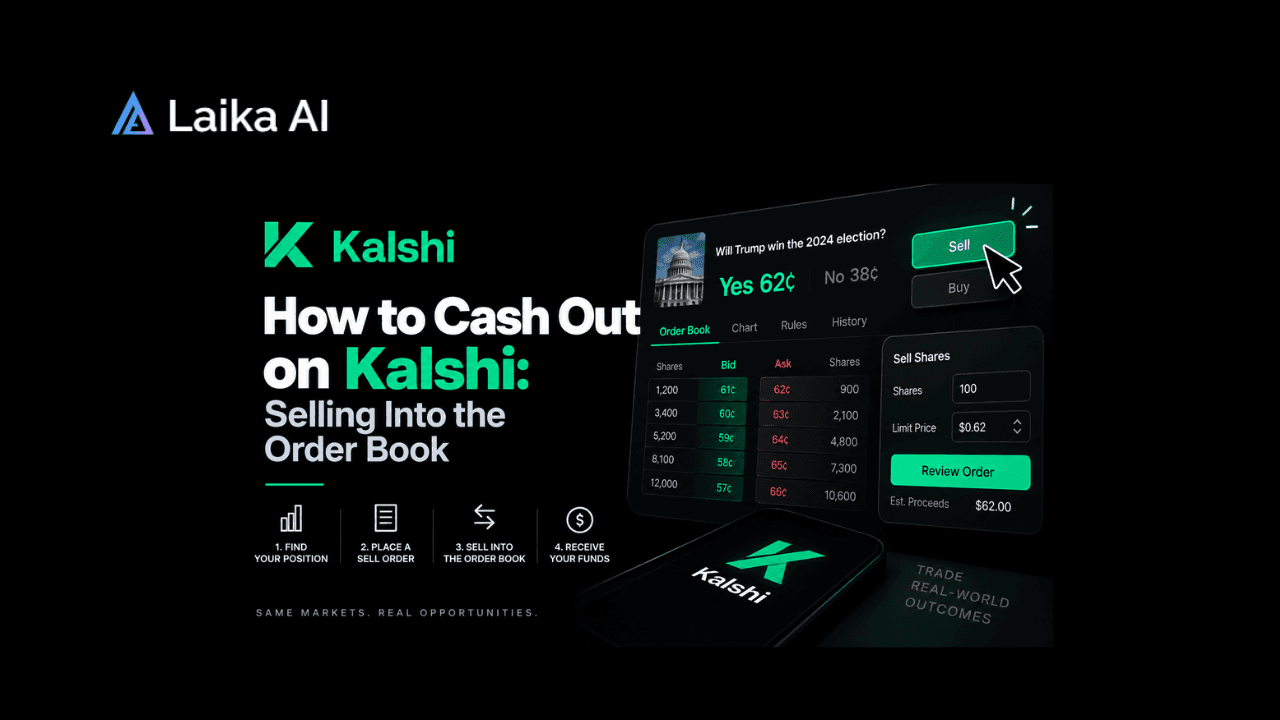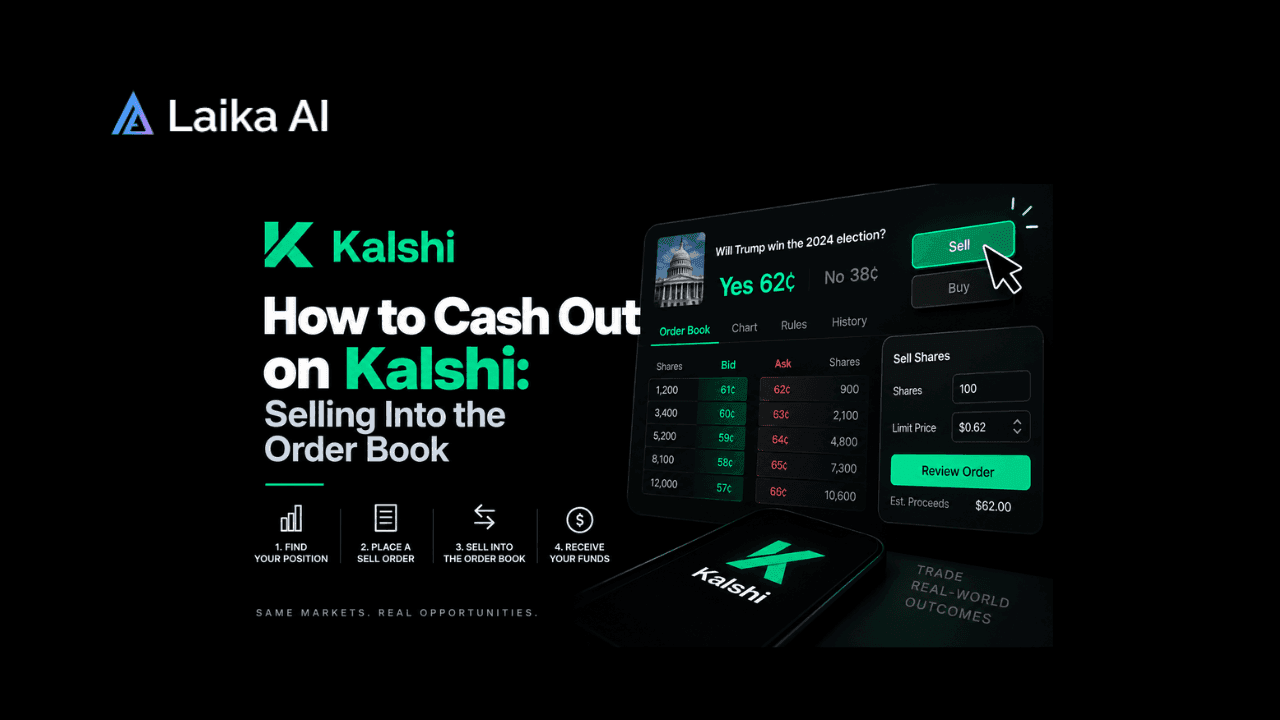
If your Kalshi review left you wanting more, you're not alone. Waitlists, sport-by-sport state restrictions, and a fee formula that takes a minute to actually understand are the usual reasons people start hunting for Kalshi alternatives. Most of what you'll find online is a list of app names with a logo and a one-line pitch. That's not much use if you actually trade. This piece judges every prediction market app on the same yardstick: how it prices trades, how deep its order books actually are, what it lets you trade, whether it's cleared any real regulatory hurdles, and whether it gives you data access beyond a mobile app screen.
Why People Go Looking for Apps Like Kalshi in the First Place
Kalshi is a legitimate, CFTC-regulated exchange, and there's no serious argument otherwise. But "legit" and "the right fit for you" aren't the same question. Some traders hit Kalshi's per-market position limits. Some live in a state where sports contracts are currently blocked while the legal fights over prediction markets keep playing out. Some just want a second venue so they're not fully dependent on one order book, or they've read enough of a Kalshi review to know its strengths and want to see what else is out there before committing. None of that is a knock on Kalshi. It's just how a fast-growing category tends to work: no single prediction market app is going to be the best fit for every trader.
What to Actually Look for in a Kalshi Alternative
Before naming names, it helps to agree on what actually separates a good alternative from a logo on a listicle. Five things matter more than anything else.
- Fee structure. A flat per-contract fee and a probability-weighted fee formula can produce very different costs depending on where a contract is priced. Know which one you're dealing with before you trade size.
- Market depth and liquidity. A platform can list a hundred markets and still have almost no one actually trading ninety of them. Depth matters more than the headline market count.
- Contract variety. Sports, politics, economics, weather, crypto: some platforms cover all of it, others lean hard into one category.
- Regulatory status and state availability. CFTC designation matters, but so does whether your specific state currently allows sports-related contracts, since that's the part still being litigated.
- Data and API access. If you want to build anything automated on top of a platform, a public API isn't optional.
Every platform below gets scored against this same list, not against how flashy its homepage looks.
Kalshi Alternatives Compared Side by Side: Quick Glance
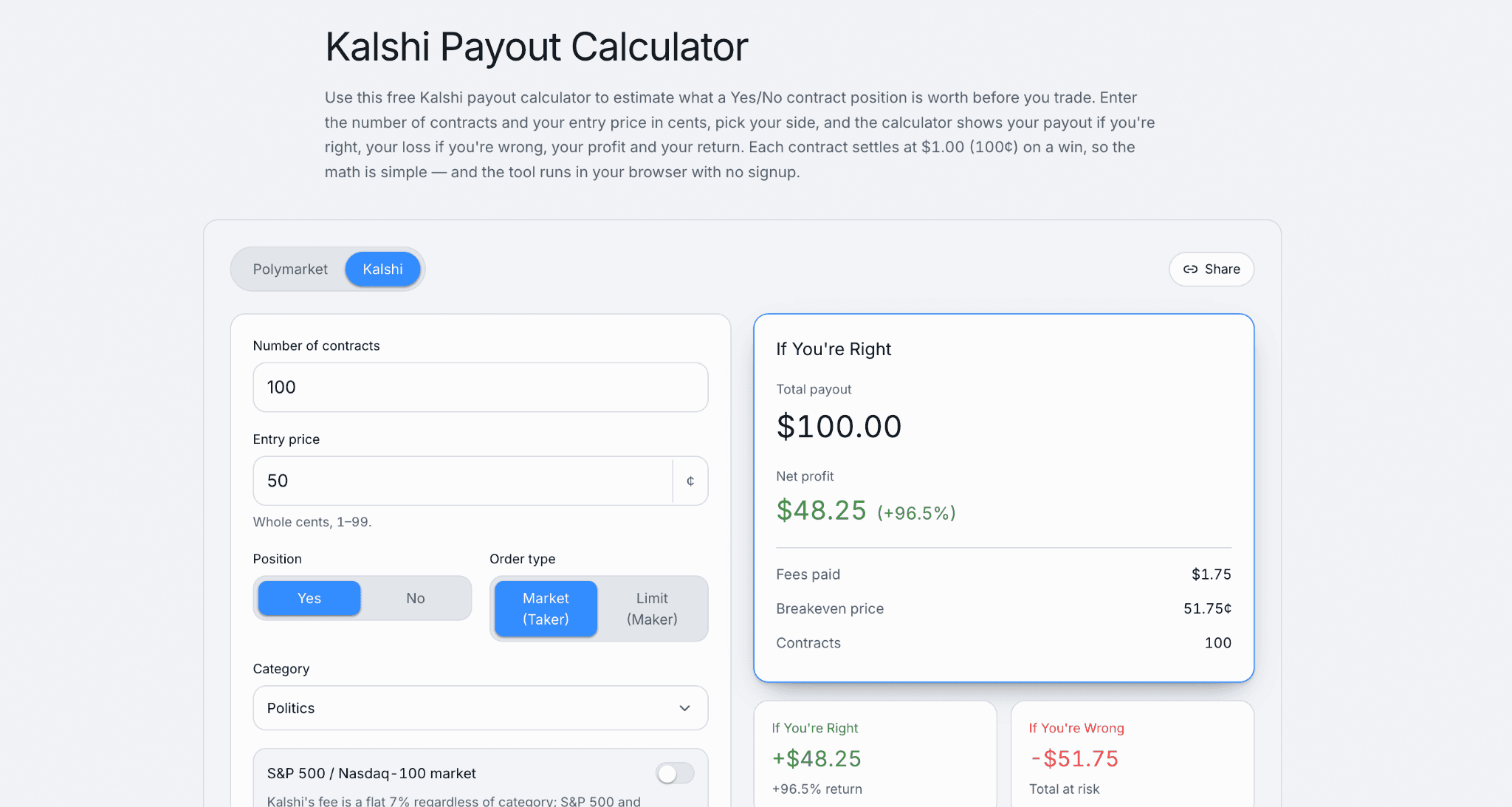
Polymarket
Polymarket is the obvious first stop, and for good reason. After a 2022 CFTC settlement pushed it out of the US market, the company acquired a CFTC-licensed derivatives exchange and returned with a regulated Designated Contract Market license and a dedicated US product. Depth here rivals or exceeds Kalshi's on the highest-profile markets, especially politics and global events, and its public API is genuinely built for developers rather than an afterthought.
Fees on Polymarket's US exchange run a flat 0.30% taker fee with a 0.20% maker rebate, a simpler structure than Kalshi's price-weighted formula but not necessarily cheaper depending on the trade. Availability isn't universal yet: a subset of states still carry restrictions while the regulatory picture settles. Anyone weighing the two head to head will want the full Kalshi vs Polymarket breakdown before picking a side, and our Polymarket guide covers the platform's mechanics and legality in more depth than fits here.
Robinhood
Robinhood isn't really a separate exchange in the way Polymarket is. It's a brokerage layered on top of existing venues, mainly Kalshi contracts through a formal partnership, with its own LedgerX-based platform now also in the mix. If you already trade stocks on Robinhood, the convenience of one login is real.
The tradeoff is cost and control. Robinhood's fee model mirrors Kalshi's own probability-weighted formula but adds its own cut on top, capping out around two cents per contract combined rather than Kalshi's roughly 1.75-cent cap. Depth on shared contracts matches Kalshi's since it's the same underlying market. Robinhood does offer a handful of contract types Kalshi doesn't list directly, including education-focused markets. Availability spans all 50 states with a few sports exceptions. For a deeper look at what Kalshi itself offers before comparing brokerage layers on top of it, see how Kalshi works.
DraftKings Predictions (DKeX)
DraftKings built its own exchange, DKeX, after acquiring Railbird Technologies, moving off third-party clearing and onto CFTC-licensed infrastructure it fully controls. Fees are usage-based rather than flat: takers pay between roughly half a cent and a cent per contract, while makers who add liquidity pay a quarter of a cent, pricing that tracks close to Kalshi's own.
Where DraftKings differs most is focus. Its strongest liquidity sits in sports and financial markets, the categories its existing sportsbook user base already trades, and depth things out fast anywhere else. If sports-adjacent event trading with a familiar sportsbook-style interface is what you want, the full DraftKings DKeX review walks through the setup, KYC requirements, and legal states in detail.
FanDuel Predicts
FanDuel's version runs through a joint venture with CME Group, one of the most established derivatives exchanges anywhere, which gives it real regulatory backbone. Financial and economic contracts are available in nearly every state; sports contracts are only offered where traditional sports betting isn't yet legalized, since FanDuel drops sports contracts the moment a state greenlights its regular sportsbook.
Fees are the simplest on this list: a flat 2% of your potential payout, calculated up front rather than baked into the spread. That's easy to understand but often costs more than Kalshi or DKeX on larger trades. Depth on major financial benchmarks is solid; open interest on niche or political markets lags well behind Kalshi and Polymarket. The full FanDuel Predicts review covers current state availability and fee examples.
Coinbase Predict
Coinbase's prediction market product doesn't run its own exchange at all. It's a front end built directly on top of Kalshi's order books, which means depth and pricing largely match Kalshi one-for-one, and fees follow a similar capped, price-weighted structure rather than anything Coinbase sets independently.
What Coinbase adds is convenience for anyone already living in its app: instant funding from an existing Coinbase balance, a familiar crypto-adjacent interface, and access to the same broad Kalshi market categories including politics, sports, weather, and crypto-specific contracts. There's no public API here, so it's not a fit if building anything automated matters to you. Available nationwide except Nevada. Our Coinbase prediction markets guide covers onboarding and how the underlying Kalshi relationship actually works.
Gemini Predictions
Gemini took the slower, more independent path: a five-year Designated Contract Market license application that finally cleared in December 2025, giving Gemini Titan its own federal license rather than a partnership arrangement. That's a meaningfully different regulatory position than Coinbase's approach.
Depth is still building. Gemini is smaller than Kalshi or Polymarket across the board, though it's growing fast and has leaned into crypto-adjacent markets where its existing exchange user base already trades. Fees follow a standard maker/taker schedule, and the platform ran fee-free for a stretch after launch, worth checking since that window may have closed by the time you read this. Coverage spans politics, sports, economics, and crypto. Our Gemini Predictions review has the current fee schedule and market list.
Manifold Markets
Manifold is the outlier on this list because it isn't a real-money market at all. Trades use Mana, a play-money currency that can be donated to charity but never withdrawn as cash, which is a deliberate choice that keeps the platform outside CFTC and gambling regulation entirely.
That structure means no KYC, no funding friction, and genuinely open market creation. Anyone can start a market on anything, from tech predictions to hyper-specific personal questions no regulated exchange would ever list. The obvious tradeoff is that nothing you win is real money, and depth on any given market depends entirely on how much community attention it attracts. It's a solid tool for practicing forecasting or tracking your calibration, not a substitute for a real-money venue. See our Manifold Markets vs Polymarket comparison for a closer look at where the play-money model actually helps and where it falls short.
Crypto.com Sports
Crypto.com's prediction market product grew out of its existing sports and crypto trading base, and it leans into that identity: contracts are funded and settled without converting in and out of fiat at each step, and it supports several hundred cryptocurrencies for deposits. That's a meaningfully different day-to-day experience than any fiat-first platform on this list.
Depth is strongest around major sporting events and crypto-price contracts, the two areas its core user base already cares about, with less coverage of the political and economic markets Kalshi and Polymarket are known for. If you're already crypto-native and want prediction markets without leaving that ecosystem, it's worth a look. If broad political or economic contract variety is the priority, it's a thinner fit.
One More Look: Every Platform, Every Angle
The table above covers regulation, fees, and depth. Here's the rest of it, contract variety, data access, and where each platform is actually usable, with Kalshi included as the baseline so you can see the full picture in one place.
Which Alternative Actually Fits Your Trading Style
There isn't one right answer here, it genuinely depends on what you're optimizing for.
If deep liquidity and a real API matter most, Polymarket is the closest thing to a direct Kalshi competitor rather than a layer built on top of one. If you want one login across investing and trading, Robinhood or Coinbase make sense since they piggyback on Kalshi's own order books. If you're coming from sports betting and want a familiar interface, DraftKings or FanDuel will feel the most natural, though expect thinner books outside sports and financial markets. If you want to test strategies with zero financial risk before committing real money anywhere, Manifold is genuinely useful for that and nothing else. And if regulatory clarity matters more than any single feature, Gemini's own federal license and Polymarket's CFTC-approved return are both worth weighing seriously.
Whichever platform you land on, the harder problem usually isn't picking an app, it's knowing whether the trade in front of you is actually good. That's the part a prediction market app itself typically won't help with. Polymetric exists for exactly that gap: pulling fee structures, historical pricing, and market depth across Kalshi, Polymarket, and the rest of this list into one place so you're evaluating an actual edge instead of just a platform's marketing page.
Frequently Asked Questions
Is Kalshi legit and safe to use?
Yes. Kalshi is a federally regulated Designated Contract Market under the CFTC, the same regulatory class as major U.S. futures exchanges, and it keeps user funds in segregated accounts separate from company funds. The one area still genuinely contested is sports-related contracts in a handful of states, where legal challenges are ongoing, but that's a state-by-state sports question, not a question about whether Kalshi itself is a legitimate exchange.
What are people saying about Kalshi's legitimacy on Reddit?
The Reddit sentiment is generally confident on the legitimacy question itself. Threads rarely argue Kalshi is a scam. Complaints that do surface tend to focus on customer support response times and confusion over the price-weighted fee formula rather than anything touching the platform's regulatory standing. If you're specifically weighing Kalshi against other options, the discussion threads worth reading are usually about fee comparisons and state-by-state sports access, not legitimacy.
What other apps are like Kalshi?
Polymarket, Robinhood, DraftKings Predictions, FanDuel Predicts, Coinbase Predict, Gemini Predictions, Manifold Markets, and Crypto.com Sports all let you trade or forecast real-world event outcomes, though they differ significantly in regulatory structure, fees, and depth, which is exactly what the comparison table above breaks down.
Are there betting apps similar to Kalshi?
DraftKings Predictions and FanDuel Predicts are the closest in feel, since both grew out of existing sportsbook apps and carry over a familiar sports-betting-style interface, even though the underlying product is a regulated event contract rather than a traditional bet.
What are the best Kalshi alternatives according to Reddit?
Polymarket and Robinhood come up most often, Polymarket for traders who want deeper liquidity and don't mind a crypto-adjacent product, Robinhood for people who already have an account there and want prediction markets alongside stocks in one place.
Is Kalshi a good platform for beginners?
It's reasonably approachable. The interface is clean and contracts are priced simply as probabilities between one and ninety-nine cents, but the fee formula takes a little longer to understand than a flat per-trade fee would. Beginners who want the simplest possible fee structure to start with sometimes prefer FanDuel Predicts' flat 2% model instead, even if it costs more on larger trades.
Are there apps like Kalshi for sports trading specifically?
DraftKings Predictions and FanDuel Predicts both lean heavily into sports contracts and will likely feel the most natural if that's your main interest, though availability depends on whether your state has already legalized traditional sports betting, since FanDuel in particular pulls sports contracts once that happens locally.
For related reading on this topic, our top Polymarket alternatives guide covers the same ground from the opposite direction, for anyone who started their search on Polymarket instead of Kalshi. And if fees are the deciding factor for you, the full Kalshi vs Polymarket fee comparison and the 50-state prediction market legality tracker go well beyond what fits in a single comparison table.