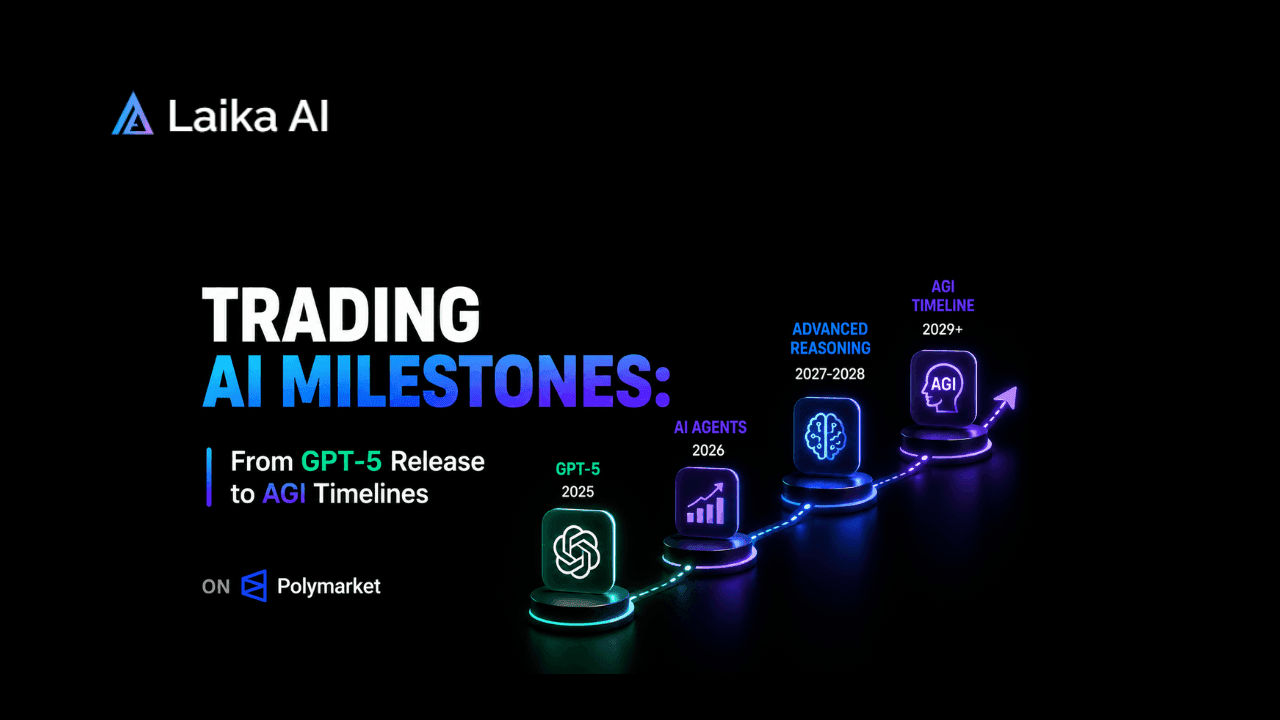
Trading AI milestones polymarket contracts occupy a genuinely different risk category from sports, elections, or macro events, because the underlying subject matter, frontier AI development, is controlled by a small number of private companies with strong incentives to control the flow of information about their own progress. A GPT-5 prediction market or an AGI timeline contract prices probability based on a mix of public statements, leaked information, developer community signal, and pure speculation, in an environment where the entities most capable of resolving the uncertainty have no obligation to be transparent and often have commercial reasons not to be.
This guide covers what AI milestone markets exist on Polymarket, how release date and capability threshold contracts are actually priced, the specific information asymmetries that create tradeable edges in this category, and the resolution risks that make AI markets structurally different from almost anything else on the platform. For the foundational mechanics of how any Polymarket contract prices probability, Polymarket explained: how prediction markets work covers the structure underlying every AI market referenced in this guide.
What AI Milestone Markets Exist on Polymarket
Polymarket AI prediction contracts split into two structurally different categories that require different analytical approaches. The first covers concrete, verifiable events: a specific model release, a specific benchmark score, a specific corporate action like an IPO or acquisition. These markets resolve against observable facts once the event occurs, similar in structure to a sports or election contract. The second covers genuinely ambiguous, definitionally contested milestones, most prominently AGI timeline markets, where even AI researchers disagree substantially on what would actually constitute the achievement being priced.
This distinction matters enormously for how you approach any specific contract, and it is the first thing to check before entering a position in this category.
How These Markets Are Priced and What Moves Them
Release date and capability markets
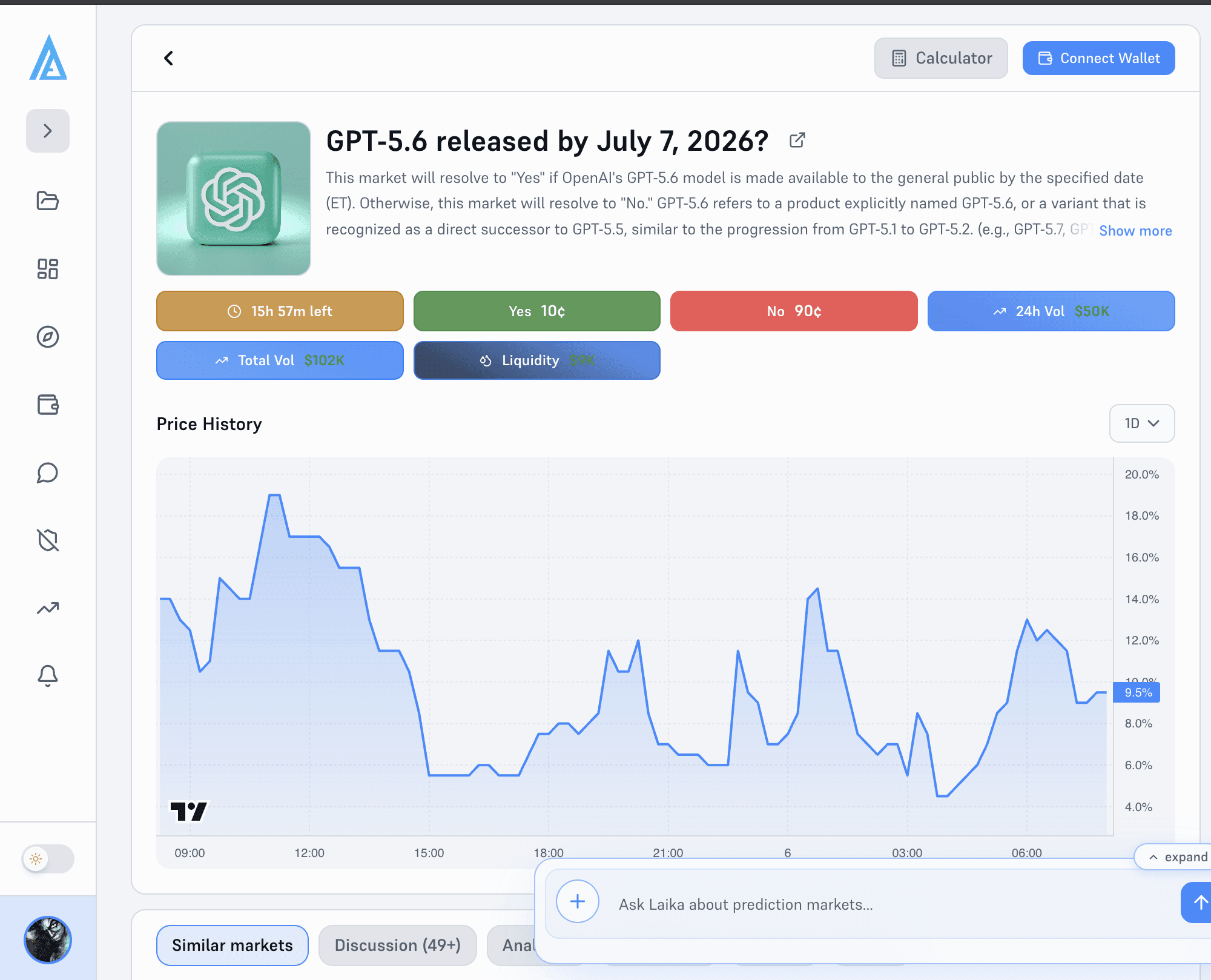
A GPT-5 prediction market, or any specific-model release market, prices the probability of a defined event by a defined date. These contracts behave similarly to other event markets in terms of mechanics: priced between $0.01 and $0.99, representing implied probability, repricing continuously as new information arrives.
The most reliable single source for release-related markets is direct company communication, whether through official blog posts, developer documentation updates, or announced keynote events. The least reliable but fastest-moving source is social media speculation from AI researchers and industry commentators, which frequently moves prices before verification and just as frequently reverses when claims turn out to be inaccurate or exaggerated.
AGI timeline markets
AGI timeline contracts are priced fundamentally differently because there is no agreed operational definition of the milestone being traded. Different market listings may define AGI achievement in terms of specific benchmark performance, a company's own public declaration, an expert consensus survey, or some combination of criteria specified in the contract rules. This is the single most important thing to check before trading any AGI-related contract: read the exact resolution criteria, because two markets that appear to ask the same question can resolve on entirely different standards.
The Metaculus AI timeline forecasting community provides a useful external calibration reference for AGI-related probability estimates, since it aggregates forecasts from a community specifically focused on rigorous, well-reasoned AI timeline predictions rather than the more speculative and narrative-driven pricing that can occur on prediction markets during periods of high AI hype or panic. Comparing Polymarket's current AGI timeline pricing against Meticulous community forecasts on a similarly defined question can reveal whether Polymarket's pricing reflects informed analysis or crowd sentiment detached from the underlying technical reality.
Trading Strategies for AI Milestone Markets
Exploiting information asymmetry from the AI research community
The single most reliable edge in this category comes from genuine technical fluency in AI development, not from speed of reaction to headlines. Traders with a real understanding of model training timelines, compute scaling patterns, and the typical gap between a capability being demonstrated internally and being publicly released have a structural advantage over traders reacting purely to social media buzz.
The announcement window trade
AI companies frequently schedule major announcements around specific industry conferences or company-hosted events. Markets on release timing often show a predictable pattern: probability drifts upward gradually as a known conference date approaches, then resolves sharply once the announcement occurs or the conference passes without the expected reveal. Traders who track the industry conference calendar directly, rather than relying on secondary speculation, can position ahead of these known timing windows with a clearer view of the actual probability distribution than the broader market, which often anchors too heavily on rumor rather than the company's own historical announcement patterns.
Cross-market signal reading
The broader framework of using prediction markets as sentiment and information signals extends naturally into the AI category. How to use prediction markets to gauge S&P 500 sentiment covers the general methodology of reading prediction market probability shifts as leading indicators, and the same logic applies to AI markets: a sharp, unexplained move in an AI capability or release market can be a genuine early signal worth investigating, particularly if it occurs outside the normal news cycle. For AI markets with geopolitical dimensions, particularly those touching export controls on AI chips or international AI regulation, geopolitical hedging with prediction markets covers the framework for treating these contracts as portfolio-relevant risk management tools rather than purely speculative positions.
For a related category of technology prediction markets with similarly private, hard-to-verify underlying information, private company valuation markets on Polymarket covers how markets price outcomes for companies that do not have the public disclosure requirements of listed corporations, a dynamic that overlaps significantly with how frontier AI labs, many of which remain privately held, communicate information to the public.
Risk Factors Unique to AI Milestone Markets
Definition ambiguity as the core structural risk
Unlike a sports contract where "did the team win" has an objective, undisputed answer, an AGI timeline market can generate legitimate disagreement about whether the resolution condition has actually been met even after the underlying technical event has occurred. A model that passes a specific benchmark test may or may not satisfy a contract's definition of AGI depending on how narrowly or broadly that contract's rules define the term. This is not a hypothetical concern. It is the single most common source of resolution disputes in this market category, and it means due diligence on contract wording matters more here than in almost any other Polymarket category.
Long time horizon capital commitment
AGI timeline markets frequently extend years into the future, which means capital committed to these positions is illiquid for extended periods relative to a typical event market, and the opportunity cost of holding that capital rather than deploying it elsewhere compounds meaningfully over a multi-year horizon. Traders considering large positions in long-dated AI timeline contracts should explicitly weigh this opportunity cost as part of their sizing decision, not treat the position as a simple binary bet with no time-value component.
Corporate information control
Frontier AI labs have strong commercial and competitive incentives to control the narrative around their own progress, sometimes overstating near-term capabilities to attract investment and talent, sometimes understating them to avoid regulatory scrutiny or manage public expectations. Treating any single company's public statement about their own AI progress as neutral, disinterested information rather than strategic communication is a common and costly mistake for traders new to this category.
For the complete framework on sizing positions appropriately given the elevated uncertainty and long time horizons common in this category, the prediction market bankroll management guide covers position sizing discipline calibrated to different risk and duration profiles across market types.
Frequently Asked Questions
What AI milestone markets exist on Polymarket?
Polymarket runs contracts across specific model release date markets, capability benchmark markets, AGI timeline and definition markets, and corporate events tied to major AI labs including IPOs, acquisitions, and regulatory actions. Release date and benchmark markets tend to have clearer, more verifiable resolution criteria than AGI timeline markets, which suffer from definitional ambiguity around what actually constitutes the milestone being priced. Check the live AI and technology markets page at laikalabs.ai/ for current active contracts.
How does the Polymarket price GPT-5 release probability?
Historical GPT-5 prediction market contracts, and any similar model-specific release market, priced probability based on the aggregate of trader positions responding to official company communications, developer conference scheduling, leaked information from within the AI research community, and pattern analysis of previous model release timelines from the same company. Prices moved most sharply on verified official statements and conference announcements, while social media speculation produced faster but noisier and less reliable price movement.
What is the current Polymarket probability for AGI?
AGI timeline probabilities vary significantly depending on the specific contract's resolution definition, since different markets define AGI achievement using different criteria ranging from specific benchmark performance to expert consensus surveys to company self-declaration. Check the specific resolution criteria on any active AGI market at polymarket.com directly, since comparing prices across differently defined contracts produces a misleading picture of genuine sentiment. Cross-referencing against the Metaculus AI timeline forecasting community can provide a useful calibration point against a community with a specific focus on rigorous AGI forecasting methodology.
What is the best strategy for trading AI milestone markets on Polymarket?
The most reliable approach combines genuine technical fluency in AI development patterns, tracking industry conference schedules and company announcement history rather than reacting to social media speculation, reading exact resolution criteria before entering any contract given the definitional ambiguity risk unique to this category, and sizing long-dated AGI timeline positions with explicit attention to the opportunity cost of multi-year capital commitment. For ongoing community discussion of specific AI milestone contracts and AGI timeline debates, polymarket AGI timeline reddit threads in AI-focused and prediction market communities carry active discussion, particularly following major model releases or research announcements from leading labs.
The Bottom Line
Trading AI milestones polymarket contracts rewards a specific combination of genuine technical understanding and careful contract-reading discipline that most other prediction market categories do not require to the same degree. Release date and capability benchmark markets behave reasonably similarly to other verifiable event contracts, with edges available to traders who track primary sources, conference schedules, and company announcement patterns more carefully than the broader crowd reacting to secondary speculation.
AGI timeline markets are structurally different and structurally riskier, given the absence of any agreed technical definition for the milestone being priced and the multi-year time horizons that tie up capital and compound opportunity cost. The single most important habit in this entire category is reading exact resolution criteria before every trade, since the definitional ambiguity that makes AGI markets interesting to trade is the same ambiguity that produces the most contested and disputed resolutions on the platform.
Track how AI milestone and model release probabilities move in real time across every active Polymarket contract with Polymetric by Laika AI. Live market intelligence for traders who need to see the information asymmetry before the broader market catches up.