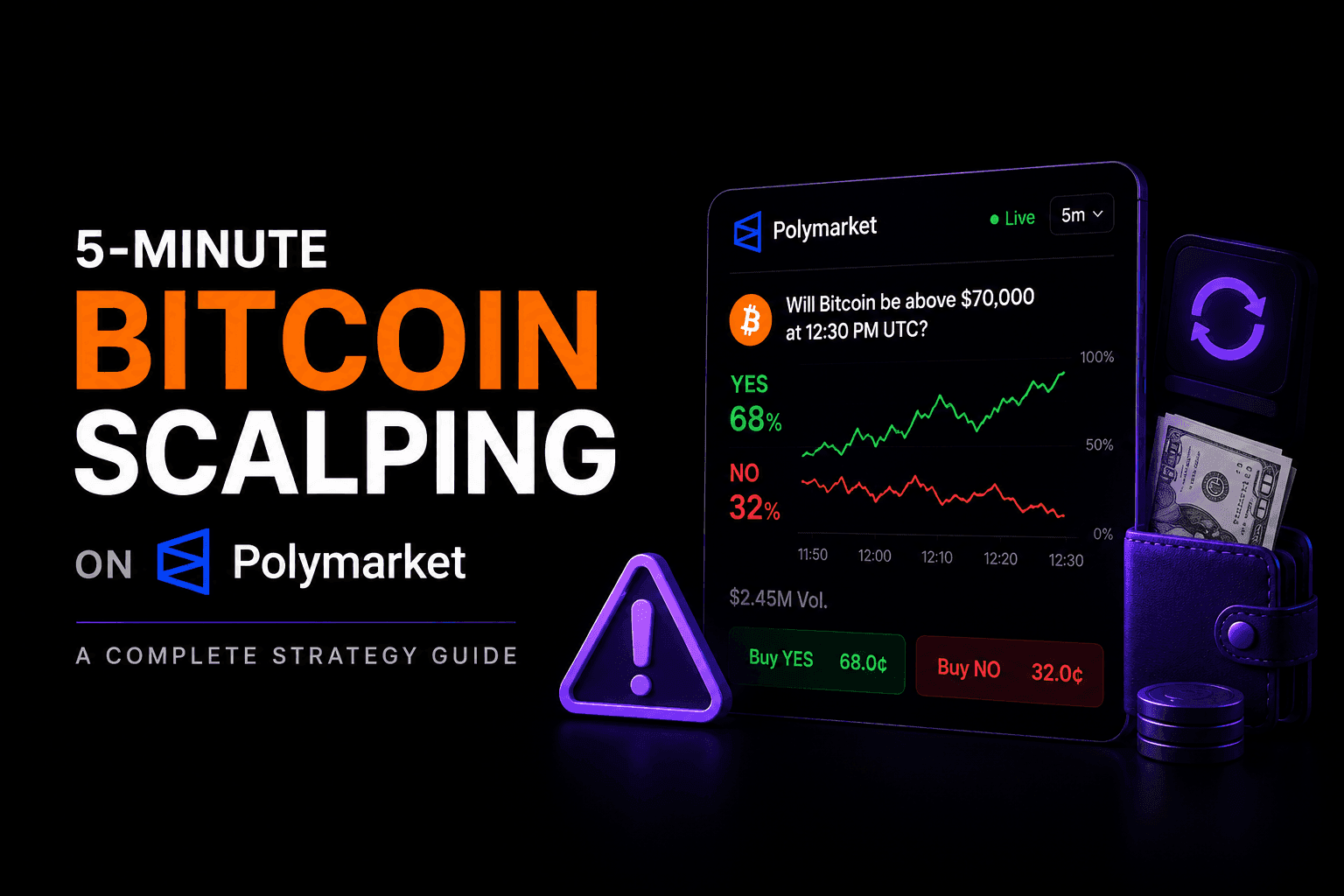
Bitcoin scalping polymarket strategies borrow a term from traditional trading, but the mechanics underneath are genuinely different from scalping on a centralized exchange, and understanding that difference before you place a single trade will save you money. On a crypto exchange, scalping means capturing small price movements in the underlying asset itself, often dozens of times per hour, using leverage and tight spreads to generate profit from moves as small as a few basis points. On Polymarket, you are not trading Bitcoin's price directly. You are trading a binary contract on whether Bitcoin's price satisfies a specific condition by a specific time. That structural difference changes what scalping actually means, what a realistic win rate looks like, and whether the strategy is viable at all once you account for spreads and settlement mechanics.
This guide covers how short-duration Bitcoin contracts are structured on Polymarket, a realistic five-minute trading workflow with entry and exit rules, and the specific costs and risks that most scalping guides gloss over. Read this before you start, because the honest answer is that Polymarket's structure makes some forms of scalping genuinely difficult, and knowing where those limits are is more valuable than a workflow that ignores them.
How Short-Duration Bitcoin Price Contracts Work on Polymarket
Before attempting any scalping strategy, you need to understand exactly what you are trading and how it differs from a spot or futures position on a crypto exchange.
The contract structure
Polymarket's Bitcoin price markets ask a binary question: will Bitcoin's price be above or below a specific threshold at a specific resolution time. The shortest-duration contracts currently available resolve hourly, checking Bitcoin's price at the top of each hour against a reference price feed specified in the market rules. Daily contracts resolve at a fixed time each day, typically tied to a standard close time referenced against a major exchange price feed.
Each contract is priced between $0.01 and $0.99, representing the market's implied probability that Bitcoin will be above the threshold at resolution. A contract priced at $0.55 means the market assigns a 55% probability to Bitcoin closing above the stated threshold when the hour or day resolves. If you buy YES at $0.55 and Bitcoin closes above the threshold, you receive $1.00 per contract. If it closes below, you receive $0.
Why this is not the same as scalping a Bitcoin chart
On a crypto exchange, a scalper watches price action on a chart and enters and exits positions based on short-term momentum, support and resistance levels, or order flow signals, often holding a position for seconds to minutes. The profit comes directly from the price movement itself, and the position can be closed at any moment at the current market price with tight, continuous liquidity.
On Polymarket, your position is a probability estimate tied to a fixed resolution time, not a continuously tradeable proxy for the underlying price. You can sell your contract before resolution, which gives you an exit mechanic similar to a traditional position, but the price you receive when selling reflects the market's updated probability estimate, not a direct one-to-one mapping to Bitcoin's price movement. A five-cent move in Bitcoin's price near the threshold can move the contract price by ten or fifteen cents if it changes the probability estimate significantly. A larger Bitcoin move that does not affect whether the threshold will be crossed might barely move the contract price at all.
This means successful Bitcoin scalping polymarket strategies require thinking in terms of probability shifts around a specific threshold, not raw price momentum. The trade you are actually making is a bet on whether a specific condition becomes more or less likely in the next few minutes, which is a subtly different skill than reading a candlestick chart.
Resolution timing and reference prices
The resolution mechanics matter enormously for a scalping strategy because your entire edge depends on understanding exactly when and how the contract settles. Most hourly Bitcoin contracts on Polymarket reference a specific price feed, commonly derived from a major exchange or an aggregated index, at the precise resolution timestamp. Check the exact resolution source listed in each contract's rules before trading, because a contract that resolves on a different exchange's price feed than the chart you are watching on tradingview.com can produce a result that surprises you even when your read on Bitcoin's general direction was correct.
For the foundational explanation of how Polymarket contract prices function as probability estimates broadly, Polymarket explained: how prediction markets work covers the mechanics that underpin every strategy in this guide.
A 5-Minute Scalping Workflow
The following workflow is built around the reality of Polymarket's order book and settlement structure rather than pretending it behaves like a centralized exchange. Treat this as the realistic version of Bitcoin scalping on Polymarket, not an idealized one.
Step 1: Identify a contract with genuine liquidity
Before anything else, filter for hourly or short-duration Bitcoin contracts with meaningful order book depth. A five-minute scalping approach depends entirely on being able to enter and exit quickly at a fair price, and a thin order book defeats the entire premise before you place a single trade. Check the current bid and ask on both sides of the contract. If the spread between the best bid and best ask is more than two to three cents on a contract trading near $0.50, the market is too thin for a scalping approach to work profitably, because that spread alone can exceed your entire expected edge on the trade.
Step 2: Establish your reference price and threshold gap
Open a live Bitcoin chart alongside the Polymarket contract and note the current price relative to the contract's resolution threshold. The closer Bitcoin's current price sits to the threshold, the more sensitive the contract price will be to small moves, and the more scalping opportunity exists. A contract where Bitcoin is trading meaningfully above or below the threshold, with the resolution time still far away, behaves more like a near-certain bet that will not move much regardless of short-term price noise.
The trades worth making are the ones where price sits within a tight band around the threshold, close enough that a five-minute price swing genuinely changes the probability calculus.
Step 3: Watch for a specific momentum trigger
Rather than trading every small fluctuation, wait for a specific, observable trigger: a sharp directional move on meaningful volume that pushes Bitcoin's price toward or away from the threshold in a way that the contract price has not yet fully reflected. This lag between the underlying price move and the contract repricing is where the actual opportunity lives, and it typically closes within one to three minutes on a liquid contract as other traders react to the same move.
Step 4: Enter with a limit order, not a market order
Given the spread sensitivity in short-duration contracts, use limit orders rather than crossing the spread with a market order whenever possible. Set your limit at a price that reflects your updated probability estimate rather than chasing the current ask. This costs you some fill certainty but protects your edge from being eroded by the spread on every single trade, which compounds significantly across a high-frequency strategy.
Step 5: Set your exit before you enter
Decide your exit trigger before placing the trade, not after. A five-minute scalp needs a predefined target: either a specific contract price where you take profit, or a specific adverse price movement in Bitcoin where you cut the position. Waiting to decide in the moment, while the position is live and moving, is how disciplined scalping turns into undisciplined holding.
Step 6: Size for the spread, not just the edge
Because spreads consume a meaningful percentage of any short-duration trade's expected value, size positions account for round-trip costs on both entry and exit. A trade with a theoretical five-cent edge that costs two cents in spread on entry and exit combined has a real edge closer to one cent, and your position size should reflect that reality rather than the gross theoretical edge.
For the parallel framework on identifying and acting on price gaps systematically, including how spread and timing constraints affect execution quality, Polymarket arbitrage: how to find price gaps covers a related methodology applied to a different market structure. For how Bitcoin price movements on Polymarket correlate with broader crypto market conditions and how to factor that correlation into short-duration positions, crypto correlation trading with prediction markets covers the framework.
Common Mistakes in Prediction Market Scalping
Transaction cost drag on high-frequency trading
The single most common mistake in crypto scalping prediction market strategies is underestimating how spread costs compound across many trades. Polymarket charges minimal or no platform fees on most major markets, but the bid-ask spread is a real cost on every single entry and exit, and it does not appear as a line-item fee the way a traditional trading fee does. A trader making twenty round-trip trades in a session, each losing one to two cents to spread, has given up 20 to 40 cents in cumulative spread cost before accounting for any actual trading edge. Over enough volume, spread cost alone can exceed the theoretical profit a scalping strategy generates, turning a strategy that looks profitable on paper into a consistent net loser in practice.
Trading thin markets because they are the only ones available
Short-duration Bitcoin contracts on Polymarket do not always have the liquidity that a genuine scalping strategy requires. When the only available hourly contract has a wide spread and shallow depth, the temptation is to trade it anyway because it is the only short-duration option on the board. Resist this. A scalping strategy applied to an illiquid market is not a scalping strategy. It is a series of forced trades at bad prices that will lose money regardless of how accurate your directional read is.
Over-trading based on noise rather than genuine signal
Bitcoin's price moves constantly, and most of that movement in any given five-minute window is noise rather than a meaningful shift in the probability of crossing a specific threshold. Traders who treat every tick as a trading signal end up entering and exiting positions far more frequently than their actual edge justifies, which multiplies spread cost drag and increases the chance of being caught on the wrong side of a reversal. The workflow above specifically calls for waiting on a defined trigger rather than reacting to every price movement precisely because undisciplined frequency is one of the fastest ways to erode an account.
Ignoring resolution timing precision
A scalping position entered with three minutes remaining before hourly resolution behaves very differently from one entered with fifty minutes remaining, even at the identical contract price. As resolution approaches, the contract price becomes increasingly binary and less responsive to further price movement unless Bitcoin is trading extremely close to the threshold. Traders who do not track exactly how much time remains before resolution can find themselves holding a position that has stopped responding to the price action they were trying to trade, because the market has already priced in near-certainty on one side.
Confusing a directional Bitcoin view with a scalping edge
Having a genuine, well-researched view that Bitcoin is likely to rise or fall over the coming days is a completely different skill from having a five-minute scalping edge on a specific threshold contract. Traders who are confident in their longer-term Bitcoin thesis sometimes apply that confidence to short-duration contracts where the relevant question is not the multi-day trend but the specific probability of crossing a threshold within the next few minutes. These are not the same trade, and conflating them leads to oversized positions on short-duration contracts that do not actually reflect the trader's real edge.
For the complete framework on sizing positions appropriately across different holding periods and risk profiles, including how to think about capital allocation for high-frequency strategies specifically, the prediction market bankroll management guide covers the methodology in full.
Frequently Asked Questions
Can you scalp Bitcoin markets on Polymarket?
Yes, but with meaningful structural limitations compared to scalping on a centralized crypto exchange. Polymarket's hourly and daily Bitcoin price contracts can be entered and exited before resolution, which creates a genuine short-duration trading opportunity. However, the bid-ask spread on short-duration contracts consumes a larger percentage of the trade's expected value than typical exchange trading fees, which means a scalping strategy needs a larger underlying edge to be profitable after costs than the equivalent strategy would need on a traditional exchange.
What is the shortest duration Bitcoin market on Polymarket?
As of the current market structure, hourly resolution contracts are the shortest-duration Bitcoin price markets available on Polymarket, resolving against a specified reference price feed at the top of each hour. Daily contracts are also available and resolve at a fixed time each day. Check the live Bitcoin price markets page at polymarket.com for the current menu of available resolution timeframes, since market offerings can change.
How do transaction costs affect Bitcoin scalping on Polymarket?
Transaction costs on Polymarket scalping strategies come primarily from the bid-ask spread rather than an explicit trading fee on most major markets. A spread of two to three cents on a contract trading near $0.50 represents a meaningful percentage of any short-duration trade's theoretical edge, and that cost is incurred on both entry and exit. Traders running high-frequency strategies need to account for cumulative spread cost across many trades, since it can consume most or all of the theoretical profit generated by an otherwise sound directional read.
What is the best 5-minute Bitcoin scalping strategy for Polymarket?
The most realistic approach involves trading only contracts with genuine order book depth, focusing on situations where Bitcoin's price sits close to the contract's resolution threshold so that small moves have a meaningful effect on probability, waiting for a specific observable momentum trigger rather than reacting to every price tick, entering with limit orders to avoid crossing wide spreads, and defining exit rules before entering the position. How to scalp bitcoin on a polymarket successfully ultimately comes down to discipline around trade selection and spread management more than speed of execution, since the platform's structure rewards patience on entry more than raw reaction time. For community discussion of specific scalping approaches and real trader experiences, polymarket bitcoin scalping reddit threads in the prediction markets subreddit carry ongoing discussion of which contracts currently have sufficient liquidity for this style of trading.
The Bottom Line
Bitcoin scalping polymarket strategies are viable but structurally different from scalping on a centralized crypto exchange, and pretending otherwise is the fastest way to lose money to spread costs that do not show up as an obvious line-item fee. The edge in this category comes from identifying contracts with genuine liquidity where Bitcoin's price sits close enough to the resolution threshold that short-term moves matter, waiting for specific triggers rather than trading every fluctuation, and sizing positions to account for the real cost of the spread on both entry and exit.
The traders who succeed at this are not the ones executing the most trades per hour. They are the ones who trade selectively, on liquid contracts, with a clear understanding of exactly how much time remains before resolution and exactly what threshold their probability estimate is actually tracking.
Track how Bitcoin price contract odds move in real time across every active Polymarket market with Polymetric by Laika AI. Live market intelligence for traders who need to see the threshold-crossing probability shift before the spread closes the opportunity.