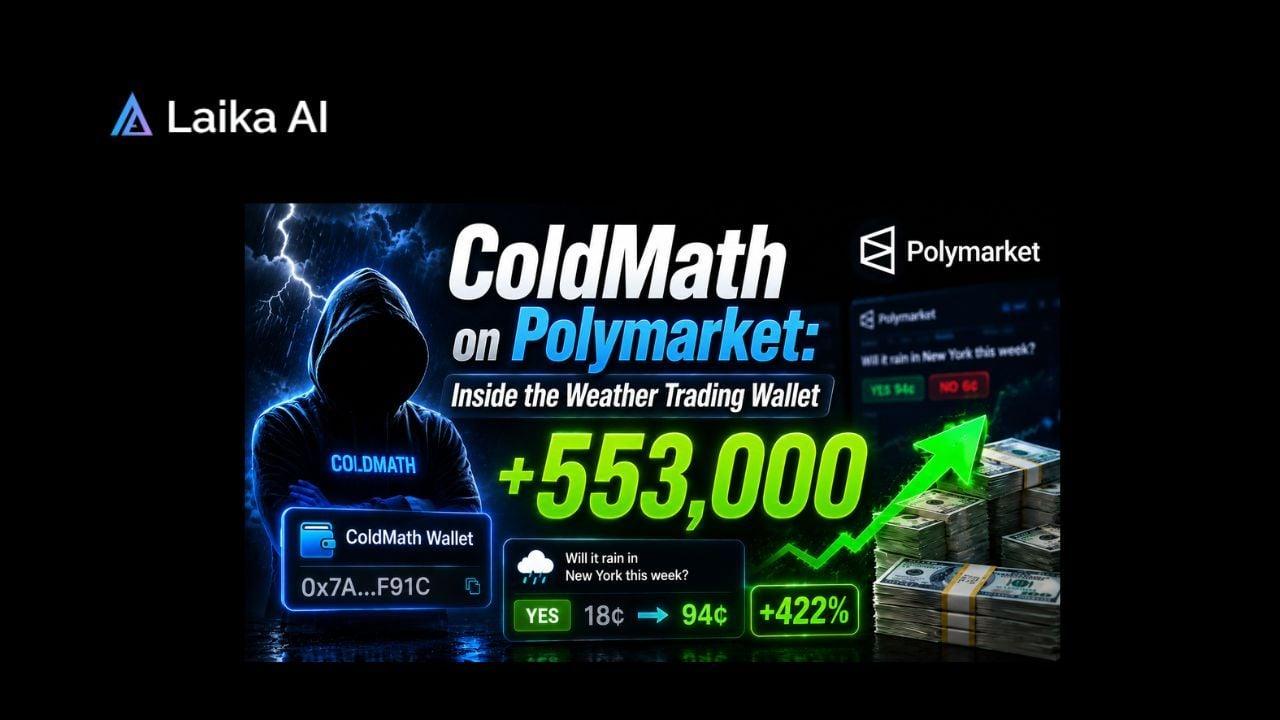
The coldmath polymarket wallet became one of the most discussed accounts in the prediction market community in early 2026, when a thread on X broke down how a single trader had turned systematic weather market positioning into over $53,000 in documented profit. The thread went viral in the Polymarket trading community because the on-chain data was fully verifiable, the concentration of trades in daily temperature markets was unmistakable, and the implied strategy was replicable in a way that most high-performing Polymarket wallets are not.
This article breaks down what the public on-chain data actually shows, reverse-engineers the most likely polymarket weather strategy behind the trades, and explains what retail traders can realistically take from it. Where the analysis is confirmed by on-chain data, it is presented as fact. Where it is inference from observable patterns, it is clearly framed as the most plausible interpretation rather than confirmed information.
For the full technical implementation of weather trading automation, how Polymarket weather trading bots work covers the complete infrastructure.
Who Is ColdMath and What Did the Public Data Show?
ColdMath is a Polymarket wallet identity, not a confirmed real-world person. The wallet address is publicly visible on the Polygon blockchain and accessible through Polymarket's public trading interface. All profit, loss, trade history, and market concentration data cited in this article is verifiable on-chain through Polymarket's leaderboard and public wallet explorer.
The headline numbers from the verifiable on-chain record: the ColdMath wallet accumulated over $53,000 in realized profit across a trading period concentrated in daily and weekly temperature markets. The wallet's trade history shows a high number of individual positions spread across multiple US city temperature markets, with a win rate and average profit per trade that caught the attention of the Polymarket analysis community.
What made the ColdMath thread viral was not just the profit figure. It was the pattern. When Polymarket weather analysts and the polymarketweather.com breakdown examined the trade history, the concentration was clear: the wallet was not diversified across market categories. It was systematically positioned in daily high-temperature range markets in a small number of US cities, executing what appeared to be the same structured trade repeatedly across different markets and dates.
The full on-chain wallet data is publicly accessible at polymarket.com. Examining the trade history directly is the most reliable way to verify any claim made about this wallet's activity.
What the On-Chain Data Actually Reveals
Breaking down what the public data confirms versus what requires inference is essential before drawing any strategic conclusions.
What is confirmed
The wallet executed a large number of trades in daily high-temperature range markets across US cities. The trade frequency was higher than casual retail trading patterns and more consistent with systematic or automated execution than manual trading. The markets traded were concentrated in a specific category rather than diversified across Polymarket's full market menu. The profit per trade, averaged across the documented trade history, was positive and consistent rather than driven by one or two large outlier wins.
What is observable but requires interpretation
The timing of individual trades relative to NWS forecast model updates. Whether trades were placed systematically after each six-hour GFS update cycle or at other times requires matching trade timestamps to model update schedules, which the viral X thread did but which this article has not independently verified to the same granularity.
What is inference based on patterns
The specific probability threshold the wallet used to trigger a trade. The position sizing formula relative to the estimated edge. Whether the execution was manual or automated. The exact data sources used to compute the probability estimate compared against market prices.
The polymarketweather.com breakdown is one interpretation of the observable data and is worth reading as a starting point. It should be treated as informed analysis, not as a confirmed account of the wallet operator's actual methodology.
The Most Likely Strategy, Reverse-Engineered
Based on the observable on-chain patterns, here is the most plausible reconstruction of how the ColdMath wallet approached daily temperature markets. This is analysis derived from the trade record, not a confirmed description of the operator's actual process.
The core thesis
Daily high-temperature range markets on Polymarket have a specific inefficiency: the market price across temperature buckets does not always reflect the latest NWS forecast model output because human traders do not monitor the GFS six-hour update cycle consistently. When a model update shifts the most likely temperature outcome from one bucket to another, the market can take several hours to reprice. A trader or bot positioned to check prices immediately after each model update can find and trade these gaps systematically.
The forecast layer
The most likely data source for a strategy of this type is the NWS GFS model output, accessed either directly through NOAA's API or through an aggregator like Open-Meteo. The trader computes the model-implied probability for each temperature bucket, compares it to the current Polymarket prices across all buckets in that market, and identifies the bucket or buckets where the gap exceeds a minimum threshold.
How did ColdMath make money on Polymarket? The most plausible answer from the observable data is by systematically identifying these forecast-to-market price gaps and trading them before the market corrected, repeatedly, across multiple cities and dates simultaneously.
The edge calculation
A simple edge calculation for each potential trade: model-implied probability minus current market price minus estimated execution cost. If the result is above a minimum threshold, typically 3 to 8 percentage points in documented weather bot strategies, the trade is placed. If the result is below that threshold, no trade is placed regardless of how interesting the market looks qualitatively.
This type of systematic threshold-based entry filter is what produces the consistent positive win rate visible in the ColdMath trade history. The wallet is not predicting weather better than anyone else. It is finding markets where the current price does not reflect the forecast model and trading the gap before the market corrects.
The position sizing
The trade history shows position sizes that vary across markets, which is consistent with Kelly criterion-style sizing adjusted for the estimated edge and available order book depth. Larger edge gaps produce larger positions. Thinner markets with wider spreads produce smaller positions to limit execution slippage.
This is not confirmed as the actual sizing formula used. It is the most consistent explanation for the position size variation visible in the on-chain trade history.
The city selection
The wallet concentrated on a small number of US cities rather than attempting to trade every available temperature market. This is consistent with the practical constraint that weather model calibration, resolution source verification, and order book monitoring take time and attention. A strategy that runs well on five cities is more reliable than one spread thinly across twenty, particularly if the edge depends on catching model updates within a narrow window.
The complete guide to trading weather markets on Polymarket covers how to identify which city temperature markets have the most consistent structure for this type of systematic approach.
What Retail Traders Can Realistically Take From This
The ColdMath story has two common misreadings in the prediction market community, and both are worth addressing directly.
Misreading 1: Anyone can replicate this immediately
The observable strategy behind the ColdMath wallet requires infrastructure that most retail traders do not have in place: a working weather API connection, a comparison script that runs on the GFS update schedule, and position sizing logic that accounts for order book depth. Building that infrastructure from scratch takes time and technical skill. Running it profitably requires calibrating the probability estimates to the specific resolution sources of each target market, which requires additional work beyond the basic bot architecture.
The bar is lower than building a quantitative trading system for financial markets, but it is not zero. The how Polymarket weather trading bots work article covers the realistic implementation requirements, including which open-source repositories lower the barrier to entry and what minimum setup is required to run a functional weather bot.
Misreading 2: The edge is guaranteed and permanent
Weather market inefficiency is real but not permanent. The ColdMath wallet made $53,000 in a period when this type of forecast-to-market gap was reliably available. As more bots and systematic traders enter the same category, the gaps compress and the edge per trade shrinks. A strategy that generated 8-point average edges in 2024 may generate 3-point average edges in 2026 as the market becomes more efficient.
The sustainable version of the ColdMath approach is not about copying the exact trades. It is about understanding the mechanism, building your own probability estimation layer, and finding the markets within the weather category where your calibration is better than the crowd's. That is a different and more durable edge than copying a specific wallet.
What is actually useful to take from it
The ColdMath story confirms three things that are actionable for retail traders.
First, daily high-temperature range markets have a documented structural inefficiency tied to the GFS model update schedule. That inefficiency is real, was profitable at scale, and is the right category for a systematic weather trader to focus on.
Second, city concentration matters. Spreading thinly across every available weather market produces worse results than concentrating on a small number of markets where you have reliable data, verified resolution sources, and consistent order book depth.
Third, win rate matters less than the edge per trade. The ColdMath wallet's profit came from consistent positive expected value per trade, not from a win rate above 90%. A systematic approach that finds 5-point edges on 60% of trades produces better long-term results than a discretionary approach that wins 80% of trades at smaller average profit.
For the practical methodology on identifying the specific markets where this type of edge currently exists, how to find mispriced markets on Polymarket covers the framework. For copying high-performing wallets without chasing already-moved prices, how to copy Polymarket whale trades without buying into the top covers the discipline required to do it profitably rather than reactively.
The Broader Context: Where ColdMath Sits on the Leaderboard
The $53,000 profit figure is substantial for a weather-focused strategy but modest in the context of Polymarket's overall profit leaderboard. The platform's top traders have accumulated eight-figure profits across multiple market categories. What makes the ColdMath wallet notable is not the absolute profit figure but the category concentration: this profit came almost entirely from one of Polymarket's lowest-volume, highest-spread market categories.
Most of Polymarket's highest-profit wallets diversify across sports, politics, crypto, and economics. A wallet that generates $53,000 from weather markets alone is either highly specialized, automated, or both. That specialization is what the community found interesting enough to build a viral thread around.
For the full context of how the ColdMath profit compares to other documented high-performing Polymarket wallets and what the leaderboard data shows about concentration versus diversification, top Polymarket traders 2026: leaderboard and copy trading covers the complete picture.
Frequently Asked Questions
Who is ColdMath on Polymarket?
ColdMath is a publicly visible Polymarket wallet identity whose on-chain trading history became widely discussed in the prediction market community in early 2026. The real-world identity of the wallet operator has not been publicly confirmed. All data about the wallet's trading activity is verifiable on-chain through Polymarket's public leaderboard and the Polygon blockchain. The wallet's documented activity is concentrated in daily high-temperature range markets across US cities.
How much money has the ColdMath wallet made trading weather markets?
The publicly verifiable on-chain record shows over $53,000 in realized profit concentrated in Polymarket weather markets. This figure is cited from the viral X thread analysis and the polymarketweather.com breakdown, both of which reference publicly accessible on-chain data. Verify the current figure directly at the wallet's public profile on polymarket.com, as trading activity and realized profit figures update continuously.
What strategy does ColdMath appear to use?
Based on observable on-chain patterns, the most plausible strategy involves comparing NWS forecast model output to current Polymarket temperature bucket prices after each GFS model update cycle, identifying gaps above a minimum edge threshold, and placing trades systematically when gaps exceed that threshold. This analysis is reverse-engineered from the trade record and is the most consistent interpretation of the observable data. It has not been confirmed by the wallet operator.
Can retail traders copy ColdMath's trades?
Copying specific trades in real time is theoretically possible given Polymarket's on-chain transparency, but practically difficult for two reasons. First, market positions are often filled quickly when a model update creates an edge, meaning the gap may have already closed by the time a copy trade reaches the market. Second, the edge in any individual trade is small enough that execution slippage from entering after the original position has moved the price can eliminate the remaining value. The more sustainable approach is to understand the underlying strategy and implement your own version rather than copying specific trades reactively.
Is the ColdMath strategy breakdown confirmed or speculative?
The on-chain trade data is confirmed and publicly verifiable. The strategy reconstruction in this article and in the polymarketweather.com breakdown is informed inference based on observable patterns in the trade record. The specific probability thresholds, data sources, and sizing formulas attributed to the strategy are the most plausible interpretation of the observable data, not a confirmed account of the wallet operator's actual methodology. Treat all strategy attribution as analysis, not as fact confirmed by the trader themselves.
The Bottom Line
The coldmath polymarket story is the clearest documented case study of systematic weather market trading producing real, verifiable profit at scale on the platform. The wallet's concentration in daily temperature range markets, its consistent positive win rate, and its systematic trade frequency all point to a structured approach built on the forecast-to-market gap that exists around GFS model updates.
What retail traders can take from it is specific: daily high-temperature range markets on a small number of US cities, compared systematically against NWS forecast model output at each six-hour update cycle, with trades placed when the gap exceeds a defined edge threshold. That is the replicable structural insight from the observable data.
The polymarket weather category remains one of the most consistently mispriced categories on the platform relative to the information available from public forecast models. That inefficiency is real. Whether it remains at the scale ColdMath documented depends on how many other systematic traders enter the same category.
For the complete strategic framework around polymarket weather trading including manual strategy, bot implementation, and market selection, the complete guide to trading weather markets on Polymarket is the full resource.
Track how weather market prices move in real time across every active contract with Polymetric by Laika AI. Live market intelligence so you see the model update gaps before the market closes them.