Key Takeaways
- Standard Chartered forecasts Ethereum at $30,000 by 2029 and $40,000 by 2030
- Near term ETH targets were lowered, but long term conviction strengthened
- Ethereum’s dominance in DeFi, stablecoins, and tokenization underpins the outlook
- A recovery in the ETH to BTC ratio is expected over the coming years
- Regulatory clarity and institutional accumulation could accelerate adoption
- The bank sees Ethereum potentially outperforming Bitcoin over the long run
Standard Chartered Raises Long Term Ethereum Outlook
Standard Chartered has updated its long term outlook for Ethereum, raising its price forecast to $30,000 in 2029 and introducing a new $40,000 target for the end of 2030, according to a recent research note from its digital assets team.
The revised projections reflect the bank’s belief that Ethereum’s structural advantages, expanding role in decentralized finance, and leadership in tokenization and stablecoins position it to outperform many crypto peers over the next decade, even as near term market conditions remain challenging.

Revised Ethereum Price Forecasts
In its January research note, Standard Chartered digital assets analyst Geoffrey Kendrick updated Ethereum’s multi year price milestones:
- End 2026: $7,500 (revised lower)
- End 2027: $15,000
- End 2028: $22,000
- End 2029: $30,000 (raised)
- End 2030: $40,000 (new forecast)
The bank identifies 2026 as a potential inflection point, where weaker short term performance gives way to improving relative fundamentals and adoption.
Why Standard Chartered Is Bullish on Ethereum Long Term
Dominance in Tokenization and Stablecoins
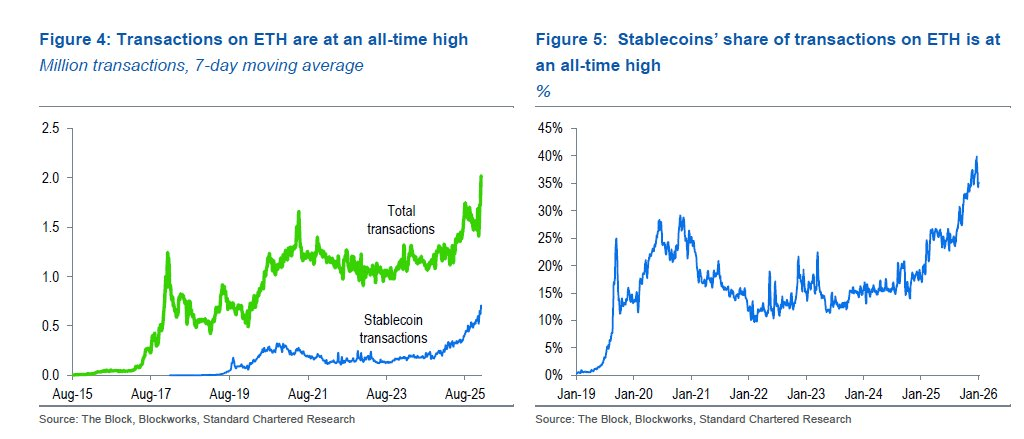
Ethereum hosts the majority of onchain stablecoins and tokenized assets, forming the settlement backbone of decentralized finance. Standard Chartered views this as a structural advantage as traditional financial activity increasingly moves onchain.
Improving ETH to BTC Ratio
The bank expects Ethereum’s relative performance versus Bitcoin to improve. The ETH to BTC ratio peaked near 0.08 in 2021 before falling to around 0.03. A partial recovery toward historical levels is seen as a key upside driver.
Leadership in Decentralized Finance
Ethereum remains the dominant platform for smart contracts, DeFi protocols, and decentralized applications. The bank sees these use cases evolving beyond speculation into real world financial infrastructure.
Short Term Cuts, Long Term Confidence
While long term targets were raised, Standard Chartered trimmed its near and medium term ETH forecasts due to broader crypto market weakness and Bitcoin’s drag on dollar denominated valuations.
Despite this, analysts repeatedly describe 2026 as the year of Ethereum, citing improving network fundamentals, growing institutional interest, and maturing real world adoption.
Regulatory and Institutional Catalysts
Standard Chartered highlights potential regulatory clarity in the United States as a meaningful tailwind for Ethereum, particularly for DeFi participation. Clearer rules could unlock greater institutional involvement and capital inflows.
The note also references ETH accumulation by corporate treasuries such as Bitmine Immersion Technologies, viewing balance sheet exposure as a long term signal of confidence, even as ETF flows remain mixed.
Ethereum vs Bitcoin: A Shift in Leadership?
While the bank remains constructive on Bitcoin, it argues Ethereum may outperform over the long run due to:
- Broader utility beyond store of value
- Settlement and infrastructure use cases
- Stronger network effects tied to financial activity
This marks a departure from past cycles where Bitcoin dominated early and decisively.
Bottom Line
Standard Chartered’s latest research presents a nuanced but firmly bullish long term outlook for Ethereum. By raising its 2029 target to $30,000 and introducing a $40,000 forecast for 2030, the bank signals growing confidence that ETH is evolving into a foundational layer for digital finance rather than a purely speculative asset. Short term volatility remains, but structurally, Ethereum’s role continues to expand.
Frequently Asked Questions (FAQs)
What is Standard Chartered’s Ethereum price target for 2030?
Standard Chartered forecasts Ethereum could reach $40,000 by the end of 2030.
What is the Ethereum forecast for 2029?
The bank raised its 2029 ETH target to $30,000.
Why were near term ETH targets lowered?
Short and medium term projections were revised lower due to broader crypto market weakness and Bitcoin’s impact on dollar based valuations.
What supports Ethereum’s long term upside?
Key drivers include Ethereum’s dominance in stablecoins, tokenization, DeFi infrastructure, and a potential recovery in the ETH to BTC ratio.
Could regulation boost Ethereum adoption?
Yes. Standard Chartered notes that clearer regulatory frameworks could increase institutional participation and strengthen Ethereum’s ecosystem.
Does Standard Chartered expect Ethereum to outperform Bitcoin?
Over the long term, the bank believes Ethereum has the potential to outperform Bitcoin due to broader utility and settlement use cases.