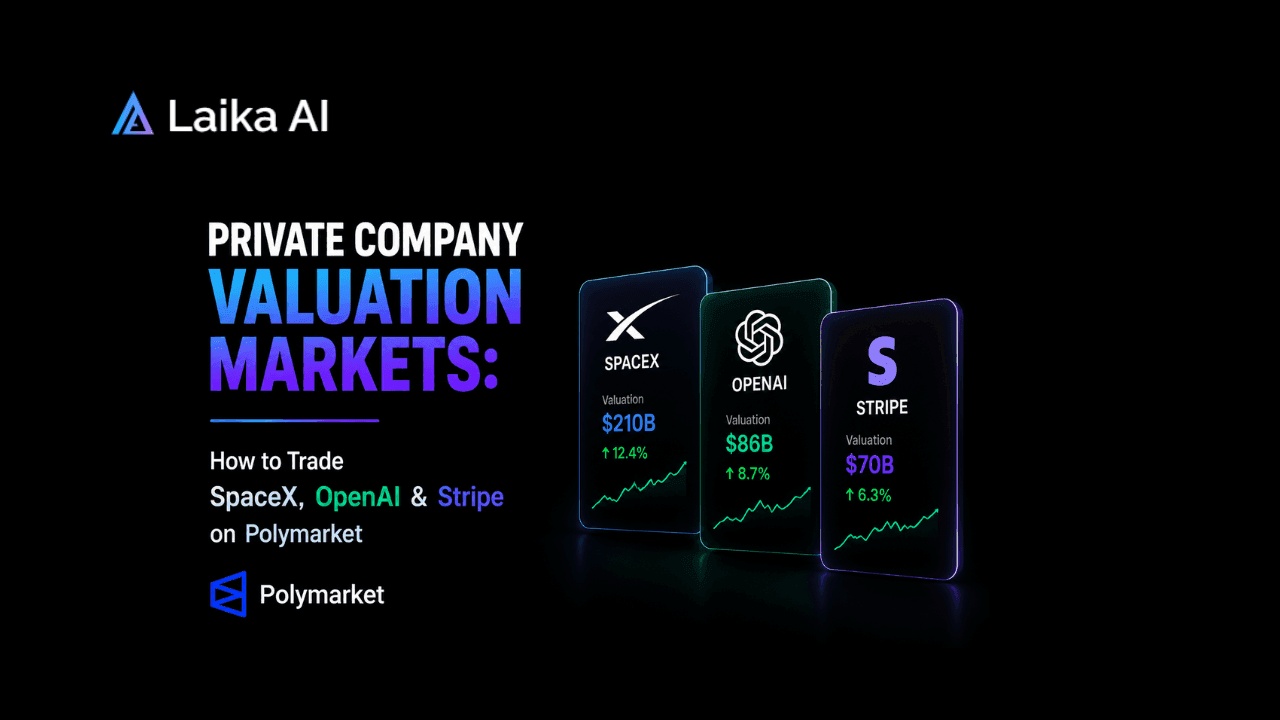
Private company valuation markets polymarket contracts solve a problem that has frustrated retail investors for years: there is no legal way to buy shares in SpaceX, OpenAI, or Stripe on a public exchange, but there is now a way to trade on the outcomes that determine and reveal their valuations. A polymarket SpaceX OpenAI contract does not give you equity exposure to the company itself. It gives you a binary bet on a specific, verifiable event, whether a funding round closes at a specific valuation, whether an IPO occurs by a specific date, whether an acquisition is announced, that resolves based on publicly reported information about a company that otherwise discloses almost nothing voluntarily.
This guide covers what private company markets currently exist on Polymarket, how contracts on SpaceX, OpenAI, and Stripe are actually structured and what specific information sources move their prices, the practical trading approach for markets built around infrequent, unpredictable catalyst events, and the unique resolution risks that come from betting on companies with no disclosure obligations. For the foundational mechanics of how any Polymarket contract prices probability, Polymarket explained: how prediction markets work covers the structure underlying every market referenced in this guide.
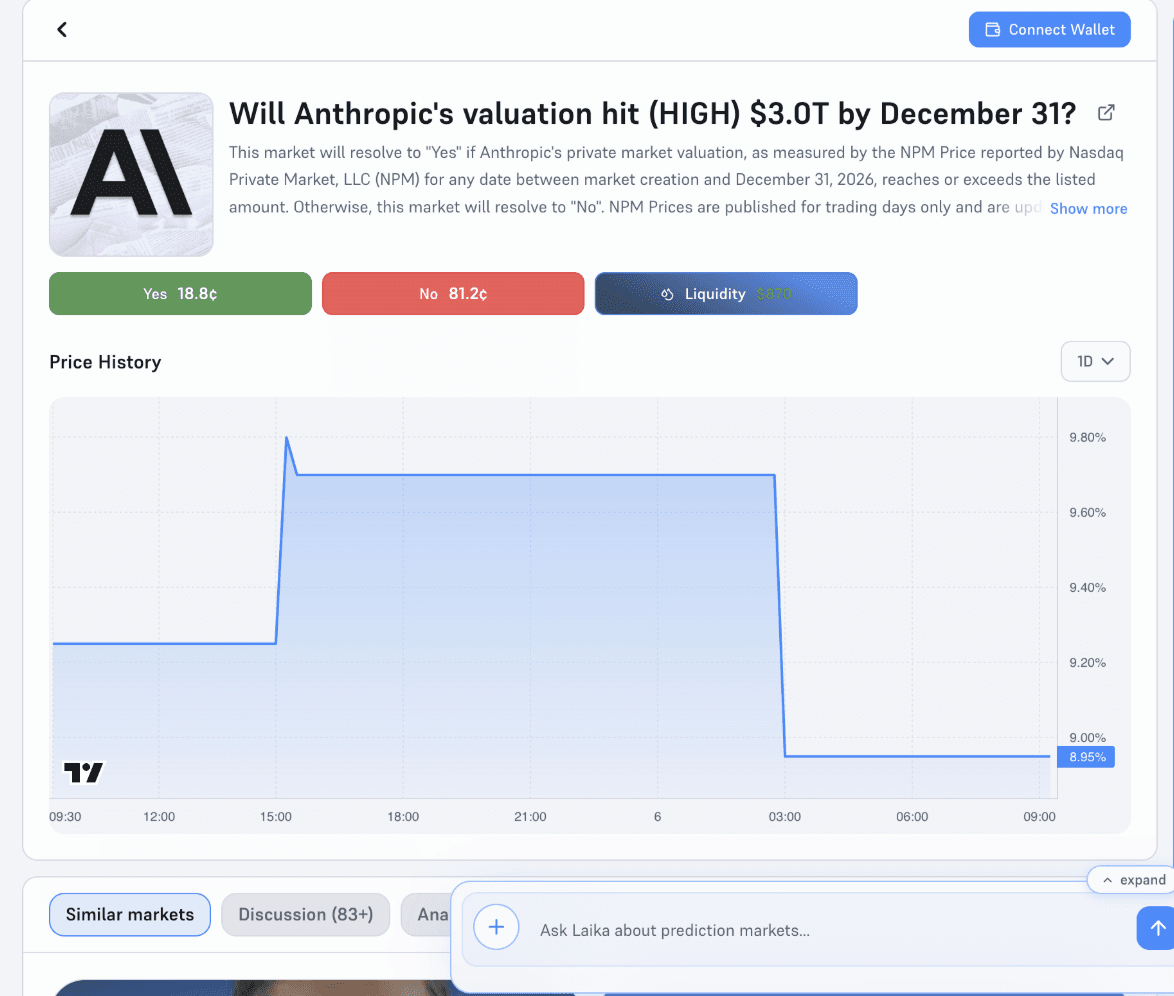
What Private Company Markets Exist on Polymarket
These four categories cover the vast majority of private company polymarket private company IPO contracts currently active. Each requires a different mix of information sources to trade well, since a funding round rumor circulates very differently from an IPO filing, which is a matter of public record the moment it happens.
How SpaceX, OpenAI, and Stripe Markets Are Structured
SpaceX markets
SpaceX valuation contracts typically price the probability of the company reaching a specific valuation threshold in its next tender offer or funding round, since SpaceX periodically allows employees and existing investors to sell shares in structured internal transactions rather than raising traditional venture funding rounds on the same cadence as most private companies.
OpenAI markets
OpenAI markets cover funding round valuations, potential restructuring events related to its unusual capped-profit corporate structure, and questions tied to leadership and governance given the company's history of public internal conflict. OpenAI's information environment is unusually noisy relative to other private companies given the intense media attention on the company and the frequency of leaks, some accurate and some not, from within the AI research community.
Stripe markets
Stripe markets center primarily on IPO timing given the company's status as one of the most closely watched potential public listings in the fintech sector, having delayed a public offering for years despite periodic reports suggesting imminent filing. Stripe is notably less public-facing than OpenAI in its communications, which makes Stripe markets more dependent on secondary reporting and less on direct company statements.
For a related category of technology-adjacent markets where the underlying subject also has significant information asymmetry and limited disclosure obligations, trading AI milestones on Polymarket covers how frontier AI labs, several of which are also private companies covered in this market category, manage information flow around their own progress, a dynamic that overlaps meaningfully with how OpenAI valuation markets should be approached specifically.
Trading Strategies for Private Company Markets
Building a tiered information source hierarchy
Because private companies have no disclosure obligations, source quality varies enormously, and treating all reported information as equally reliable is the fastest way to lose money in this category.
Pitchbook's private company valuation data provides useful contextual benchmarking for assessing whether a rumored valuation figure circulating in the market is plausible given the company's historical funding trajectory, revenue multiples in comparable private company transactions, and broader venture funding environment trends. Cross-referencing a specific rumor against this kind of aggregated data helps distinguish a credible valuation report from speculative noise.
Catalyst window identification
Private company valuation events cluster around specific, somewhat predictable windows even without exact date certainty.
Tracking the historical cadence of each company's previous catalyst events provides a baseline probability distribution that is more reliable than reacting purely to news as it breaks. A company that has historically raised funding roughly every 12 to 18 months is more likely to have a near-term catalyst if it has been 14 months since the last round than if it has been 4 months.
Reading market sentiment as a broader signal
The same framework used to read prediction markets as a leading indicator for broader equity sentiment applies within this category as well. How to use prediction markets to gauge S&P 500 sentiment covers the general methodology of treating prediction market probability shifts as an early information signal, and a sharp move in a private company valuation contract, particularly one that occurs without an obvious accompanying news catalyst, can sometimes indicate that informed capital has access to information not yet publicly reported. This is speculative by nature given the private information environment, but it is a pattern worth monitoring rather than dismissing outright.
Liquidity considerations
Private company markets on Polymarket are generally thinner than major sports, political, or macro contracts, given the smaller pool of traders with genuine expertise or interest in venture-stage company valuations. Check order book depth carefully before sizing any position, and be prepared for wider spreads than you would encounter on a flagship election or Fed decision market. For the broader framework on managing correlated positions and sizing appropriately in lower-liquidity market categories, crypto correlation trading with prediction markets covers a parallel liquidity and sizing discipline that applies directly to thinly traded private company contracts as well.
Unique Risks in Private Company Markets
Resolution ambiguity as the core structural risk
Private company valuations are not single, objective numbers the way a public company's market capitalization is. A funding round can be reported with different valuation figures depending on whether the source is citing pre-money or post-money valuation, whether preferred share terms affect the effective valuation, or whether different reports simply disagree based on different sourcing. A contract that resolves on whether SpaceX raised at above a specific threshold requires knowing exactly which reported figure and which specific data source the contract rules reference, since two credible outlets reporting the same funding round can cite different headline numbers.
The verification lag problem
Even Tier 1 and Tier 2 information sources in this category often report deals after they have effectively closed but before official confirmation, creating a window where the market has priced in near-certainty based on reporting that has not yet been formally verified. This is different from a sports or election result, where the outcome is unambiguous the moment it occurs. A private company funding round can remain technically unconfirmed for weeks after credible reporting suggests it has happened, and Polymarket's resolution process must wait for whatever standard the contract specifies before paying out, which can create a gap between when the market has effectively decided the outcome and when the contract can actually resolve.
For the complete framework on sizing positions appropriately in categories with limited liquidity, long time horizons, and elevated information uncertainty, the prediction market bankroll management guide covers position sizing discipline calibrated to exactly these conditions.
Frequently Asked Questions
Can you trade SpaceX or OpenAI on Polymarket?
You cannot buy equity in SpaceX or OpenAI through Polymarket, since neither company is publicly traded and Polymarket does not offer equity products. What you can trade are binary event contracts tied to specific, verifiable milestones related to these companies, including whether a funding round closes at a specific valuation threshold, whether an IPO occurs by a specific date, or whether a specific corporate event happens. Check the live private company and IPO markets page at polymarket.com for current active contracts on SpaceX, OpenAI, and similar companies.
What private company valuation markets exist on Polymarket?
Polymarket runs markets on funding round valuation thresholds, IPO timing, and acquisition events for a range of high-profile private companies including SpaceX, OpenAI, and Stripe. Contract structures vary by company depending on how that specific company typically raises capital or approaches liquidity events, with SpaceX markets often centered on periodic tender offers, OpenAI markets on funding rounds and governance events, and Stripe markets primarily on IPO timing given its long-anticipated public listing.
How does Polymarket resolve private company valuation markets?
Resolution criteria are specified in each contract's rules and typically reference either an official company or regulatory disclosure, such as an SEC filing for IPO markets, or aggregated reporting from credible financial press outlets for funding round valuation markets. Because private companies have no disclosure obligation, resolution can depend heavily on which specific reported figure or source the contract designates as authoritative, which is why reading exact resolution language before trading is more critical in this category than in markets tied to publicly disclosed events.
What is the best strategy for trading private company markets on Polymarket?
The most effective approach builds a tiered hierarchy of information sources, weighting official filings and multiple-source confirmed reporting far above single-source or social media speculation, tracks the historical cadence of each company's funding or catalyst events to establish a baseline probability rather than reacting purely to breaking news, cross-references rumored valuation figures against aggregated private market data for plausibility, and sizes positions conservatively given the generally thinner liquidity in this category compared to major sports and political markets. For ongoing community discussion of specific private company valuation rumors and contract pricing, polymarket OpenAI valuation reddit threads in prediction market and startup-focused communities tend to carry active discussion following major reported funding news.
The Bottom Line
Private company valuation markets polymarket contracts offer a genuine way to trade on outcomes tied to some of the most closely watched private companies in the world, but they demand a different information discipline than any publicly disclosed event market on the platform. The absence of mandatory disclosure means source quality varies enormously, resolution criteria require careful reading given the ambiguity in how private valuations get reported, and liquidity is generally thinner than flagship market categories.
The traders who do well in this category are the ones who build a genuine information source hierarchy rather than treating every rumor equally, track each company's historical catalyst cadence to establish realistic baseline probabilities, and size positions with explicit awareness of both the liquidity constraints and the potential for long, uncertain time horizons before a contract actually resolves.
Track how private company valuation and IPO timing probabilities move in real time across every active Polymarket contract with Polymetric by Laika AI. Live market intelligence for traders who need to see the reporting catalyst before the broader market catches up.