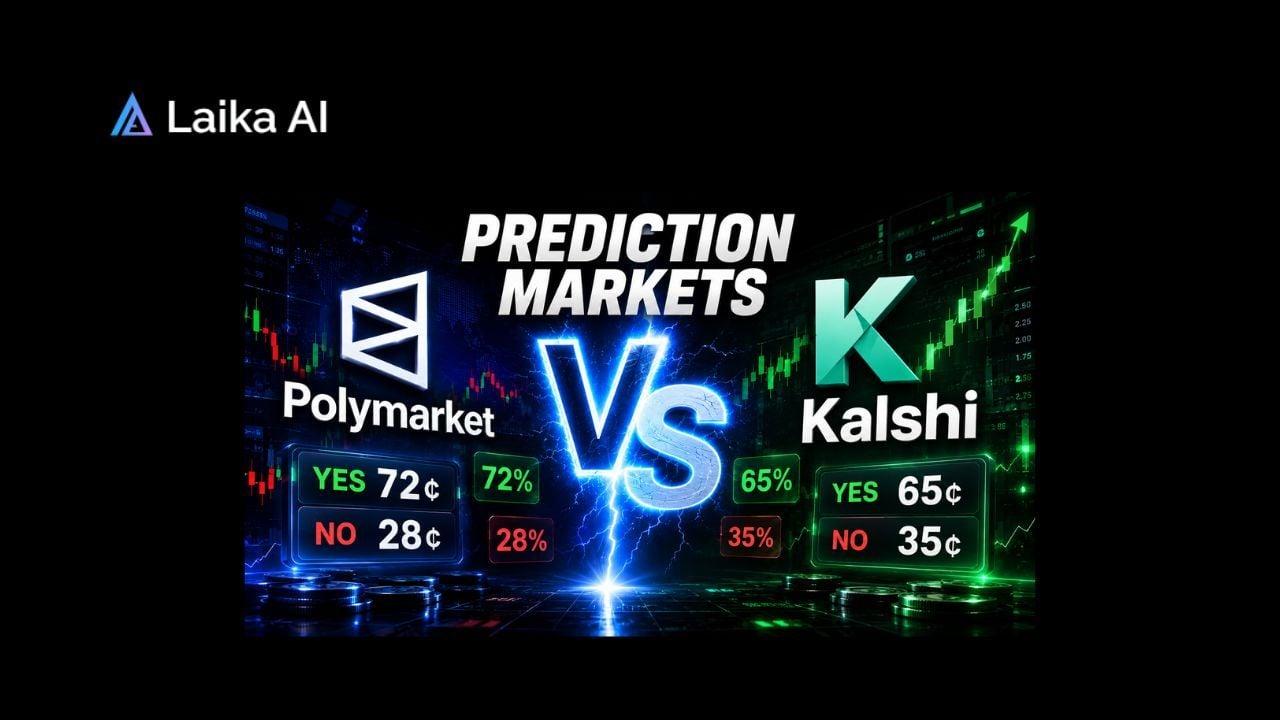
The crypto prediction market category has grown from a niche DeFi experiment into a multi-billion dollar trading ecosystem in under three years. The 2026 Bitcoin ETF approval market on Polymarket crossed $40 million in volume before resolution. Ethereum quarterly price targets regularly hit $10 to $20 million. The best crypto prediction market platforms in 2026 offer something no sportsbook or exchange can: the ability to trade the probability of a specific outcome rather than the asset itself. For anyone already using how Polymarket crypto markets work as a foundation, this guide covers the full competitive landscape beyond Polymarket alone.
This article compares every major crypto prediction market platform available in 2026, ranked by liquidity, crypto coverage, fees, and trader profile. Polymarket is the dominant platform, but it is not the only one worth knowing.
What Is a Crypto Prediction Market?
A crypto prediction market is a platform where traders buy and sell contracts on the outcome of specific crypto-related events. Not the price of Bitcoin itself, but whether Bitcoin closes above $100,000 on December 31. Not whether Ethereum will upgrade, but whether the upgrade happens before a specific date.
Each contract is a binary yes/no instrument. A contract priced at 62 cents means the market assigns a 62% probability to that outcome. If the outcome occurs, the contract pays $1. If it does not, it pays $0. You can buy or sell your position at any time before resolution at the current market price.
This structure is fundamentally different from spot trading or derivatives trading on crypto exchanges. You are not exposed to price volatility between entry and resolution in the same way. You are trading a probability, not an asset. For the foundational explanation of how these mechanisms work, what are prediction markets covers the complete structure before you trade anything.
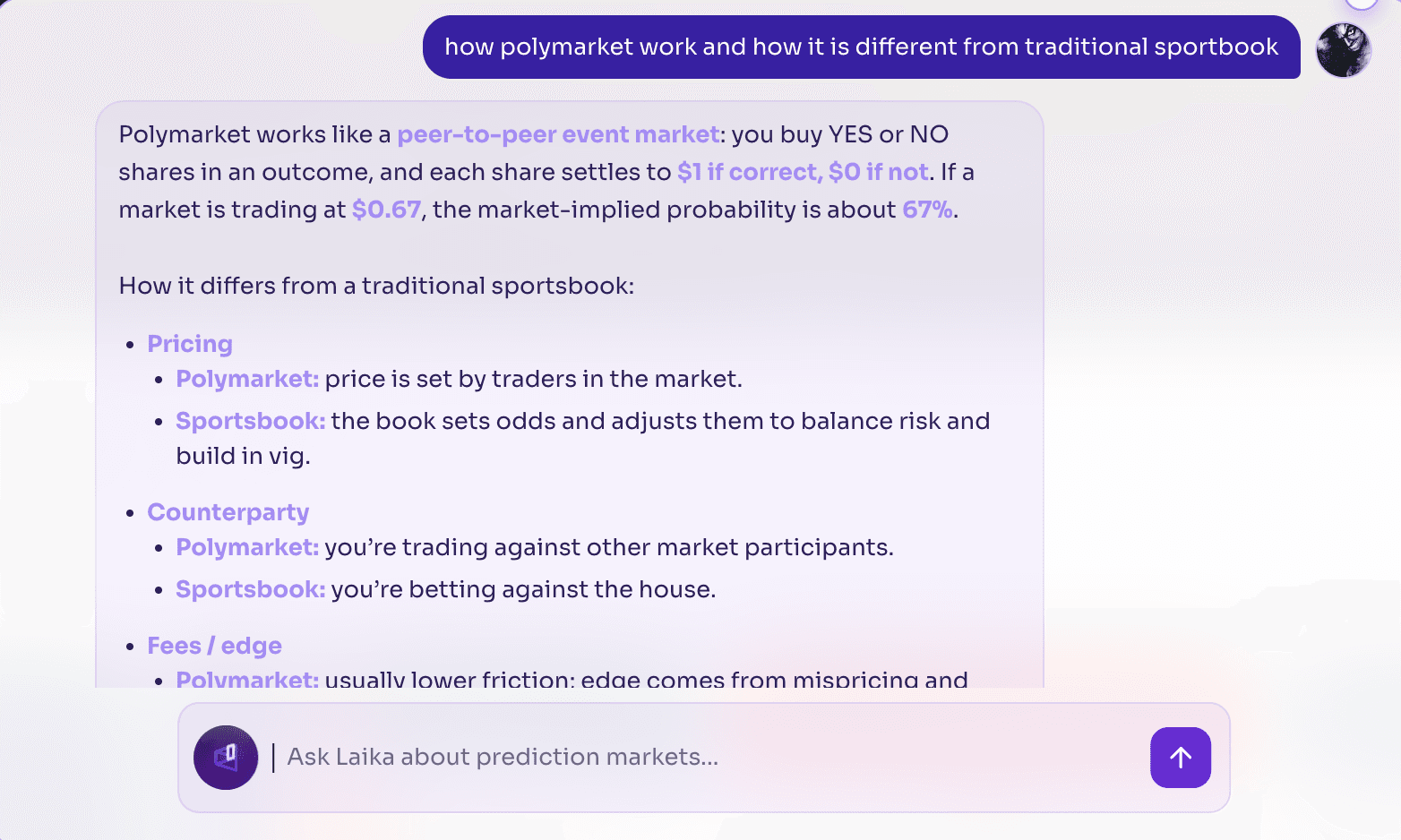
The question of how does polymarket work is answered by this structure: it is a peer-to-peer exchange where every position is matched with a counterparty, the platform earns a small fee on resolution, and prices reflect the aggregate of all capital-backed positions in real time. No house, no vig, no counterparty risk from the platform itself.
Stop trading on guesses.
Trade with intelligence.
Ask our AI-powered Claude + Fable what the highest conviction trade is before you enter the market.
The Best Crypto Prediction Market Platforms in 2026
1. Polymarket: The Dominant Platform
Best for: Global traders who want the deepest liquidity on major crypto events
Polymarket is the largest prediction market platform in the world by trading volume, and its crypto category is where the platform's global reach creates the most consistent pricing depth. The Bitcoin end-of-year price market consistently crosses $50 million in volume. Ethereum quarterly targets run at $10 to $20 million. The platform has run markets on Bitcoin ETF approvals, SEC enforcement actions, CFTC rulemaking, token launches, exchange events, and DeFi protocol decisions at a depth no competitor currently matches.
Current crypto market coverage on Polymarket:
Bitcoin price targets run across multiple timeframes: end-of-week, end-of-month, end-of-quarter, and annual targets at round-number thresholds. Ethereum follows an identical structure. Solana, XRP, and major altcoins have dedicated price markets during periods of elevated volatility. Regulatory and policy markets cover ETF decisions, enforcement actions, and legislative outcomes. Protocol markets cover chain upgrades, token launches, and governance decisions.
Fees: Zero on most major crypto markets beyond Polygon gas costs averaging $0.01 to $0.10 per trade.
Access: Global platform requires USDC on Polygon. Polymarket US launched in December 2025 with fiat deposits via debit card, ACH, and Apple Pay, though the US platform has shallower crypto market depth than the global version.
Verdict: If you want depth, coverage, and the most accurate crowd-sourced probabilities on major crypto events, Polymarket is the benchmark every other platform is measured against. For a direct comparison on crypto specifically, Polymarket vs Kalshi crypto covers the head-to-head in full.
2. Kalshi: The Regulated US Alternative
Best for: US traders who want crypto price markets without crypto infrastructure
Kalshi is a CFTC-regulated Designated Contract Market that offers Bitcoin and Ethereum price target markets accessible through standard US bank accounts, PayPal, and Venmo. No crypto wallet required. The platform has held federal regulatory status since 2020 and is currently available in over 40 US states.
Current kalshi crypto market coverage
Bitcoin price markets run across weekly, monthly, and quarterly timeframes at round-number thresholds. Ethereum follows a similar structure. Kalshi does not currently offer altcoin price markets, DeFi protocol markets, or the regulatory decision markets that Polymarket carries at depth.
Fees: Up to 2% of expected profit per trade, versus Polymarket's zero fees on most major markets. Kalshi also charges a 2% fee on debit card deposits and a flat $2 withdrawal fee. Partially offset by 3 to 4% APY on idle balances that Polymarket does not offer.
Liquidity: Significantly lower than Polymarket on equivalent crypto contracts. For small to mid-size retail positions this does not affect execution quality. For positions above $10,000 on a single contract, Polymarket's order book depth produces meaningfully tighter fills.
Verdict: The correct choice for US traders who want Bitcoin or Ethereum price markets without managing a crypto wallet. Not the correct choice for anyone who needs altcoin coverage, DeFi protocol markets, or deep liquidity on major crypto events.
3. Manifold Markets: The Community Platform
Best for: Traders who want free play and community-driven markets on niche crypto topics
Manifold Markets is a free-to-play prediction market platform where users create and trade on questions using play money called mana. It is not a regulated financial instrument and does not involve real money by default, though the platform has experimented with real-money features in select jurisdictions.
What makes it relevant for crypto traders
Manifold hosts a large volume of community-created crypto markets on topics Polymarket does not cover. Will a specific DeFi protocol launch on a specific date? Will a particular token reach a certain market cap by year-end? These niche markets attract crypto-native communities who have genuine knowledge advantages on specific protocol questions.
Limitations: Play money means no real financial stake, which also means prices are less reliably calibrated than on Polymarket or Kalshi. The accuracy of Manifold prices on crypto outcomes is lower than on real-money platforms because the crowd has no financial consequence for being wrong. Useful for gauging community sentiment on niche crypto topics. Not a serious trading platform for real capital.
Verdict: A supplementary signal source rather than a primary trading platform. Watch Manifold crypto markets for early community sentiment on protocol events that have not yet appeared on Polymarket. Do not treat Manifold prices as reliable probability estimates.
4. Augur and Gnosis: The Decentralised Layer
Best for: Technically sophisticated traders who want permissionless, censorship-resistant markets
Augur and Gnosis represent the original vision of decentralised prediction markets built directly on blockchain infrastructure with no central operator. Both platforms allow any user to create any market on any topic without permission from a central authority.
Current state in 2026:
Augur v2 is operational but has significantly lower volume than Polymarket across all categories including crypto. Gnosis's prediction market infrastructure has been forked and adapted into multiple products, but no single Gnosis-based platform has achieved meaningful liquidity on crypto prediction markets in the same tier as Polymarket.
The theoretical advantage of fully decentralised platforms, censorship resistance and permissionless market creation, has not translated into liquidity in practice. Liquidity begets liquidity. Polymarket's centralised-but-transparent model has attracted the volume that fully decentralised alternatives have not been able to match.
Verdict: Relevant for traders in jurisdictions where centralised platforms are inaccessible. Not the best crypto prediction market choice for most traders in 2026 due to thin liquidity and slower resolution infrastructure.
5. Metaculus: The Accuracy-Focused Platform
Best for: Researchers and analysts who want calibrated probability estimates rather than financial trading
Metaculus is a forecasting platform, not a trading platform. Users make probabilistic forecasts on questions including crypto events, but positions are not backed by real money. Metaculus scores forecasters on accuracy over time using a Brier score methodology and maintains a rigorous community focused on calibration rather than profit.
Why it matters for crypto traders:
Metaculus aggregates forecasts from some of the most carefully calibrated forecasters in any public platform. On major crypto regulatory decisions, Metaculus community forecasts have historically been well-calibrated. Comparing Metaculus community forecasts to Polymarket prices on the same question can reveal whether the Polymarket crowd is overpricing or underpricing a specific outcome relative to carefully considered analysis.
Verdict: A calibration reference rather than a trading platform. Check Metaculus forecasts on major crypto regulatory decisions alongside Polymarket prices to identify potential divergences. Do not use Metaculus as a primary platform for real-money trading.
How to Choose the Right Crypto Prediction Market Platform
The best prediction market for your specific situation depends on four variables.
Where you are located
If you are in the US in an eligible state and do not have crypto infrastructure, Kalshi is the path of least friction. If you are in the US and comfortable with USDC and Polygon, Polymarket's global platform gives you significantly better crypto market depth. If you are outside the US, Polymarket global is the default choice on depth and coverage.
What crypto markets you want to trade
Bitcoin and Ethereum price targets: both Polymarket and Kalshi. Altcoin price markets: Polymarket only. DeFi protocol markets and governance decisions: Polymarket only. Regulatory decision markets on ETF approvals and enforcement actions: Polymarket has the dominant depth. Niche community crypto topics: Manifold for sentiment signals.
Your position size
Under $1,000 per position: both Polymarket and Kalshi execute without meaningful spread impact. Over $5,000 per position: Polymarket's order book depth on major crypto markets is necessary to avoid adverse price impact on entry and exit. The Bitcoin end-of-year market at $50 million plus in volume can absorb large positions. Kalshi's equivalent contracts cannot.
Your fee tolerance
Polymarket charges zero on most major crypto markets beyond minimal gas costs. Kalshi charges up to 2% of expected profit on every trade plus deposit and withdrawal fees. At $1,000 in monthly notional volume the difference is modest. At $10,000 monthly the fee gap compounds into a meaningful number across a full year of active trading.
For anyone wanting to build systematic crypto prediction market strategies including automated position monitoring, the Polymarket trading bot guide covers the technical framework.
Crypto Prediction Market Accuracy: What the Data Shows
The question of whether crypto prediction market platforms are accurate deserves a direct answer rather than a hedge.
Prediction markets aggregate the financial conviction of thousands of participants in real time. Each position is backed by real money, which creates an incentive for accuracy that community forecasting platforms lack. Academic research covering 86 million on-chain Polymarket transactions from April 2024 to April 2025 found that arbitrageurs extracted over $40 million in risk-free profits from the platform, which is evidence of pricing inefficiency at the margins but also evidence that the market is liquid and active enough to make arbitrage viable.
On major crypto regulatory events, Polymarket has demonstrated strong calibration. The Bitcoin spot ETF market correctly priced approval probability rising from below 30% in mid-2023 to above 80% in the weeks before approval. The crowd's collective assessment incorporated information from regulatory signals faster than most analyst commentary.
On volatile price target markets, accuracy is inherently limited by the underlying uncertainty of the outcome. A Bitcoin end-of-year price target at $0.35 is the market's best estimate of a 35% probability. It is not a prediction. Whether Bitcoin hits that target is partly random. The market's job is to price the probability accurately, not to predict the outcome.
The practical conclusion: crypto prediction market platforms are most accurate on binary regulatory and event outcomes where the crowd can aggregate genuine information advantages. They are less reliable on price target markets where the underlying outcome is highly uncertain regardless of information quality.
For understanding how to read the odds these platforms produce and when to trust them, how to read Polymarket odds covers the complete interpretation framework.
Comparison Table: Best Crypto Prediction Market Platforms 2026
Frequently Asked Questions
What is the best crypto prediction market in 2026?
Polymarket is the best crypto prediction market in 2026 for traders who want deep liquidity, broad coverage, and zero fees on major contracts. It hosts the most liquid Bitcoin and Ethereum price markets, the deepest regulatory decision markets, and the only meaningful liquidity on altcoin and DeFi protocol markets. For US traders who want fiat access without crypto infrastructure, Kalshi is the regulated domestic alternative covering Bitcoin and Ethereum price markets specifically.
Is Polymarket a crypto prediction market?
Polymarket is a general prediction market platform that includes a large and deeply liquid crypto market category. It runs on the Polygon blockchain and settles trades in USDC, which makes it crypto-native in infrastructure. Its crypto market category covers Bitcoin and Ethereum price targets, regulatory decisions, ETF approvals, enforcement actions, protocol upgrades, and token launches. The platform also runs sports, politics, economics, and entertainment markets at comparable depth.
What are the best Polymarket alternatives for crypto trading?
The most relevant polymarket alternatives for crypto trading are Kalshi for US-accessible Bitcoin and Ethereum price markets with fiat deposits, Manifold for free-play community sentiment on niche crypto topics, and Metaculus for calibration reference on major regulatory decisions. None of these alternatives match Polymarket's liquidity or coverage breadth on crypto prediction market contracts. The choice between them depends primarily on access requirements and whether real-money trading is the goal.
How do crypto prediction markets work?
A crypto prediction market lets traders buy and sell binary yes/no contracts on specific crypto outcomes. Each contract is priced between $0.01 and $1.00, representing the implied probability of that outcome. A $0.62 contract means a 62% implied probability. If the outcome occurs, the contract pays $1. If it does not, it pays $0. Traders can sell their position at any time before resolution at the current market price. The platform earns a small fee on resolution. Understanding how does polymarket work in practice comes down to this structure: peer-to-peer exchange, probability-based pricing, and full exit flexibility before resolution.
Are crypto prediction markets accurate?
Crypto prediction markets are most accurate on binary regulatory and event outcomes where the crowd can aggregate genuine information advantages. On major events like Bitcoin ETF approvals, Polymarket prices tracked the rising probability accurately in advance of approval. On price target markets, the underlying uncertainty of crypto prices limits calibration regardless of the platform's quality. Prediction market prices are the market's best estimate of probability, not predictions of outcomes. Comparing Polymarket prices to Metaculus community forecasts on the same regulatory question can reveal whether the financial crowd is pricing a specific outcome accurately.
The Bottom Line
The best crypto prediction market in 2026 is Polymarket for most traders in most situations. The depth, coverage, fee structure, and global user base that prices crypto events accurately are not matched by any current alternative on the market.
Kalshi is the correct choice for US traders who need fiat access and want to trade Bitcoin or Ethereum price targets without crypto infrastructure. The fee gap and liquidity gap are real, but the onboarding friction difference is also real.
The polymarket alternatives covered in this article, Manifold, Augur, Metaculus, each serve a specific function that Polymarket does not. Community sentiment signals, permissionless markets, and calibration references respectively. None of them replace Polymarket as a primary trading platform. They supplement it for specific use cases.
The crypto prediction market space is growing rapidly. In 2024, combined trading volume across major platforms reached $44 billion. The category is attracting institutional attention, regulatory clarity, and mainstream integration. The platforms worth knowing today are the ones that will anchor the ecosystem as it scales.
For live crypto markets on Polymarket, visit polymarket.com. For Kalshi's crypto market offering, visit Kalshi
Track how crypto prediction market odds are moving in real time across every active contract with Polymetric by Laika AI. Live market intelligence built for traders who want to be ahead of the crowd, not reacting to it.