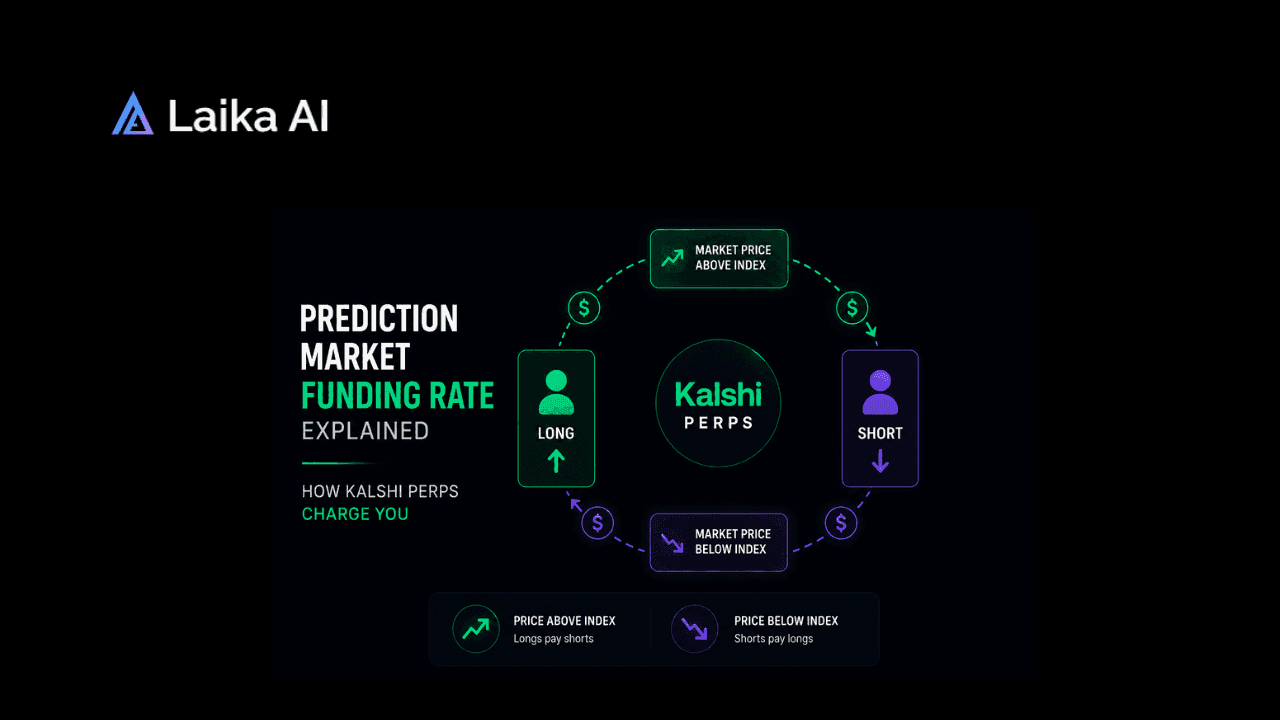
What is the funding rate? It's the recurring payment that keeps a perpetual futures contract's price anchored to the real-world spot price of whatever it tracks, charged automatically between long and short position holders for as long as a position stays open. On Kalshi specifically, this only applies to the platform's crypto perpetuals, like BTC and ETH contracts, not to Kalshi's original binary event contracts, which have no expiration-free structure and therefore no funding mechanism at all.
Understanding what the funding rate in crypto matters more on Kalshi than it might elsewhere, because Kalshi's version works differently from the 8-hour cycles most offshore platforms use. This guide breaks down exactly how the kalshi funding rate is calculated, when it's charged, and what it actually costs to hold a position over time. For the full mechanics of the product this funding rate belongs to, Kalshi Perpetual Futures (Timeless) Complete Guide 2026 covers account setup, leverage, and order types in more depth.
What Is Funding Rate?
A funding rate exists because a perpetual futures contract, by design, never expires and never settles the way a traditional futures contract or a binary event contract does. Without some mechanism pulling the contract price back toward reality, a perp could drift arbitrarily far from the actual price of the asset it's supposed to track.
The funding rate solves that by making it costly to be on the "wrong" side of that gap. When the perpetual's price trades above the spot price, longs pay shorts, which discourages piling into long positions and nudges the contract price back down. When the perpetual trades below spot, the payment flows the other way, from shorts to longs. Kalshi's own explanation of this mechanism, published at help.kalshi.com, walks through the same logic directly from the source.
Crypto Perpetuals vs Kalshi's Original Event Contracts
It's worth being explicit about a distinction that's easy to miss: "Kalshi" refers to two genuinely different product lines, and only one of them has a funding rate at all. Kalshi's original business is binary event contracts that resolve Yes or No on a fixed date, the kind of market the platform launched with and is best known for. Those contracts settle once and never involve funding, since there's no ongoing position to anchor to a spot price.
Kalshi's crypto perpetuals are a separate product, launched after CFTC approval in late May 2026, cleared through a distinct entity called Kalshi Klear LLC. These are the contracts that carry leverage, margin requirements, and the funding rate mechanics covered in this guide. If a friend mentions trading "Kalshi" without specifying which product, it genuinely changes whether funding applies at all. The regulatory and account infrastructure behind this newer product, including how margin accounts are held separately from standard Kalshi balances, is covered in more detail in Kalshi Margin Trading 2026: How Kinetic Markets and Institutional Accounts Work.
How Kalshi's Funding Rate Works
The Kalshi funding rate mechanism, a perpetual futures funding rate calculated fresh each cycle, runs on a fixed daily schedule rather than the rolling 8-hour cycle used by many offshore perpetual exchanges. Funding settles three times a day, at 12:00 AM, 8:00 AM, and 4:00 PM ET, and only applies to positions that are still open at the moment a cycle settles. A position closed before settlement pays or receives nothing for that cycle.
The rate itself has two components, the same two components used across the perpetuals industry generally, even if the terminology varies slightly by platform:
- An interest rate component, currently set at 0% on Kalshi, which on many other platforms is a small, steady baseline built into the calculation.
- A premium index, the variable component driven directly by the gap between the perpetual's traded price and the underlying spot price.
Put together, that's Funding Rate = Interest Rate + Premium Index, the same basic formula used by most perpetual exchanges, just with Kalshi's interest component fixed at zero. Since that component contributes nothing to Kalshi, the funding rate in practice tracks the premium index almost one-to-one.
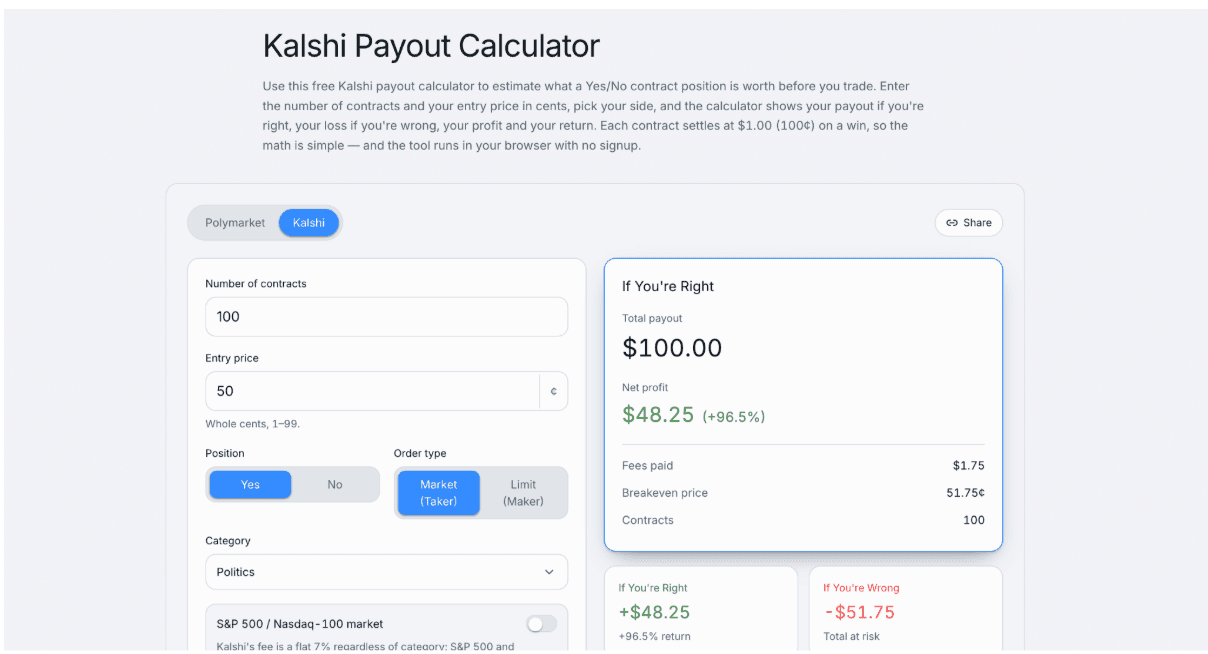
The combined rate is capped at ±2.00% per cycle, which limits how extreme funding payments can get even during a period of unusually one-sided positioning. The current, live rate for any given contract is visible directly on that contract's product page before a trade is even placed, so there's no guesswork involved in checking what a position will cost to hold through the next cycle.Try the Kalshi Payout Calculator to estimate your returns before every trade and make more informed trading decisions.
The Funding Rate Formula and Example
The actual dollar cost of funding scales directly with position size and the current rate. A straightforward way to think about it: take the position's total notional value, multiply by the funding rate for that cycle, and that's the payment owed or received.
A small example makes this concrete. A $1,000 position with a funding rate of 0.01% for a given cycle works out to a $0.10 payment at settlement, a trivial amount on its own. Scale that up, and the numbers matter more: a sustained 1% funding rate on a $10,000 position means $100 changes hands every cycle, and a $100,000 position at that same rate means $1,000 per cycle. Since Kalshi settles three times daily rather than once every eight hours flat, that cost compounds on a schedule worth actually tracking if a position is held for more than a day or two. Kalshi's own perpetuals learning hub at kalshi.com/perpetuals/learn shows the live funding rate for each listed asset directly, which is the most reliable place to check current numbers rather than relying on any example that may already be out of date by the time you're reading this.
What Is Funding Rate in Crypto, Beyond Kalshi?
A crypto funding rate explained simply is just this: the recurring long-short payment that keeps a perpetual contract's price honest relative to spot, applied specifically to crypto assets rather than commodities, equities, or anything else a perpetual might track. The core mechanic is standard across the crypto perpetuals industry, not something Kalshi invented. Where platforms differ is in the details: settlement frequency, whether there's a published interest-rate component, and how tightly the rate is capped.
Offshore platforms that built the category over the past several years, including the largest decentralized perpetual exchanges, generally settle funding on a straight 8-hour cycle rather than Kalshi's fixed clock-time schedule. That difference matters more than it might seem, since a trader coming from one of those platforms could reasonably misjudge when a Kalshi position will next be charged if they assume the same rolling cadence applies. Polymarket Perps vs Hyperliquid: Better for Crypto Traders? covers how funding conventions differ across a couple of the larger offshore-style venues, which is useful context for anyone comparing Kalshi's onshore version against what they're used to elsewhere.
Funding Rate Arbitrage
Because funding payments are predictable and visible in advance, some traders try to capture them directly rather than trading on price direction at all. The basic idea behind funding rate arbitrage is to hold a position on the side receiving funding payments while hedging out the underlying price exposure elsewhere, collecting the funding as a relatively low-risk return rather than betting on where the asset's price goes.
This strategy works better in theory than in practice for most traders. It requires a hedge on another venue, ties up capital as collateral in two places at once, and the funding rate itself can flip direction between cycles if positioning shifts, turning an expected payment into an unexpected cost. It's a real strategy used by more sophisticated traders, but not something to back into casually based on a single favorable rate you noticed on one product page.
Funding Rate Explained: What It Actually Costs You
Pulling this together, the practical cost of funding on any perpetual position comes down to three things: how large the position is, how far the contract's price sits from spot, and how long the position stays open across multiple settlement cycles. A short-term trade held for a few hours across one or two funding cycles will barely notice the cost. A position held for weeks through a sustained, one-sided funding rate can see that cost add up to a meaningful drag on returns, separate entirely from how the underlying price moves.
Since Kalshi's crypto perpetuals sit within a fully CFTC-regulated framework, the transparency around funding, visible live on every product page, is arguably the biggest practical difference from a lot of offshore alternatives, even when the underlying mechanism is conceptually the same. For anyone weighing that regulatory difference directly, Kalshi vs Hyperliquid Perps: Regulated vs Offshore Crypto Derivatives compares Kalshi's onshore structure against a purely offshore perpetuals exchange in more depth, funding conventions included.
The Bottom Line
A funding rate is ultimately a simple idea wearing some technical language: it's the fee that keeps a never-expiring contract honest about tracking the real price of whatever it's built on. On Kalshi specifically, that means a fixed three-times-daily schedule, a rate capped at ±2.00%, and a mechanism that only touches the platform's newer crypto perpetuals rather than its original event-contract lineup.
For traders sizing a position, the funding rate deserves the same attention as the entry price itself, especially for anything held longer than a single day. If you're also comparing costs across platforms rather than just within Kalshi, Prediction Market Fees in 2026: Kalshi vs Polymarket covers the standard fee side of that comparison, which sits alongside funding as the other real cost of holding a leveraged position over time.
FAQ
What is the funding rate?
A perpetual futures funding rate is a recurring payment exchanged between long and short holders of a perpetual futures contract, designed to keep the contract's traded price anchored to the spot price of the underlying asset. It only applies to positions still open when a funding cycle settles, and the party on the "expensive" side of the price gap pays the other.
What is the funding rate in crypto?
A crypto funding rate explained the simple way: it's a periodic payment between longs and shorts, typically every 8 hours on most offshore platforms. Kalshi's crypto perpetuals use a different, fixed schedule instead, settling three times a day at 12:00 AM, 8:00 AM, and 4:00 PM ET, with the rate capped at ±2.00% per cycle.
How does the funding rate work in perpetual futures?
Anyone asking what the funding rate in perpetual futures is really asking about two components: a baseline interest-rate component, which Kalshi sets at 0%, and a variable component tied directly to the gap between the contract's price and the spot price. When the perpetual trades above spot, longs pay shorts; when it trades below spot, the payment flows in the opposite direction, and the size of the payment scales with position size and the current rate.
What is funding rate arbitrage?
Funding rate arbitrage is a strategy where a trader holds a position on the side collecting funding payments while hedging out the underlying price risk elsewhere, aiming to capture the funding payment as a return rather than trading on price direction. It requires managing a hedge across two venues and carries the risk that the funding rate itself can reverse between cycles.
How often does Kalshi charge funding?
Kalshi charges funding three times a day, at 12:00 AM, 8:00 AM, and 4:00 PM ET, rather than the rolling 8-hour cycle used on many offshore perpetual platforms. Funding only applies to positions open at the moment a cycle settles; a position closed beforehand doesn't pay or receive anything for that cycle.
Do you pay funding if your position is closed?
No. Funding only applies to open positions at the exact moment a funding cycle settles. If a position is closed before that settlement time, whether minutes or hours earlier, no funding payment is charged or received for that cycle at all.