On Polymarket, a market can look obviously settled in the real world and still pay out differently if the resolution is disputed and escalates into UMA's oracle process. The settlement path is not simply an event that happens when the market pays out. It is a proposal, challenge window, possible UMA vote, and final on-chain settlement. If you are trading a large or controversial market without understanding that path, you are carrying risk you have not priced.
For the foundational explanation of how prediction markets work before diving into dispute mechanics, what are prediction markets covers the complete structure.
This guide explains exactly how the dispute process works, what can change at each stage, and how to evaluate resolution risk before entering a significant position.
The Normal Resolution Path: Fast, Simple, and Usually Undisputed
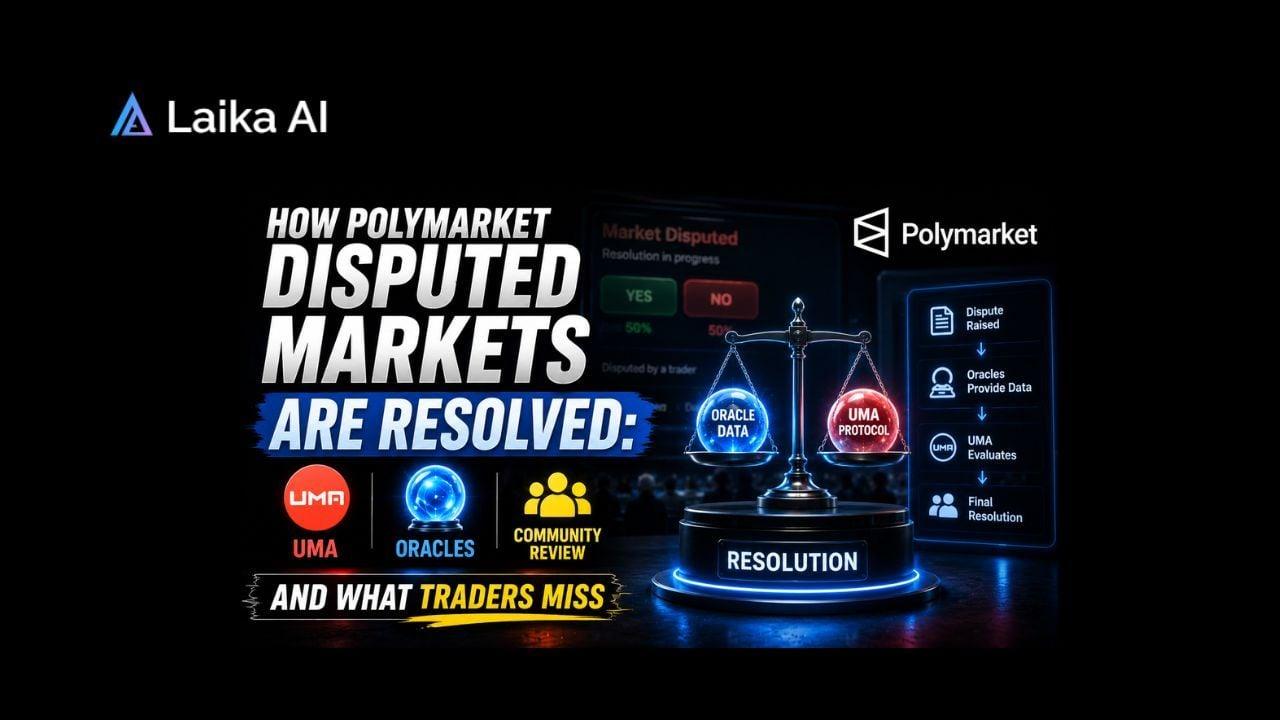
For most Polymarket markets, resolution is straightforward. Once the market's end condition is met, someone submits a proposed outcome to UMA's Optimistic Oracle and posts a bond. If nobody disputes that proposal during the challenge window, the market resolves to that outcome and winning shares become redeemable for $1 each.
The dispute path is rare relative to the total number of resolutions. But for large, politically charged, or legally technical markets, understanding what happens when a dispute does occur is the difference between knowing your risk and guessing at it.
Step by Step: How Resolution Works
Step 1: Someone proposes an outcome
After the market's end date or end condition is reached, a proposer submits the outcome to UMA's Optimistic Oracle and posts a bond, typically $750 USDC.e for Polymarket markets. The proposal asserts YES or NO, usually with supporting evidence or links. If the proposal is not challenged, the proposer recovers the bond plus a small reward.
Step 2: A two-hour challenge window opens
After the proposal, a two-hour dispute window opens. During that period, anyone can challenge the proposed outcome by posting a matching bond. This is the first practical check for active traders: if you are watching a market near settlement, do not treat the first proposed outcome as final until the challenge window has expired. A market can look settled and still be inside this liveness period.
Step 3: If nobody disputes, the market resolves
If the proposal survives the two-hour window, the market resolves to that outcome. Winning shares redeem at $1. Losing shares go to $0. For most markets, this is the end of the process.
What Changes When a Proposal Is Disputed
If someone challenges the first proposal, the original proposal is voided and the process can move to a second proposal round. If that second proposal is also disputed, the query escalates to UMA's Data Verification Mechanism, known as the DVM.
This is the point where most traders get surprised. The market is no longer being settled by a simple check of whether the event happened. It is being settled by a token-holder voting process designed to identify the correct answer under the market's specific rules.
For a deeper dive into how Polymarket disputes and the UMA oracle process work in practice, including examples of past contested markets, Polymarket disputes and UMA oracle process covers the complete breakdown.
For anyone holding a large position in a market that could be disputed, risk has a second layer beyond the event itself: will the market be disputed at all, will the first proposal stand, will the next proposal stand, and if it reaches UMA voting, how will token holders interpret the rules and evidence.
That extra layer matters far more in large, ambiguous, political, legal, or deadline-sensitive markets than in straightforward markets with clean public records.
How UMA Voting Works When a Market Escalates
UMA's DVM is the final arbitration layer for disputed Polymarket markets.
Who votes: UMA token holders, with voting power weighted by the amount of UMA staked in the vote. This is not a one-person-one-vote system.
What they vote on: The correct outcome for the disputed query, using the market rules, the title, the evidence, and any Polymarket clarifications as their reference frame.
What the vote can decide:
The last category is the one most traders do not expect. A market is not always forced into a binary yes or no answer. If the rules or facts are genuinely unclear, a 50-50 settlement is a real and documented outcome, not a failure mode.
Can UMA Voters Override the Obvious Real-World Result?
The practical answer is yes. They can produce a final settlement that differs from what most traders consider the obvious real-world outcome.
That does not mean the system is designed to ignore reality. UMA's mechanism is intended to converge on the answer that informed voters believe is correct under the market's specific rules. In many disputes, that lines up with the real-world event as reported by credible sources and clarified by Polymarket. But obvious to me is not the same as final on-chain outcome.
When a market reaches the DVM, the final result depends on how oracle voters interpret the question, the evidence, and the rules. That interpretation can be influenced by how the market question is written, whether the event is actually complete, whether the evidence is ambiguous, whether Polymarket issued a clarification, and how voters understand the market's intent. Each of those variables is independent of whether the underlying event occurred.
Resolution Risk: The Five Layers Every Large-Position Trader Should Price
For a significant position, think in layers rather than treating the trade as purely event-driven.
Event risk: Will the real-world event happen?
Rule risk: Does the event satisfy the exact market wording? A market can be obvious in the abstract but turn on a narrow rule like permanent treaty, officially announced, or by end of day UTC.
Dispute risk: Will someone challenge the first proposal? Markets are more likely to be disputed when they are large, politically charged, legally technical, dependent on a single official statement, or vulnerable to conflicting sources.
Oracle interpretation risk: If disputed, how will UMA voters read the evidence and rules? This is genuinely uncertain and not always predictable from the outside.
Timing risk: Was the market proposed too early or before the event was fully knowable? A lot of disputes are not about truth. They are about timing.
If any of those layers are uncertain, you are not just trading the event. You are also trading the settlement process.
A Pre-Trade Checklist for Any Large or Ambiguous Position
Read the market rules, not just the title. The title tells you the broad question. The rules tell you what counts. Look for the exact end date or cutoff, the resolution source, whether temporary agreements count, whether official announcements are required, and whether clarifications have already been added.
Ask whether the event could be called too early. If the event is still unfolding, a proposal can be challenged as premature. A framework, draft, or verbal agreement may not satisfy a rule that requires a signed final document. A premature proposal can be disputed and potentially reversed.
Check whether the market has a clarification. Polymarket can issue clarifications that UMA voters are expected to consider. If a clarification exists, treat it as part of the ruleset. Do not rely only on the original wording if the clarification narrows or expands the interpretation.
Judge whether the market is likely to be contested. Small, straightforward markets with clean public records have lower dispute risk. Large, ambiguous, or politically sensitive markets have higher dispute risk. That distinction should affect both whether you enter and how large a position you take.
Do not treat the first proposal as final until the challenge window closes. This is a simple operational habit that protects against a specific category of surprise. A market in the two-hour liveness period is not settled yet.
Edge Cases That Catch Traders Off Guard
Temporary framework versus permanent agreement. A market may require a permanent treaty, final deal, or signed agreement. A temporary ceasefire, interim arrangement, or framework may not qualify under the rules. Traders who read the headline may believe the event occurred while the market rules say it did not.
Conflicting sources. When official statements, media reports, and market wording point in different directions, dispute becomes more likely. UMA voters are not checking one source in isolation. They are trying to resolve the market according to the question and the totality of the evidence.
Broken or unanswerable questions. If the event is fundamentally ambiguous, UMA can settle the market 50-50. Traders holding a strong directional position on a market that resolves 50-50 recover only half their stake per contract regardless of what they believed was obvious.
Late clarifications. If Polymarket clarifies a market late in the process, that clarification can affect how UMA voters interpret the dispute. Resolution risk can change even after the market has been trading for weeks.
What the Bond System Is Actually Doing
The proposer posts a bond to assert an outcome. The disputer posts a matching bond to challenge it. If the dispute is resolved in one side's favour, the winning side recovers its bond and receives part of the losing side's bond. This creates an economic cost to bad-faith proposals and casual disputes.
For traders, the key takeaway is simpler: the existence of a bond does not guarantee the proposed outcome is correct. It means the system has made disputes economically meaningful. It does not make the first proposal final.
The Safest Practical Habit
The main mistake traders make is assuming that the real-world event alone determines payout. On Polymarket, that is only true when the market resolves cleanly without dispute. Once a market is disputed, the final answer comes from the oracle process.
Before entering a large position, ask these four questions. Is the wording precise enough that there is little room for interpretation? Is there an existing clarification? Is the event fully complete, or could a proposal be called too early? If disputed, would a reasonable UMA voter read the market the same way you do?
If you cannot answer those questions with confidence, the market carries resolution risk that is separate from and independent of the event risk you have priced.
The Bottom Line
Polymarket disputed markets are not settled by a manual judgment of reality. They move through UMA's optimistic oracle process: proposal, two-hour challenge window, possible second proposal, and then token-holder voting if escalation is required. In that process, the final on-chain outcome can differ from what looks obvious in the real world if the market wording, timing, or evidence leads UMA voters to a different conclusion.
For a complete overview of how Polymarket's dispute resolution mechanism compares to traditional settlement approaches and what traders should watch for, Polymarket disputes and UMA oracle process covers the full breakdown.
For large markets, evaluating whether the event happens is only half the analysis. The other half is evaluating whether the market is likely to be disputed and how the oracle would interpret it if it is. Both halves belong in your pre-trade assessment before any significant position.