Polymarket weather markets look complicated at first glance. A single temperature market can have six or seven outcome buckets, each with its own price, and the connection between those prices and the actual forecast is not immediately obvious if you have never traded a prediction market before. The good news is that once you understand one mechanic, every polymarket weather market on the platform makes sense. The price is the probability. Everything follows from that.
This guide explains how polymarket weather odds work from the ground up, using a real temperature-range market as the worked example throughout. By the end you will know how to read any weather prediction market on the platform, how to check whether a price is fair against the current forecast, and what the three most common beginner mistakes look like before you make them yourself.
For the complete trading strategy framework once you understand the mechanics, the complete guide to trading weather markets on Polymarket covers every market type and edge in detail.
The One Thing You Need to Understand First
Before anything else: on Polymarket, the price is the probability.
A contract priced at $0.35 means the market assigns a 35% probability to that outcome. A contract priced at $0.72 means the market assigns a 72% probability. A contract priced at $0.08 means the market assigns an 8% probability. There is no vig, no juice, no house margin hidden in the number. The price you see is the market's collective estimate of the likelihood of that specific outcome occurring.
This is fundamentally different from reading a sportsbook line or a weather app forecast percentage. On a sportsbook, a -150 line embeds the house margin into the number. On a weather app, the percentage shown is the model's estimate from a single provider at a single moment. On Polymarket, the price reflects the aggregate of all capital-backed positions from every trader active in that market, updating continuously as traders buy and sell.
A contract that pays $1.00 if the outcome occurs and $0 if it does not, priced at $0.35, offers a potential profit of $0.65 per share if you are right and a loss of $0.35 per share if you are wrong. Your expected value on that trade is positive only if the true probability of the outcome is higher than 35%. If you believe the true probability is 50%, you have a 15-point edge. If you believe it is 30%, you are on the wrong side of the trade.
The Polymarket probability guide: how price equals probability covers the full mathematical framework for anyone who wants the complete picture before trading.
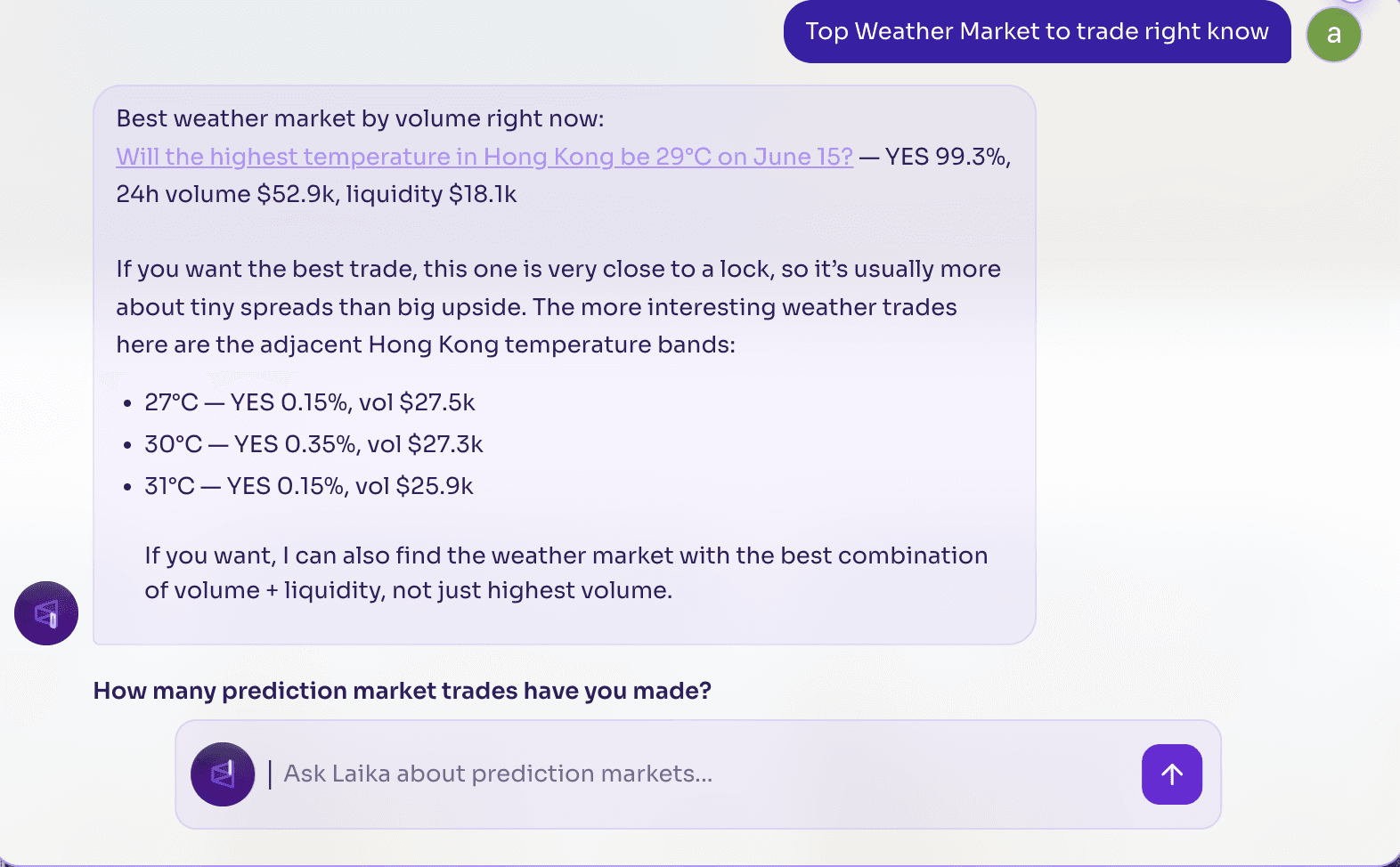
How Polymarket Weather Odds Work: The Temperature Range Market
The most common polymarket weather market format is the temperature range market, and it is the one that confuses most beginners. Once you can read a temperature range market, every other weather market format is simpler.
A temperature range market asks a single question: what will the high temperature be at a specific location on a specific date? The market then divides all possible temperature outcomes into mutually exclusive buckets, each represented by a separate contract.
A real example for New York City on a summer day might look like this:
Notice that all six prices sum to approximately $1.00. This is not a coincidence. In a correctly functioning prediction market, the probabilities of all mutually exclusive outcomes that cover all possibilities must sum to 100%. If they sum to significantly more than $1.00, there is an arbitrage opportunity. If they sum to significantly less, the market maker is extracting a fee through the gap.
How do polymarket weather odds work in this structure: you are betting that one specific temperature bucket will be the correct one at resolution. If you buy the 85F to 89F bucket at $0.35 and the official NWS station records a high of 87F that day, your contract pays $1.00. All other bucket contracts pay $0.
Now compare this to the NWS forecast for the same day. If the National Weather Service is forecasting a high of 86F with an uncertainty range of plus or minus 4 degrees, the probability distribution implied by that forecast should roughly match the Polymarket prices across the buckets. If the NWS forecast strongly supports the 85F to 89F range and Polymarket is pricing that bucket at $0.35, that may be fair. If the same forecast supports it at 60% probability and Polymarket is pricing it at $0.35, that is a potential edge.
Checking the current forecast against the market price is how polymarket weather odds work in practical trading terms. You are looking for gaps between what the forecast model says and what the market is pricing.
Reading a Live Weather Market: Step by Step
Here is the exact process for reading any polymarket weather betting market before placing your first trade.
Step 1: Identify the resolution condition
Every Polymarket weather market has a resolution source listed in its rules. For most US temperature markets this is the official NWS observation at a named station. Click the market information tab and find the exact resolution criteria before doing anything else. The resolution source determines which temperature reading matters. Not the weather app on your phone. Not the model forecast on weather.gov. The specific station observation listed in the contract.
Step 2: Find the current forecast for the resolution station
Go to weather.gov and find the forecast for the specific station or the nearest city. Look at the current high temperature forecast for the resolution date. Note the forecast confidence: a seven-day forecast has much higher uncertainty than a 24-hour forecast. The NWS provides forecast discussion documents that describe the meteorologist's confidence level and the key uncertainties in the forecast.
Step 3: Estimate the probability distribution
With the forecast in hand, estimate what percentage of the probability belongs in each temperature bucket. If the forecast says 86F with high confidence and a tight range of plus or minus 2 degrees, almost all the probability should sit in the two or three buckets centered on 86F. If the forecast says 84F but with significant uncertainty due to storm timing, the probability is spread more widely across several buckets.
Step 4: Compare your estimate to the Polymarket prices
The buckets where your probability estimate is higher than the Polymarket price are the potential buying opportunities. The buckets where your estimate is lower are the potential selling opportunities. A gap of 5 percentage points or more on a clear forecast is worth examining further. A gap of 2 to 3 points is within the noise of any reasonable forecast uncertainty.
Step 5: Check the order book depth
Before entering a position, check how many shares are available at the current price. Weather markets with under $10,000 in volume can have spreads of 3 to 8 cents between the buy and sell price. If you buy into a 3-cent spread on a market where your edge is 5 points, your actual realized edge is only 2 points after execution costs. On larger markets with $50,000 or more in volume, spreads are typically under 1 cent on the most liquid buckets.
How Weather Market Prices Change Before Resolution
Understanding why weather market prices move is as important as knowing how to read them initially.
Prices change for three reasons: forecast model updates, new observational data, and other traders repositioning. The first two are information-driven. The third is noise.
Forecast model updates
The NWS and NOAA update their forecast models on a known schedule. The GFS model updates every six hours. When a new model run comes out showing a warmer or cooler temperature than the previous run, traders who are monitoring these updates will reprice the affected temperature buckets within minutes. If you are watching a weather market and see a price move without any obvious news, check whether a model update has just been published.
This is also the mechanism behind polymarket weather bot trading: the bot checks the new model output every six hours and automatically places trades when the gap between the new model-implied probability and the current market price exceeds a defined threshold. For the full technical explanation of how that automation works, how Polymarket weather trading bots work covers the implementation in detail.
New observational data
As the resolution date approaches, weather forecasts become more accurate because there is less atmospheric uncertainty to propagate through the model. A temperature market for tomorrow has much less uncertainty than one for next week. Prices on near-term markets tend to converge toward the actual forecast more aggressively than prices on markets that are still seven to ten days away from resolution.
In the final 24 hours before resolution, prices typically compress to reflect the high-confidence NWS forecast. The 85F to 89F bucket on a day when the NWS is confidently forecasting 87F might move from $0.35 to $0.65 in the final 12 hours as uncertainty collapses and the market converges on the most likely outcome.
Other traders repositioning
Not every price move is informative. A single large trader entering or exiting a position on a thin market can move prices 3 to 5 cents without any new information. Distinguishing between information-driven price moves and capital-driven price moves requires checking whether a model update has just been published. If prices move and no model update has occurred, treat the move with skepticism until you can identify the cause.
Three Common Beginner Mistakes
Mistake 1: Using the wrong data source
The most expensive beginner mistake in weather market trading is comparing a price to the wrong forecast. If the contract resolves on the NWS O'Hare station reading and you are checking the forecast for Chicago Midway Airport, you are comparing different things. Airport stations are typically 5 to 15 miles apart and can have meaningfully different temperature readings on the same day due to local terrain effects, urban heat islands, and proximity to water.
Always identify the exact resolution station first, then find the forecast specifically for that location. The NWS station page at weather.gov provides station-specific forecasts that are more precise than the city-level forecast shown by default.
Mistake 2: Ignoring forecast uncertainty
Weather forecasts are probability distributions, not point predictions. When the NWS forecasts a high of 84F, they are describing the center of a distribution, not a certain outcome. In meteorological terms, there is a meaningful probability of the temperature being 79F or 89F even when the point forecast is 84F. The uncertainty increases rapidly with forecast lead time.
Beginners often see a forecast of 84F and immediately buy the 83F to 86F bucket at whatever price is shown, treating the forecast as more certain than it is. A better approach is to use the NWS forecast discussion, which describes the meteorologist's confidence level and the key uncertainties explicitly, before assigning your probability estimates across the buckets.
Mistake 3: Over-trusting a single bucket price without reading the full market
On a correctly functioning weather prediction market, all bucket prices across the full temperature range must sum to approximately $1.00. If you are evaluating a single bucket without checking the full market, you may miss signals that the market is out of equilibrium. A market where the six buckets sum to $1.12 is either mispriced, has updated its prices inconsistently across buckets, or has an unusual fee structure. Reading the full market before entering any position protects against entering at a price that looks attractive only because the rest of the market is mispriced in the opposite direction.
For the systematic methodology on identifying genuinely mispriced weather markets before committing capital, how to find mispriced markets on Polymarket covers the complete framework. For the comparison of how Kalshi weather markets differ in format, resolution source, and liquidity, Kalshi vs Polymarket weather markets covers the full head-to-head.
Frequently Asked Questions
What do the prices on Polymarket weather markets actually mean?
Each price represents the market's implied probability of that specific outcome occurring. A price of $0.35 means a 35% implied probability. If that outcome occurs at resolution, the contract pays $1.00. If it does not, it pays $0. The prices across all mutually exclusive outcomes in a market sum to approximately $1.00, reflecting the constraint that exactly one outcome must occur.
How is probability calculated on a weather market?
Prices are set by the aggregate of all buy and sell orders in the market. There is no algorithm or formula that sets the starting price. Early traders place orders at prices they believe reflect the true probability based on current forecasts. Other traders take the other side when they disagree. The interaction of orders determines the current price. Prices update continuously as traders incorporate new forecast model output and observational data.
What is a temperature range bucket?
A temperature range bucket is one of several mutually exclusive outcome contracts that together cover all possible temperature outcomes for a specific market. A typical high-temperature market might have buckets below 75F, 75 to 79F, 80 to 84F, 85 to 89F, 90 to 94F, and 95F or above. Each bucket is a separate contract that pays $1 if the official station observation falls within that range and $0 if it does not. Only one bucket pays out per market.
Why do weather market odds change before resolution?
Prices change because forecast model output updates on a known schedule, typically every six hours for the GFS model, and because new observational data reduces forecast uncertainty as the resolution date approaches. Traders who monitor these updates reprice the affected buckets when new model output diverges from the current market price. In the final 24 hours before resolution, prices typically compress rapidly toward the high-confidence NWS forecast as uncertainty collapses.
Where can I check the resolution source for a weather market?
Click the information or rules tab on any Polymarket weather market. The resolution source, typically a specific NWS station identifier, will be listed explicitly in the contract rules. Once you have the station identifier, find its specific forecast at weather.gov by searching for the station name or identifier. Never compare a Polymarket weather market price to a city-level forecast without first confirming that the city forecast corresponds to the exact resolution station named in the contract rules.
The Bottom Line
Reading polymarket weather odds comes down to one mechanic and three habits. The mechanic: the price is the probability, and all bucket prices across a full temperature range market sum to approximately $1.00. The habits: always identify the exact resolution source before evaluating any price, use the NWS forecast discussion to understand forecast uncertainty rather than treating the point forecast as certain, and check the full market before entering any single bucket position.
The gap between what a well-calibrated weather forecast says and what the Polymarket price shows is where the trading opportunity lives. Weather markets reprice on a known model update schedule, and positions can be entered and exited at any time before resolution. That combination of known information timing and live exit flexibility makes weather prediction market trading structurally different from any other weather-related financial instrument.
For everything running across polymarket weather markets including strategy, market types, bot implementation, and cross-platform comparison, the complete guide to trading weather markets on Polymarket is the complete resource.
Track how weather market prices move in real time across every active contract with Polymetric by Laika AI. Live market intelligence so you always know when the model has updated before you decide whether to trade.