Every experienced Polymarket trader knows the feeling. You look at a market price, cross-reference the primary data, and think: that number is wrong. Not slightly off. Actually wrong in a way that creates real opportunity.
That gap between what the crowd is pricing and what the evidence actually suggests is where all the money in prediction markets gets made. This article identifies the specific Polymarket markets as of May 2026 where the case for mispricing is strongest, explains the analytical basis for each, and covers the framework for finding similar opportunities yourself on an ongoing basis.
One important caveat before anything else. Identifying mispricing and profiting from it are two different things. Markets can stay wrong longer than your patience holds. Position sizing, exit planning, and the discipline to wait for convergence matter as much as the initial identification. Use this as a starting point for your own research, not as a trade list.
What Makes a Polymarket Market Mispriced
Before getting into specific markets, the framework matters. A mispriced Polymarket contract is one where the current implied probability diverges meaningfully from the true probability based on verifiable primary source evidence. The divergence can come from several sources.
Crowd anchoring. Traders form opinions from headlines rather than primary data. A Federal Reserve market priced by people who read news summaries rather than FOMC minutes is priced on the summary, not the meeting.
Resolution criteria misread. The most durable mispricing type. When the contract resolution criteria differ subtly from how most traders interpret the headline question, the price reflects the headline while the payout depends on the criteria. Whoever reads the Rules section carefully holds the edge.
Category neglect. Some market categories receive systematically less sophisticated attention than others. Niche political markets, regional elections, and obscure economic indicators attract fewer analytical traders and stay mispriced longer.
Emotional overreaction. After breaking news, markets overshoot in the directional of the narrative before mean-reverting. The overshoot is temporary. The reversal is the trade.
Cross-platform arbitrage. When the same underlying event is priced differently on Polymarket and Kalshi, at least one market has not fully processed available information. That gap points directly at which one to investigate.
With that framework established, here are the markets where the case for mispricing is strongest as of May 18, 2026.
Value Bet 1: Federal Reserve Rate Cuts in 2026
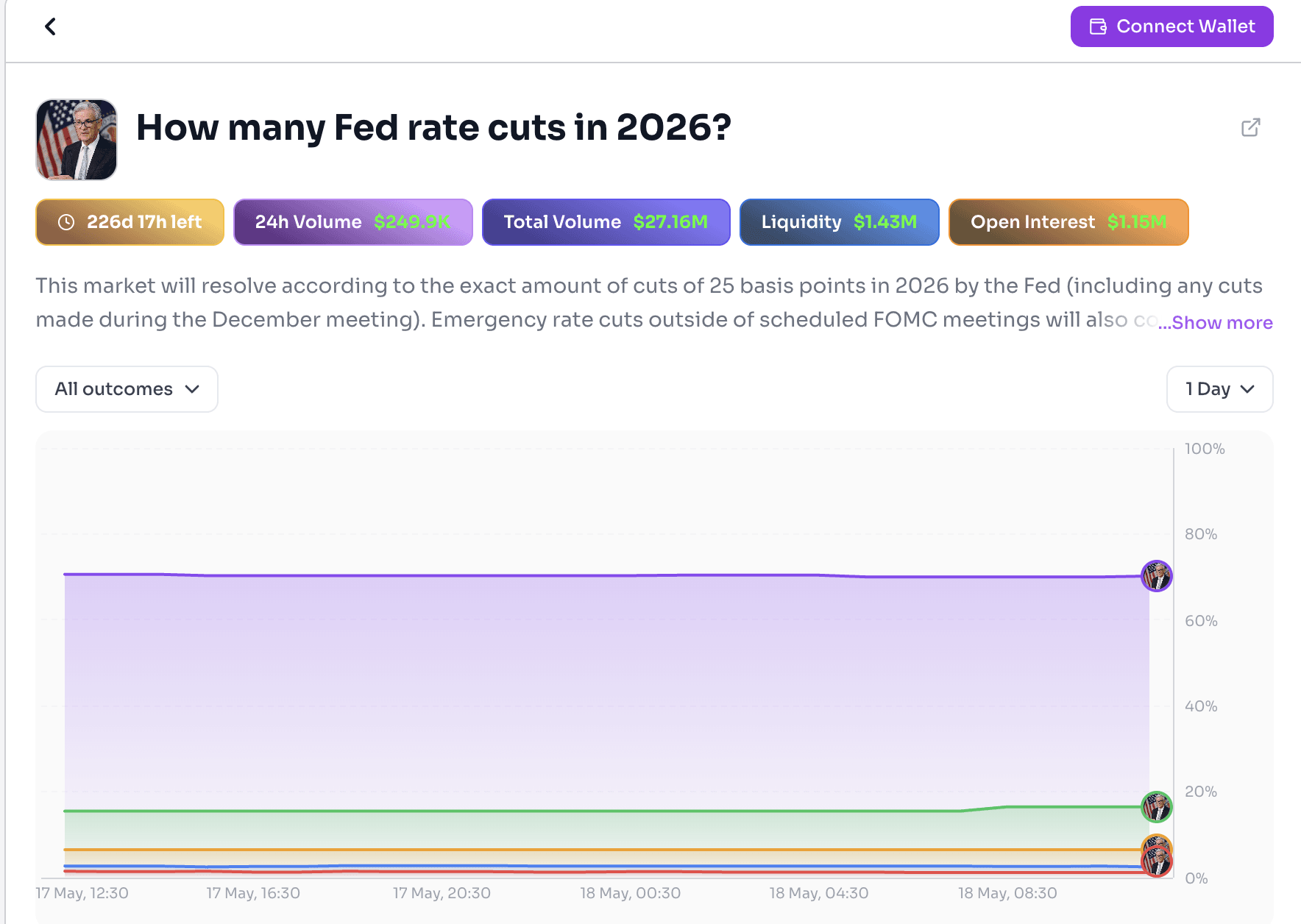
Current Polymarket price: 70.3% probability of ZERO rate cuts in 2026 Current price for one or more cuts: 29.7% The case for mispricing: The market may be overweighting the inflation narrative and underweighting the growth deterioration that typically forces the Fed's hand
Here is what the data actually shows. April 2026 CPI came in at 3.8% year-over-year, the highest since May 2023, driven by a 17.9% surge in energy prices tied to the Iran conflict. The FOMC held the federal funds rate steady at 3.50% to 3.75% at its April 29 meeting for the third consecutive time, with the most dissents since 1992.
Based on that data, the 70.3% zero cuts probability looks defensible. But dig deeper into what is actually happening.
The dissent pattern is an important context. The most dissents since 1992 does not mean unanimous hawkishness. It means fractures are appearing. Some FOMC members want to cut now. Some want to hold. Some want to raise. That internal disagreement creates volatility in the path, not a clean hold.
More importantly, the energy price spike driving April's CPI number is tied directly to the Iran conflict. If the geopolitical situation continues to de-escalate, the energy component reverses. A reversal in energy prices would pull the headline CPI figure down significantly even with stickier core components. A CPI print that surprises to the downside in May or June changes the entire calculus for the June 16 to 17 FOMC meeting.
BofA Global Research and several other major banks have indeed shifted to hold forecasts through year-end. CME FedWatch futures reflect similar consensus. But historically, when every major bank agrees on a hold path and the consensus becomes this uniform, the risk-reward tilts toward the scenario the consensus has ruled out. Surprise cuts have happened in exactly this kind of environment.
The June 16 to 17 FOMC meeting resolves this market for the near-term contract. The updated economic projections released at that meeting, including the dot plot, will be the most important data point for whether the 29.7% probability of at least one cut is a genuine value bet or fairly priced.
The trade framework: If you believe energy prices will reverse on continued Iran ceasefire progress and May CPI surprises to the downside, the June 16 meeting creates a specific catalyst. Buy the one or more cuts at current prices before the May CPI release. Exit if May CPI confirms the hold consensus. Hold if it surprises dovishly.
Value Bet 2: US Recession by End of 2026
Current Polymarket price: Approximately 40% YES The case for potential mispricing: Crowd may be underpricing recession risk given current tariff regime
This is a directional rather than arbitrage bet, and it requires taking a genuine view on macroeconomic trajectory.
The current environment has several historically reliable recession indicators flashing amber. Tariff-driven supply shocks have historically been stagflationary, meaning they simultaneously reduce growth and raise prices. The Federal Reserve is holding rates at 3.50% to 3.75% while CPI runs at 3.8%, which means real rates are effectively near zero or negative. That combination does not historically support sustained expansion.
Labor market data remains resilient as of Q1 2026, which is the primary argument against imminent recession. But labor market deterioration consistently lags the underlying economic turn by two to four quarters. The current strength in payrolls may reflect Q4 2025 and Q1 2026 conditions rather than forward conditions.
The Goldman Sachs recession probability model was running elevated probability estimates earlier in 2026 before the tariff situation partially resolved through some trade deals. The partial resolution is what kept recession odds from spiking to 60% or higher on Polymarket. But partial resolution is not full resolution, and the remaining tariff burden on a significant portion of US goods trade is a meaningful growth headwind.
The 40% probability for a US recession by the end of 2026 is in the range where a genuine analytical view can diverge meaningfully from the market in either direction. If you believe the tariff situation resolves further and Fed policy normalises, 40% is too high. If you believe tariff-driven inflation keeps the Fed on hold while growth deteriorates, 40% is too low.
The trade framework: This is a medium-duration position that resolves December 31, 2026. Watch the June FOMC dot plot for growth projections, the May and June employment reports for early signs of labor market softening, and the ongoing trade negotiation calendar for further tariff resolution news. Each of these catalysts should update your probability estimate, and the position can be adjusted accordingly.
Value Bet 3: 2026 FIFA World Cup Winner Markets
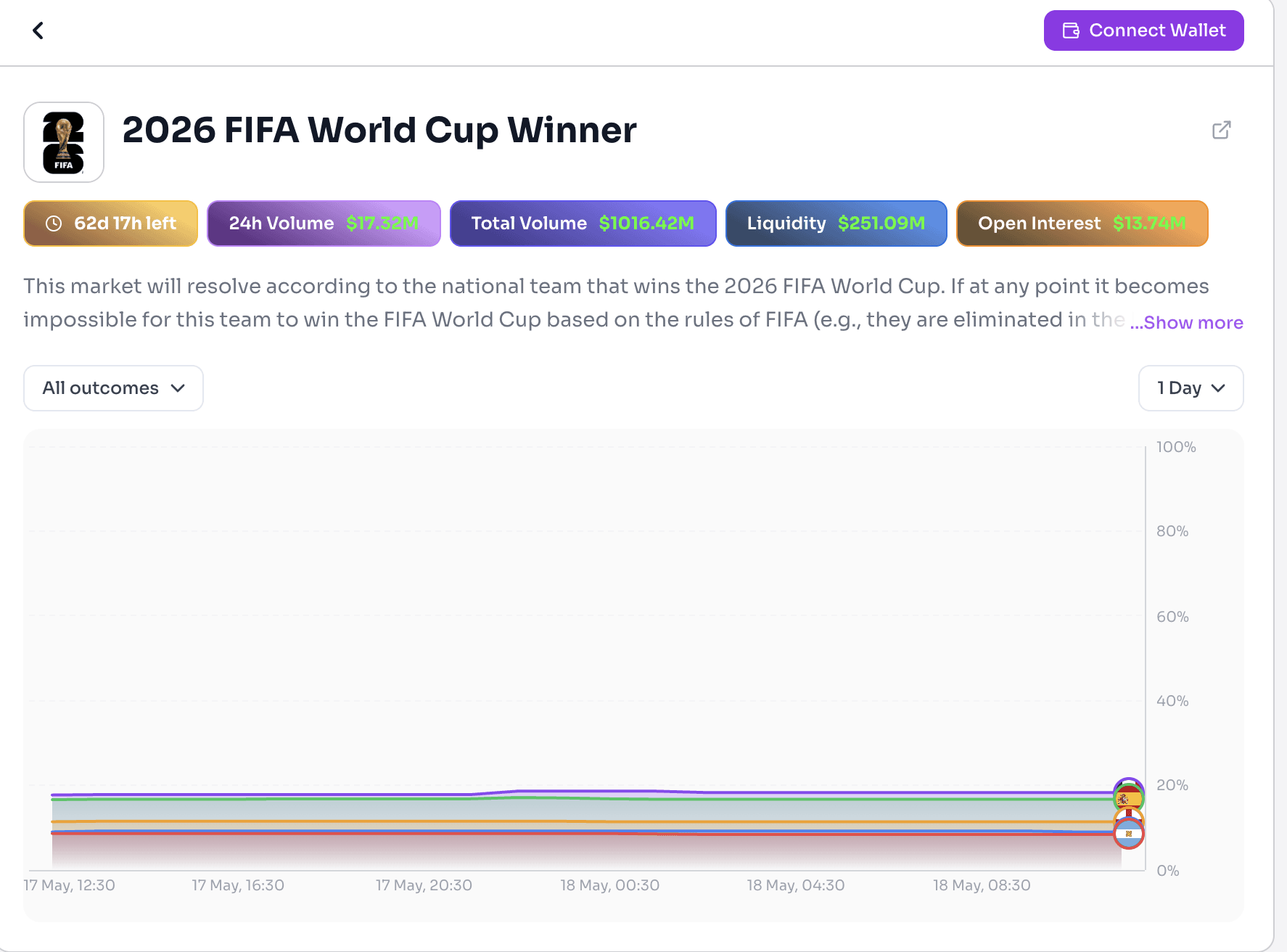
Current Polymarket situation: The USA at home advantage may be underpriced in certain outcome structures
Key market: 2026 FIFA World Cup Winner at $770 million total volume
The 2026 FIFA World Cup is the largest sports event Polymarket has ever listed, with $770 million in total volume as of mid-May 2026. The tournament runs June through July across 16 host cities in the United States, Canada, and Mexico, with the USA team playing its group stage games in a massively favourable crowd environment.
The structural value question is whether the home advantage factor is fully priced into the USA's odds. Host nations in FIFA World Cups have historically overperformed their pre-tournament Elo ratings by a meaningful margin, driven by crowd support, travel advantages, referee familiarity bias, and team morale effects.
The USA is not a short price. Brazil, France, England, and Argentina are typically priced ahead of the host team. The value question is not whether the USA wins, which at any given price must be weighed against other contenders, but whether the home advantage premium added to their baseline probability is sufficient.
For non-USA outcome bets, the market at this volume is generally efficiently priced among the top contenders. The edges, if any, are in the mid-tier contenders where analytical crowd attention is lower and regional biases may produce mispricings.
The trade framework: Check the current Elo ratings for your preferred team against the Polymarket implied probability. For teams where the Elo-implied probability exceeds the Polymarket price by more than 5 percentage points, the gap is worth investigating. For the USA specifically, research the historical home advantage premium in World Cups and calculate whether current pricing adequately reflects it.
Value Bet 4: 2026 NBA Champion
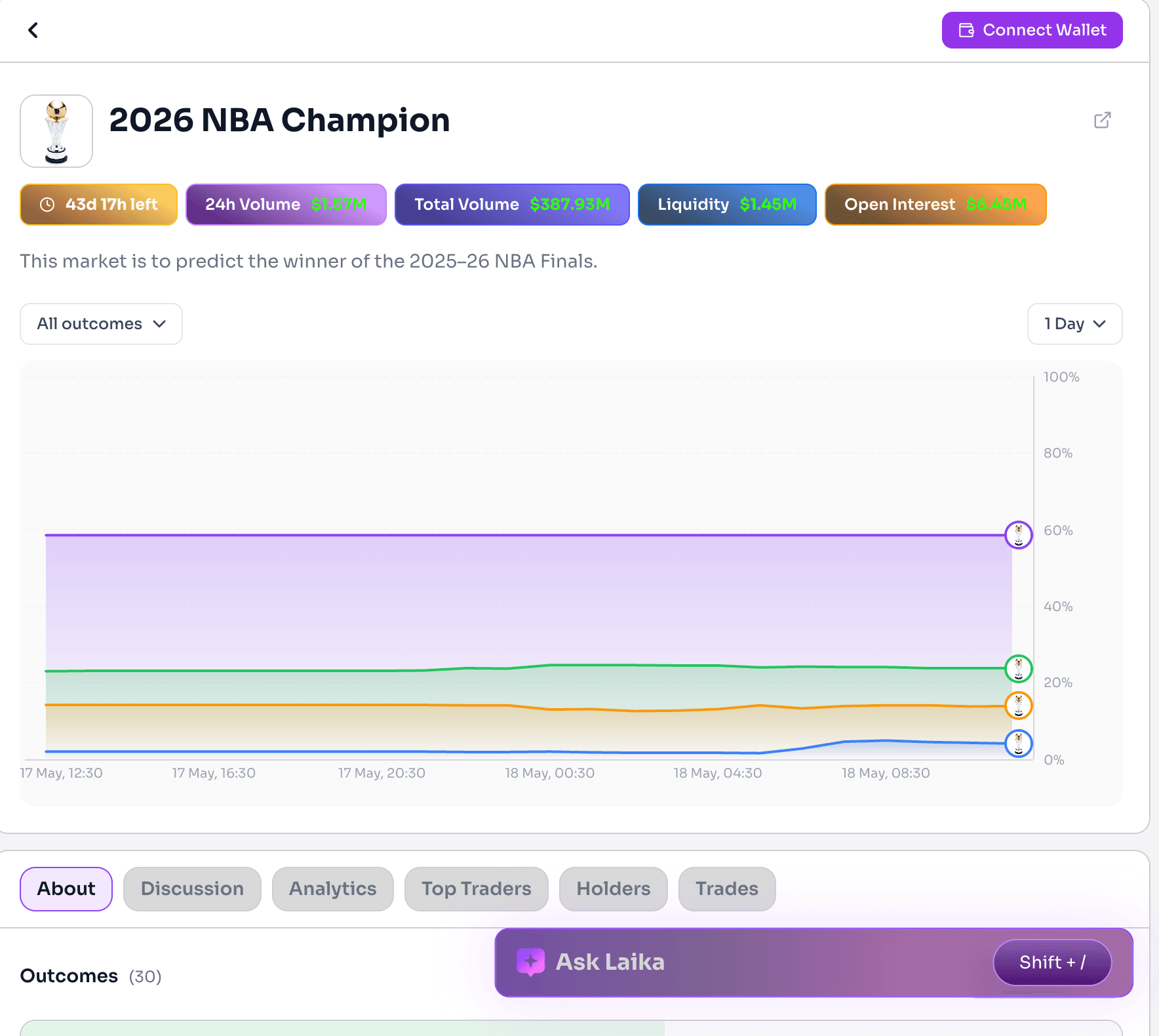
Current Polymarket price: Oklahoma City Thunder leading at approximately 30% to 35%; San Antonio Spurs at 16% in earlier data Total volume: $338.1 million The case for investigating: Late-season injury information often not fully reflected in early futures pricing
The NBA Championship market at $338.1 million in volume is deeply liquid, which means obvious analytical mispricings get corrected quickly by sophisticated sports traders. The edges in this market are found in second-order analysis rather than first-order win probability.
The specific areas worth investigating are: the injury status of key players for leading contenders in the playoff run-up, which affects win probability in ways that daily pricing adjusts but multi-week futures lag behind, and the bracket structure, which determines whether top seeds face easier or harder matchups in early rounds.
The playoff series markets, which ask about specific matchup outcomes rather than the overall winner, often show larger mispricings because they attract less systematic attention than the overall champion market. Series where one team has a significant home court advantage but the market has not fully priced the specific matchup dynamics are the primary hunting ground.
The trade framework: Focus on specific series markets rather than the overall champion if you have genuine NBA analytical knowledge. The champion market at $338 million volume is efficiently priced by sophisticated traders. Individual series at $1 million to $5 million volume are less efficiently priced and more accessible to domain expertise.
Value Bet 5: Democratic Presidential Nominee 2028
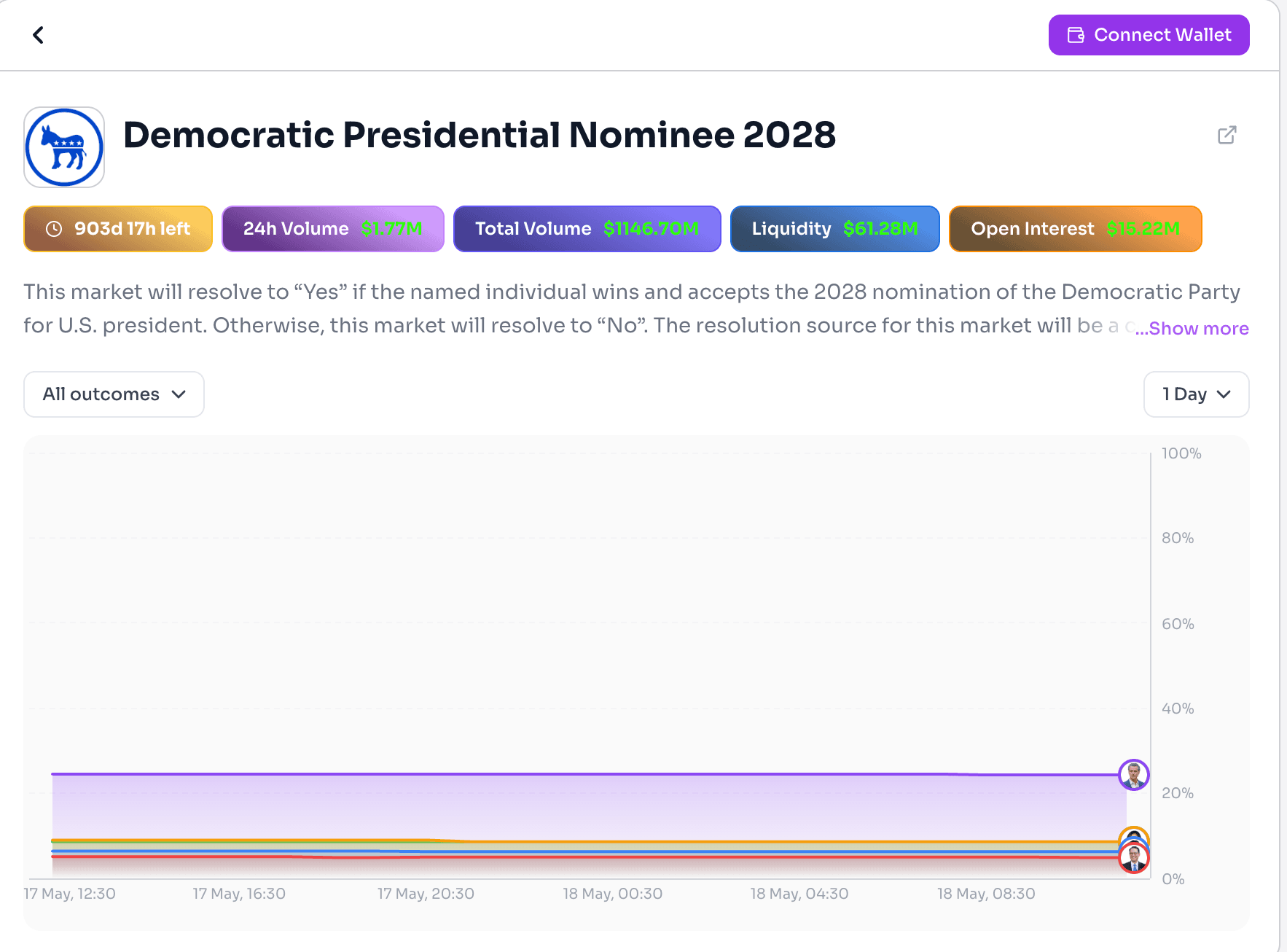
Current Polymarket price: Gavin Newsom at 24%, with most other candidates at 1% Total volume: $1.1 billion The case for value: Ultra-long-duration markets systematically underprice uncertainty
This is a market resolving in 2028, with 924 days remaining as of May 2026. At that duration, the crowd is essentially pricing on current name recognition and current political positioning rather than on anything predictive.
The structural insight is that 924-day markets systematically overprice whoever is currently in the news and underprice the field as a collective. In 2022, no one was pricing Ron DeSantis as the dominant story he became in 2023, and no one was pricing his subsequent collapse. The prediction market crowd anchors to the present.
Gavin Newsom at 24% reflects his current visibility and his stated positioning as a potential candidate. But 924 days of political developments, economic conditions, Democratic primary dynamics, and potentially transformative news events will intervene between now and the 2028 primary.
The value bet in these ultra-long-duration markets is typically to buy the field at its aggregate current price if you believe the collectively-priced candidates other than the current leader are collectively underpriced. In this market, every candidate except Newsom is priced at 1%, meaning collectively the entire field except Newsom is priced at 76%. That seems roughly right, which means the specific names within that 76% are essentially priced at random.
If you have a genuine analytical view on a specific candidate who is currently at 1% but whose political circumstances suggest meaningfully higher probability, the long duration of this market makes that an attractive position because you have nearly three years for the repricing to occur.
The trade framework: This is a speculative position for political analysts with genuine knowledge of Democratic primary dynamics. The edge is not in the overall market structure but in identifying specific candidates where current positioning at 1% understates their actual probability given their state-level infrastructure, fundraising capacity, and potential political developments.
The Systematic Process for Finding Mispriced Markets Yourself
Rather than relying on any list of specific markets, building the process for finding mispricings independently is more valuable for ongoing trading.
Primary Source vs. Market Price Comparison
Generate your own probability estimate from primary sources before looking at any Polymarket price. For economic markets, use FOMC statements, BLS releases, and CME FedWatch. For political markets, use official polling aggregators and historical base rates. For sports markets, use Elo ratings, injury reports, and home advantage research.
Only after committing to your own number do you compare it to the market price. A divergence of 10 or more percentage points in either direction is the minimum threshold worth investigating. Smaller gaps generally do not produce reliable returns after fees.
Resolution Criteria Reading
Read the Rules section on every market you consider before looking at the price. The most durable mispricings on Polymarket are in markets where the resolution criteria differ subtly from the headline. These require no speed advantage to exploit. They require attention and careful reading.
Low-Volume New Market Scanning
Sort Polymarket by newest created and filter for categories where you have genuine domain expertise. Markets that have been live for less than 24 hours with volume under $500,000 are the most likely to carry significant analytical mispricings. The crowd has not yet arrived. Your domain knowledge against three or four early traders is the most favourable competitive environment available.
Cross-Platform Price Checking
Check whether the same event is priced on both Polymarket and Kalshi. When a meaningful gap exists between the two, at least one is wrong. The gap tells you where to focus your analysis. The gap alone is not a trade signal, but it is a reliable signal that something is worth investigating.
Laika AI monitors Polymarket on-chain activity continuously and surfaces markets showing unusual price movements, smart money entries, and new market openings in real time. Rather than manually scanning 4,000-plus active markets for the signals described above, Laika flags the specific contracts worth your attention before the window closes.
Frequently Asked Questions
How do you identify a mispriced Polymarket market?
A mispriced Polymarket contract is one where the current implied probability diverges from the true probability by 10 or more percentage points based on primary source evidence. The most reliable way to identify one is to generate your own probability estimate from primary sources before looking at the current price, then compare the two. Sources include FOMC statements for monetary policy markets, BLS data for economic markets, official polling for political markets, and Elo ratings for sports markets. A large and articulable gap between your estimate and the current price is the starting point for further investigation.
Which Polymarket market categories produce the most mispricings?
The categories with the most durable mispricings in 2026 are low-volume regional and international political markets, new markets in their first 24 hours before crowd price discovery, economic indicator markets in the 10 to 21 days before scheduled data releases, and resolution criteria-specific markets where the contract rules differ subtly from the headline question. Ultra-short-duration crypto price markets are almost entirely bot-dominated and are not viable for manual edge trading. Sports markets at the overall champion level are efficiently priced at high volume but individual series markets in the playoffs carry more accessible mispricings.
Is the Fed zero cuts in the 2026 market correctly priced at 70%?
As of May 18, 2026, the 70.3% probability of zero Fed rate cuts in 2026 reflects the current CPI at 3.8%, three consecutive holds at the 3.50% to 3.75% target range, and major bank consensus forecasting a hold through year-end. The case for this being too high rests on the energy-driven nature of the April CPI spike, the historically unusual dissent level at the April 29 FOMC meeting suggesting internal disagreement, and the potential for growth deterioration to force the Fed's hand before December. The June 16 to 17 FOMC meeting and the May CPI release are the primary catalysts that will determine whether the current price is justified.
How long do mispricings typically last on the Polymarket in 2026?
It depends on market category and volume. High-volume markets with over $10 million in 24-hour trading, covering Bitcoin, US elections, and major US sports, see mispricings close within minutes to hours as sophisticated participants and automated systems compete for the same edges. Low-volume markets with under $500,000 in total volume can carry mispricings for 24 to 72 hours or longer, particularly in niche political and international markets. Resolution-criteria-based mispricings, where the edge comes from reading the Rules section carefully rather than from information speed, can persist until close to resolution because they are not closed by new information arriving but by participants making the same careful analytical observation you did.
What is the best free tool for finding Polymarket value bets?
Several free tools are useful for different parts of the process. Dune Analytics hosts community dashboards tracking Polymarket wallet activity, which show which high-performing wallets are entering specific markets and can signal where informed money is moving. The Polymarket interface itself is sorted by newest created surfaces and new market opportunities in their opening hours. CME FedWatch provides the institutional benchmark for monetary policy markets. For sports markets, Elo rating databases like FiveThirtyEight's historical models or Club Elo provide systematic probability estimates to compare against Polymarket prices. Laika AI monitors on-chain Polymarket activity in real time and surfaces unusual price movements and smart money entries automatically.
Should I bet on the 2026 FIFA World Cup winner on Polymarket?
The FIFA World Cup market at $770 million in total volume is the largest sports market Polymarket has ever hosted. At that volume, the top contender prices, specifically Brazil, France, England, Argentina, and Germany, are efficiently priced with meaningful analytical participation. The edges that remain are in the home advantage premium for the USA as host nation, mid-tier contenders where analytical crowd attention is lower, and specific group stage and knockout round markets that receive less sophisticated analysis than the overall winner market. Always verify current prices directly on Polymarket and conduct your own research using Elo ratings and recent tournament form before trading any sports market.