Everyone keeps asking the same question, so let's just answer it: Kalshi went from a $2 billion valuation in June 2025 to a reported $40 billion by mid-2026. Twenty times in about a year. That $40 billion number is still a target under negotiation, not a signed deal, and there's no IPO date, no S-1 filing, no underwriters lined up. If someone tells you otherwise, they're guessing. This piece sorts out what's actually confirmed from what's still rumor, and gets into the question that matters more if you're trading on the platform rather than investing in it: does any of this change your experience.
The Full Kalshi Funding Timeline
Kalshi's rise from a niche CFTC-approved exchange to one of the most talked-about private companies in fintech happened in five distinct jumps. Here's every round, in order.
A quick note on that Series F date, since a few outlets reported it differently. Bloomberg first reported the $22 billion figure on March 19, 2026, citing a source familiar with the deal, well before anything was official. Kalshi's own newsroom, along with the New York Times and TechCrunch, didn't confirm the round publicly until it formally closed on May 7. That's a normal pattern for late-stage rounds, an early leak followed by an official announcement once terms are locked, so both dates are accurate, they're just describing different moments in the same round.
The Kalshi funding round you're most likely to have heard about is that $40 billion talk, first reported by the Financial Times on June 24-25, 2026. If it closes as discussed, this would nearly double Kalshi's valuation in under two months and put the company ahead of rival Polymarket, which has separately been raising at a $15 billion valuation, a gap worth understanding on its own since it says something about how the two platforms are being priced by very different investor logic.
Kalshi has now raised roughly $2.9 billion across all rounds combined, according to Sacra's funding data, a figure that includes both equity and earlier debt financing from before the company's growth really took off.
Who Owns and Backs Kalshi
Kalshi was founded in 2018 by Tarek Mansour and Luana Lopes Lara, who met while studying at MIT. Mansour serves as CEO and Lara as COO, and together they're estimated to hold somewhere between 20% and 25% of the company, a stake that's made both of them billionaires on paper as the valuation climbed. If you're curious about the founding story and how a company that started as a college project became a federally regulated exchange, our full profile on Kalshi's billionaire founders and the platform's origins goes into that in more depth than a valuation piece really should.
The investor list reads like a who's-who of both traditional venture capital and crypto-native funds, which is itself a little unusual. Sequoia Capital and Andreessen Horowitz, two of the most established names in Silicon Valley, have been in nearly every round since Series C. Paradigm, a crypto-focused fund, has anchored several rounds too. And the Series F brought in a name you don't usually see backing a prediction market: Morgan Stanley, a signal that traditional Wall Street institutions are treating Kalshi less like a novelty and more like infrastructure.
What's Actually Driving This Growth
A valuation jump this fast usually means one of two things: hype outrunning fundamentals, or genuine business growth catching up to what investors already believed. The numbers here point pretty clearly to the second.
Monthly trading volume on Kalshi went from $226 million in December 2024 to $6.6 billion by December 2025, and then to $29.2 billion by June 2026. Annualized volume hit $178 billion in April 2026, a 32x increase year over year. Revenue tells a similarly steep story: roughly $25 million annualized in December 2024, climbing to about $735 million by December 2025. By June 2026, Sacra estimated annualized revenue near $3.5 billion, while CEO Tarek Mansour separately told CNBC the company had crossed $2 billion in annualized revenue earlier in the year. Those two figures come from different methodologies and different points in time, so it's worth citing both rather than treating them as contradictory.
Three Specific Developments Explain Most of That Curve
The FIFA World Cup
Sports contracts already made up the bulk of Kalshi's fee-generating volume, and the tournament pushed that further, with parlay-style trades reportedly surging to roughly half of total platform volume during the event, up from about 2% before it started. During the World Cup's first week alone, Kalshi says it processed $5.1 billion in volume, the largest single week any prediction market platform has recorded.
Regulated Crypto Perpetual Futures
Kalshi became the first US exchange to offer a CFTC-regulated perpetual futures contract, launching a Bitcoin perp that reportedly cleared $5.5 billion in volume within its first two weeks alone. That product opened up an entirely new category of trader who wouldn't otherwise have touched an event-contract platform. Our full guide to how Kalshi's perpetual futures product actually works covers the mechanics for anyone considering trading it.
It's worth pausing on that Polymarket comparison for a second, since the two companies are being priced by fairly different logic even though they compete for a lot of the same traders. Kalshi's premium leans heavily on its federal regulatory status and institutional adoption, while Polymarket's separate fundraising at a $15 billion valuation reflects its global reach and blockchain-native settlement instead. If you're weighing what Polymarket's own valuation climb actually means for someone trading there day to day, our piece on what the $15 billion Polymarket valuation means for retail traders covers that side of the comparison.
Institutional Demand
Kalshi says institutional trading volume grew roughly 800% over a six-month stretch in 2026, and it's been actively building infrastructure, block trading tools, deeper broker integrations, new risk products, specifically to serve hedge funds, asset managers, and proprietary trading firms rather than just retail users. That's a meaningfully different growth engine than most consumer fintech stories, and it's part of why a firm like Morgan Stanley showed up as a backer.
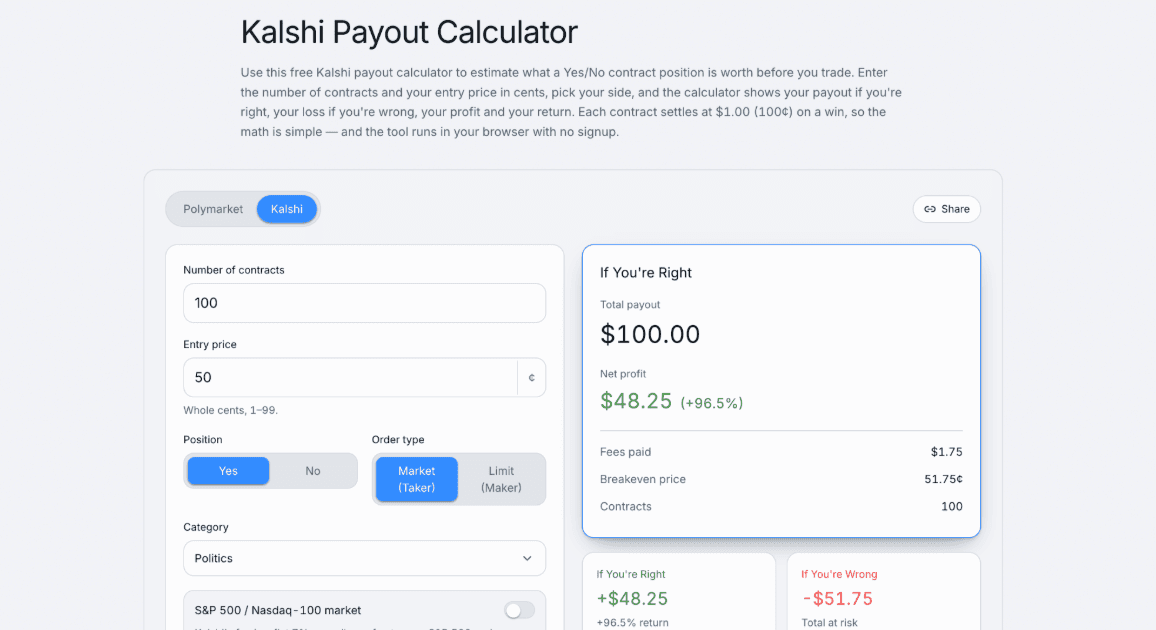
Try the Kalshi Payout Calculator for free →
The IPO Question: What's Confirmed vs. What's Speculation
This is the section where it's easiest to get ahead of the facts, so here's exactly where things stand.
- What's confirmed: CEO Tarek Mansour told CNBC on June 24, 2026 that Kalshi is weighing an eventual public listing, but explicitly ruled out an IPO happening before 2027. That was the first time company leadership had publicly acknowledged IPO deliberations at all.
- What's reported but not confirmed: The Information separately reported, days earlier on June 18, that Kalshi had begun informal conversations with investment banks about managing a future offering, with some sourcing pointing toward a possible 2028 listing window rather than 2027.
- What doesn't exist yet, as of this writing: no S-1 filing, no confirmed underwriters, no price range, and no locked date. Anyone searching for a specific kalshi ipo date right now is going to come up empty, because that date hasn't been set, publicly or, as far as reporting suggests, privately either.
There's also a real legal backdrop shaping the IPO timeline that doesn't get enough attention. Kalshi is currently fighting legal battles on two fronts: state regulators arguing its sports contracts amount to unlicensed gambling, and a lawsuit from CME Group challenging the CFTC's approval of Kalshi's perpetual futures products. Neither dispute threatens the company's core business immediately, but unresolved regulatory litigation is exactly the kind of thing that tends to push a public listing later rather than sooner, since it complicates the disclosure and risk-factor sections of any prospectus. Our deeper look at the regulatory fight between Kalshi, Polymarket, and state authorities covers where that battle currently stands.
What This Actually Means If You Trade on Kalshi
Here's the part that most valuation coverage skips entirely, and it's the reason this piece exists.
A rising valuation doesn't change your fees, your account, or how a contract settles. What it does change, gradually, is the platform underneath you. A few things worth actually watching as a trader rather than an investor
- Product velocity is increasing. Perpetual futures and margin trading through the affiliated Kinetic Markets entity both launched within the past year, and a company flush with fresh capital tends to ship faster, not slower. If leveraged trading interests you, our guide to how Kalshi's margin trading and Kinetic Markets setup actually works is worth reading before you touch it, since it carries real risk that standard cash-collateralized contracts don't.
- Platform stability tends to improve with institutional capital, if the Super Bowl weekend deposit slowdown covered elsewhere on this site is any indication, since fixing that kind of infrastructure gap is exactly what fresh funding rounds are typically earmarked for.
- Mainstream visibility is rising fast, which cuts both ways. Kalshi's odds increasingly show up as a data source on major networks, a shift we cover in our piece on how Kalshi became an odds source for outlets like CNN and Bloomberg, which means more liquidity and tighter spreads on popular markets, but also more regulatory and media scrutiny aimed at the platform.
- None of this guarantees Kalshi survives its legal challenges. A high valuation reflects investor confidence, not certainty, and the state-level gambling lawsuits mentioned above are a real variable that could still reshape which contracts remain available in which states.
The Bottom Line
Kalshi's valuation trajectory, from $2 billion to a reported $40 billion in about a year, is one of the fastest markups in recent fintech history, and it's backed by genuinely steep growth in both volume and revenue, not just hype. An IPO is coming eventually, but not before 2027 at the earliest, and treating any specific date as locked in right now would be getting ahead of what's actually been confirmed. If you're trading on the platform day to day, the valuation headlines matter less than the products and fee structures underneath them, which is exactly the kind of thing Polymetric is built to help you track as Kalshi, and its competitors, keep evolving.
Frequently Asked Questions
When is Kalshi's IPO date?
There is no confirmed Kalshi IPO date. CEO Tarek Mansour has said publicly it won't happen before 2027, and separate reporting has pointed to informal bank discussions around a possible 2028 listing, but neither an S-1 nor a firm timeline has been filed or announced.
Who owns the Kalshi betting app?
Kalshi was co-founded by Tarek Mansour and Luana Lopes Lara, who together hold an estimated 20% to 25% of the company. The remainder is held across roughly three dozen institutional investors from eleven funding rounds, including Sequoia Capital, Andreessen Horowitz, Paradigm, Coatue, and Morgan Stanley.
What was Kalshi's most recent closed funding round?
The most recently closed Kalshi funding round was a $1 billion Series F, officially announced May 7, 2026, at a $22 billion valuation, led by Coatue with participation from Sequoia, Andreessen Horowitz, Paradigm, Morgan Stanley, and ARK Invest. A larger round targeting a $40 billion valuation was reported in talks shortly after but had not closed as of this writing.
Who owns Kalshi and Polymarket?
Kalshi and Polymarket are separately owned companies with no shared ownership. Kalshi is led by co-founders Tarek Mansour and Luana Lopes Lara, while Polymarket was founded by Shayne Coplan. The two compete directly but are backed by different, though sometimes overlapping, sets of venture investors.
Is Kalshi really worth $40 billion?
That figure reflects private funding talks reported by the Financial Times, not a closed transaction or a public market price, so it should be treated as a target valuation under negotiation rather than a confirmed fact. For context, secondary-market pricing tracked by Nasdaq Private Market put Kalshi shares around $534 each in late July 2026, which analysts use as a rough proxy for where investors are actually pricing the company between official rounds.
Will Kalshi IPO in 2027?
It's possible but not confirmed. Kalshi's CEO has only said the IPO won't happen before 2027, which leaves the door open without setting a firm date, and separate reporting suggests bank conversations may be aiming closer to 2028.
What is Kalshi's valuation in 2026?
Kalshi's confirmed 2026 valuation is $22 billion, set by its Series F round in May. A follow-on round targeting roughly $40 billion was reported in talks by mid-2026 but remained unclosed as of this writing