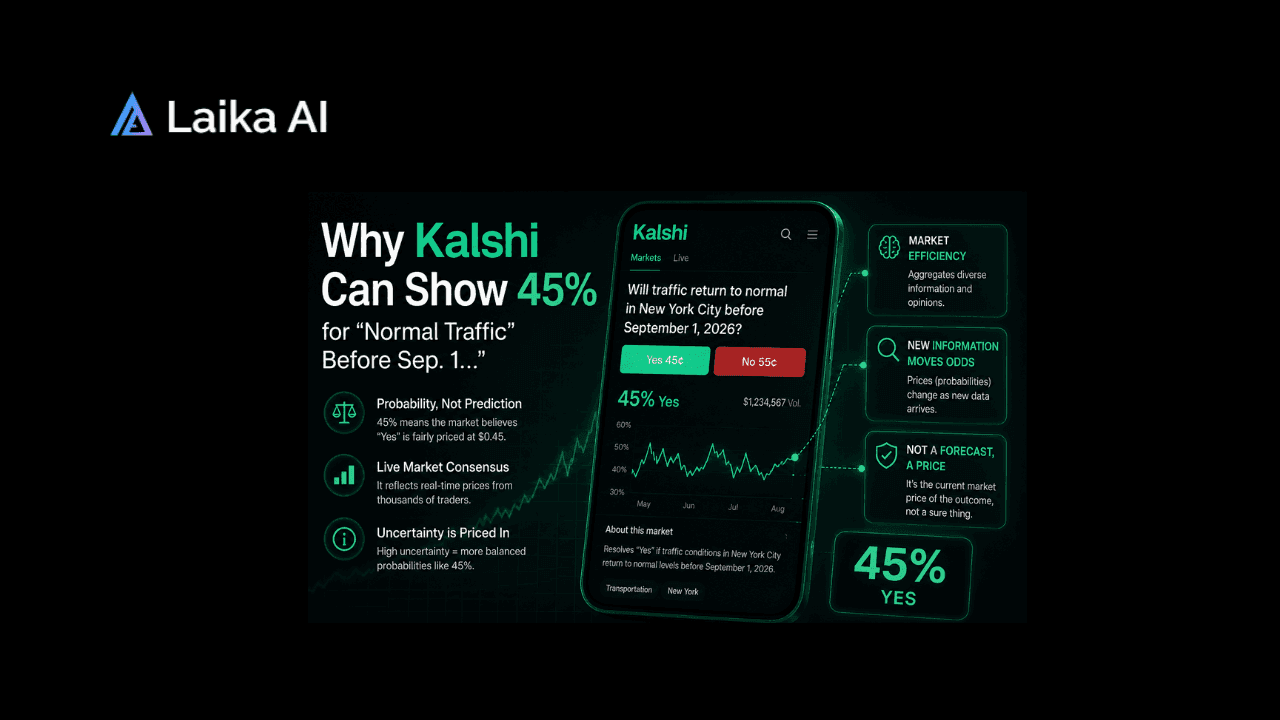
That confusion usually comes from reading the headline as if it were the contract. On Kalshi, the contract is not “Is the strait open?” It is a deadline-based binary event: whether traffic at the Strait of Hormuz returns to “normal” before a specific date, using the market’s own rule text and data source.
So a 45% price does not mean “the news is wrong” or “traffic is already normal.” It means traders are collectively assigning about a 45% chance that the contract’s exact YES condition will be satisfied before the cutoff.
Most Polymarket traders rely on headlines, emotions, and market momentum. That’s why they lose.
Polymetric by Laika AI gives you a real trading edge with AI-powered market analysis, whale wallet tracking, probability breakdowns, sentiment monitoring, and live market intelligence across politics, crypto, sports, and macro events.
If you're trading Polymarket without data, you're trading blind.
Check Polymetric
Step 1: Read the contract as a rule, not as a headline
The market in question is the Kalshi Strait of Hormuz “when will traffic return to normal?” series. The important part is that it is a multi-expiry timing market: separate contracts can ask whether the event happens before Aug. 1, before Sep. 1, before Oct. 1, and so on.
That structure matters because each contract is a different question. “Before Sep. 1, 2026” is not the same as “eventually” or “by the end of 2026.” A market can be low for an earlier deadline and higher for a later one because traders think the event is possible, just not soon enough.
Kalshi’s own pricing framework is straightforward: a Yes contract pays $1 if the event happens and $0 if it does not. A Yes price of 45 cents implies the market is pricing roughly a 45% probability of the event occurring under the contract rules.
Step 2: Understand what “45%” means on Kalshi
Kalshi event contracts are binary. That means:
- Yes settles at $1 if the rule-defined event happens.
- No settles at $0 if it does not.
- The quoted price is the market’s implied probability.
So if the Sep. 1 contract is trading at 45%, the market is saying:
“Given the current information, there is about a 45% chance that the contract’s YES condition will be met before the deadline.”
That is very different from saying:
- traffic is already normal,
- the strait is fully open in a practical sense,
- or the latest headline should have forced the price to 0% or 100%.
Prediction markets are forward-looking. They price the chance of a future rule outcome, not a summary of the latest news article.
Step 3: The contract is about a threshold and a time window
For this Hormuz market, the relevant mechanics are not just “traffic up or down.” The contract is tied to a specific traffic metric and a specific deadline.
The source material indicates the market uses the 7-day moving average of transit calls through the Strait of Hormuz as reported by IMF PortWatch, with a threshold above 60 for the YES condition in the related Hormuz traffic markets.
The practical structure is:
- Kalshi watches the designated data source.
- It checks whether the rule-defined traffic condition is met.
- It asks whether that happened before the deadline.
This is why a headline saying “the strait is open” can coexist with a 45% price. The market is not asking whether ships can theoretically pass. It is asking whether the rule-defined normal-traffic threshold will be reached in time.
Step 4: Why “open but still weak traffic” can still support a 45% price
This is the core of the confusion.
A headline like “the strait is open except for adversaries and traffic is still weak” sounds contradictory only if you assume the market is about a simple binary state: open vs closed. But the Kalshi contract is more nuanced.
A 45% price can make sense if traders think any of the following are true:
- traffic is improving, but not fast enough yet,
- the 7-day average is still below the threshold,
- the threshold may be crossed later, but the deadline is close enough that the chance is only moderate,
- official data may lag behind real-world conditions,
- or the market is pricing uncertainty about whether the data source will confirm the move in time.
In other words, the market can be saying:
“The situation is better than before, but there is still a meaningful chance the contract will not resolve YES by Sep. 1.”
That is exactly what a mid-range price like 45% is for.
Step 5: Separate three different questions people often mix together
When users see this market, they often collapse three different questions into one:
1) Is the strait physically open?
That is a real-world status question.
2) Is traffic back to normal by the contract’s definition?
That is the Kalshi settlement question.
3) Will the market resolve before Sep. 1?
That is the timing question.
A headline can answer #1 partially, while the market is pricing #2 and #3.
For example, the strait may be “open” in the sense that some vessels can pass, but traffic can still be far below the level needed for the contract’s “normal” threshold. If the market requires a 7-day average above a set level, then a few days of weak or uneven traffic can keep the contract from resolving YES even if the strait is not literally shut.
Step 6: Why the market can stay open even after news seems to settle the issue
Kalshi’s market FAQs make an important point: a market remaining open is not proof that the event has not happened. Kalshi may wait for official data before closing or settling a market.
That matters a lot in a data-based shipping market.
If traders believe the threshold has been crossed, the price may move before Kalshi officially settles. But if the designated source, IMF PortWatch, has not yet published finalized data, the market can still trade while participants debate what the official reading will be.
So you can see a market at 45% even when the latest news sounds bullish because the market is still pricing:
- the official data confirmation,
- the exact moving-average rule,
- and the deadline.
Step 7: A concrete example of how 45% can happen
Imagine the Sep. 1 contract is based on a 7-day moving average threshold.
Suppose traders think:
- traffic has improved from crisis levels,
- but the average is still below the required level,
- and there are only a few weeks left before the deadline,
- with some risk that shipping remains uneven or data lags behind reality.
In that case, a trader might reason:
“Yes, normal traffic by Sep. 1 is possible.”
“No, it is not yet likely enough to justify a much higher price.”
If enough traders share that view, the market can settle around 45%.
That price is not a contradiction. It is a compressed expression of uncertainty about whether the threshold will be met in time.
Step 8: Why headlines can be misleading for timing markets
News stories usually describe the present tense:
- the strait is open,
- traffic is weak,
- some vessels are being turned back,
- shipping is improving,
- or the situation is stabilizing.
But Kalshi timing markets care about a future cutoff.
That means the market is not asking, “What is true today?” It is asking, “What is the probability that the rule will be satisfied before the deadline?”
A headline can be directionally positive and still leave the market below 50% if traders think:
- the improvement is too slow,
- the threshold is still far away,
- or the deadline is too soon.
This is especially true in markets based on moving averages. A moving average does not flip instantly. Even if daily traffic improves, the 7-day average may take time to catch up.
Step 9: Practical checks to interpret this specific market correctly
If you are trying to understand why the price is 45%, check these items in order:
1) What exactly is the YES condition?
Look at the market rules, not the headline. Confirm the threshold, the metric, and the source.
2) What is the deadline?
“Before Sep. 1, 2026” means the market is about timing, not eventual recovery.
3) Is the source data delayed or revised?
If the market uses IMF PortWatch, the official reading may lag real-world shipping conditions.
4) Is the market using a moving average?
If yes, a short burst of better traffic may not be enough.
5) Are you comparing the right thing?
“Open” is not the same as “normal.” “Less weak” is not the same as “above threshold.”
These checks usually resolve the apparent contradiction.
Step 10: Edge cases that matter here
Edge case 1: The strait is open, but traffic is still below the threshold
This is the most likely source of confusion. The market can still be below 50% because the contract is not about mere access; it is about a quantified return to normal.
Edge case 2: Traffic improves, but not enough days remain
A market can stay around 45% even if the trend is positive, because the deadline is part of the bet. Traders may think the event is likely eventually, but not before Sep. 1.
Edge case 3: The market price moves before official confirmation
Kalshi prices reflect trader expectations before settlement. The market can move on anticipation, then settle later when the source data is confirmed.
Edge case 4: The data source is incomplete or delayed
If the designated source is slow or imperfect, the market can trade on expectations while everyone waits for the official reading.
Edge case 5: Different platforms or trackers show different numbers
Other trackers may use different definitions, different data feeds, or different timing windows. A Kalshi price only reflects Kalshi’s contract rules.
Step 11: How to read the 45% price without overreacting to the headline
A useful way to translate the market is:
45% Yes = “The market thinks there is a meaningful but not dominant chance that the contract’s exact condition will be met by the deadline.”
It does not mean the event is already settled.
It does not mean the headline is false.
It does not mean the strait must be closed.
It means the market is pricing the combination of:
- current traffic conditions,
- the moving-average rule,
- the official data source,
- and the time remaining until Sep. 1
That is why a contract can trade at 45% even when the latest news sounds contradictory.
Bottom line
For this Kalshi market, the price is not a vote on the headline. It is a probability estimate for a specific rule-defined outcome by a specific date.
So if the strait is “open” but traffic is still weak, a 45% price is not strange at all. It usually means traders think the market’s exact “normal traffic before Sep. 1, 2026” condition is still only moderately likely to be confirmed in time.
If you want to interpret these markets correctly, always anchor on three things: the rule text, the data source, and the deadline.