A crypto prediction market does not trade Bitcoin. It trades the probability that Bitcoin does something specific. Whether it closes above $100,000 on December 31. Whether a spot ETF gets approved before a specific date. Whether a protocol upgrade ships on schedule. The distinction matters because a crypto prediction market lets you express a precise view on a crypto event without taking direct price exposure to the underlying asset.
The largest polymarket crypto market currently live is the Bitcoin end-of-2026 price target, with tens of millions in volume and prices updating in real time as traders incorporate new information about macro conditions, institutional flows, and regulatory developments. This guide explains how that market works, how prices are set, how contracts resolve, and where the edge lives for prepared traders.
For the full comparison of every major platform in this category, best crypto prediction markets cover the competitive landscape.
What a Crypto Prediction Market Actually Is
A crypto prediction market contract is a binary yes/no instrument with two possible outcomes. It resolves to $1 or it resolves to $0. Nothing between those two numbers.
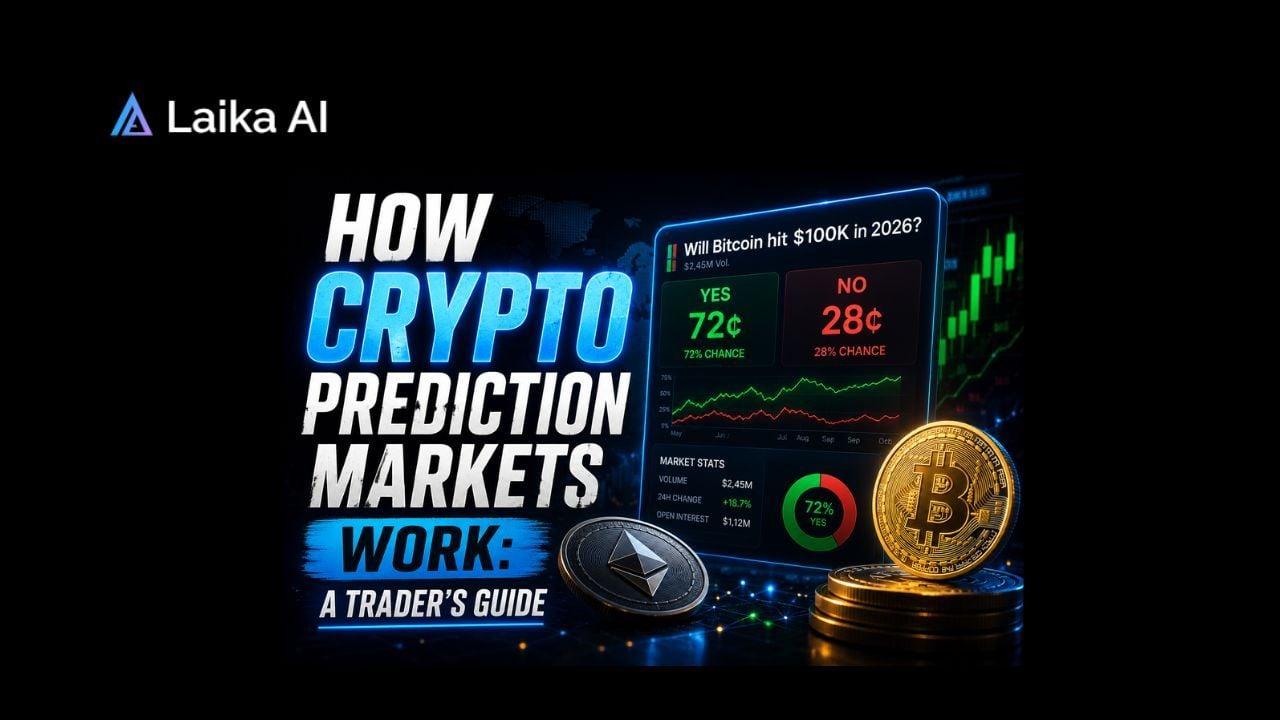
The price of the contract at any moment is the market's implied probability of the YES outcome occurring. A contract priced at 62 cents means the crowd collectively assigns a 62% probability to that outcome. A contract priced at 17 cents means the crowd assigns a 17% probability.
The mechanics are straightforward. You buy a YES contract at the current price. If the outcome occurs when the market resolves, each YES contract pays $1. If the outcome does not occur, it pays $0. The difference between what you paid and $1 is your profit per contract. The amount you paid is your maximum loss per contract.
You can also buy NO contracts, which pay $1 if the outcome does not occur. On any binary market, YES and NO contracts always sum to approximately $1.00. If YES is at 62 cents, NO is at approximately 38 cents. This internal consistency is structural, not coincidental.
You do not have to hold yourself to a resolution. You can sell your position at any time before the market resolves at the current market price. If you bought YES at 30 cents and the market has moved to 55 cents based on new information, you can sell and realize 25 cents profit per contract without waiting for the final outcome.
This exit mechanic is what distinguishes a crypto prediction market from a traditional bet. It is a tradeable position in a live market that replicates continuously as information changes.
How Prices Are Set
Understanding how does polymarket work at a price-setting level is the foundation of finding edge in these markets.
Polymarket is a peer-to-peer exchange with a central order book. There is no house setting the odds. There is no algorithm determining a starting price from nothing. When a new market opens, early traders place limit orders at prices they believe reflect the true probability of the outcome. Other traders take the other side of those orders when they disagree with the price. The interaction of buy and sell orders determines the current market price at every moment.
Every price reflects the aggregate of all capital-backed positions. A trader who believes Bitcoin has a 70% chance of ending 2026 above $120,000 and places $10,000 on that view has ten times the price influence of a trader who places $1,000 on the same view. The market weights conviction expressed through capital, not by the raw number of traders who hold a view.
Three important properties emerge from this mechanism.
Prices tend toward accuracy on liquid markets because traders with wrong views lose money and traders with correct views make money. Over time capital concentrates with better-calibrated traders and the crowd becomes self-correcting.
Prices update faster than any other information aggregation mechanism. When regulatory news breaks in a crypto market, prices move within minutes. There is no editorial process, no analyst update cycle, no institutional approval required.
Prices can be wrong in predictable ways. The crowd overweights recent news. It underweights base rates. It follows narratives. These systematic errors are documented and tradeable, and they are the source of edge for prepared traders.
For the complete framework on reading and interpreting polymarket odds in practice including conversion to traditional sportsbook formats, how to read Polymarket odds covers every dimension of the pricing system.
How a Crypto Prediction Market Contract Works: End to End
The Bitcoin end-of-2026 price market on Polymarket is the clearest live example of the full contract lifecycle. Visit the live BTC price market at polymarket.com/event/bitcoin-price-end-of-2026 to see the current price and order book depth.
Market creation
The market asks a specific binary question: will Bitcoin close above a specific price threshold on December 31, 2026? The resolution source is specified in the market rules, typically CoinGecko or CoinMarketCap closing price. The resolution date is fixed. The criteria are unambiguous. This specificity is what makes the market tradeable and resolvable without dispute.
Trading period
From the day the market opens until resolution, any trader with a funded account on a crypto prediction market platform can buy or sell YES or NO contracts at the current market price. Prices update continuously as traders enter and exit positions. The market reflects the aggregate view of all active participants at every moment.
Price movement during the trading period
Prices move when new information changes the collective assessment of the outcome's probability. A strong on-chain accumulation signal pushes the price up. A major exchange insolvency pushes it down. A hawkish Federal Reserve statement pushes it down. A Bitcoin ETF inflow record pushes it up. Each piece of information is processed by the crowd in real time and immediately reflected in the price.
The polymarket odds on this market are not static price targets. They are live readings of current collective probability assessment. A price of 62 cents today and 55 cents next week does not mean the crowd was wrong. It means new information changed the collective view of probability.
Resolution
On December 31, 2026, the market resolves based on the official closing price from the specified source. If Bitcoin closes above the threshold, all YES contracts pay $1 and all NO contracts pay $0. If Bitcoin closes below the threshold, all NO contracts pay $1 and all YES contracts pay $0. Payouts are automatic. There is no claim process, no waiting period, no manual review.
Holding to resolution versus selling early
Holding to resolution means accepting binary outcome risk. Selling early means locking in a market price that reflects current probability. A trader who bought YES at 30 cents and sold at 55 cents made 25 cents per contract without needing to know whether Bitcoin hit the target. A trader who held to resolution either made 70 cents per contract or lost 30 cents per contract. The right choice depends on conviction, position size, and risk tolerance relative to the remaining time.
The Main Types of Crypto Prediction Markets
Not all crypto prediction market contracts behave identically. Understanding the four main types determines which edge opportunities apply to each.
Price target markets
The most common type. Binary yes/no on whether a specific asset closes above a specific price by a specific date. Bitcoin end-of-year, Ethereum end-of-quarter, Solana monthly targets. Volume concentrates on Bitcoin and Ethereum. Altcoin markets appear during high-volatility periods.
The edge on price target markets comes from having a better-calibrated view of the probability distribution of a volatile asset than the crowd. The most consistent edge is in identifying when the crowd has overreacted to recent price movement and pushed the contract price beyond what the full-distribution analysis supports.
Regulatory and policy markets
Markets on specific regulatory decisions: will the SEC approve a specific application, will a specific bill pass by a specific date, will a specific enforcement action be filed. These markets have cleaner resolution criteria than price targets and reward traders with genuine information advantages about regulatory processes.
The Bitcoin spot ETF approval market in early 2024 is the canonical example. The market correctly priced rising approval probability months before the event. Traders who tracked SEC comment letters, meeting schedules, and legal framework developments had a consistent information advantage.
Protocol and ecosystem markets
Markets on DeFi protocol decisions, chain upgrades, token launch dates, and governance outcomes. Lower liquidity than price or regulatory markets, but genuine edge for traders with deep protocol knowledge that the broader market has not yet priced.
Exchange and institutional markets
Markets on exchange events, institutional adoption milestones, and corporate crypto announcements. These carry higher resolution risk because the criteria can be ambiguous, which is also where the most edge lives for traders who read the resolution rules carefully before the crowd does.
For the head-to-head comparison of which crypto prediction market platform carries each market type at the best depth, Polymarket vs Kalshi crypto covers the complete analysis.
Where the Edge Lives
Three specific and documented edges grounded in how these markets actually behave.
The information asymmetry window
Crypto prediction markets reprice faster than any other information aggregation mechanism, but there is still a window between when information becomes available and when it is fully reflected in the price. In regulatory markets, when a key SEC comment letter or court filing is published, prices on affected markets begin moving within minutes. Most other information channels take longer.
The broader version of this window is in protocol markets where deep technical knowledge is required to assess an outcome. A trader who has read the full specification for a proposed Ethereum upgrade and understands the implementation timeline has a genuine information advantage over the broader market, which prices the upgrade based on general news coverage rather than technical analysis.
The narrative overreaction fade
Crypto prediction market prices overweight recent news reliably. When Bitcoin makes a dramatic single-day move, the probability of Bitcoin hitting year-end price targets adjusts sharply. The adjustment is usually larger than the actual change in the underlying probability warrants, because one day's price movement is a small signal in a distribution that spans an entire year.
The correct response to a narrative-driven price spike is to assess whether the underlying probability case has actually changed. If the case has not materially changed and the price has moved 8 to 12 cents, that is a fade opportunity, not a momentum signal. This pattern repeats reliably across crypto price target markets and is the most consistent structural edge available.
The resolution criteria advantage
Many crypto prediction market contracts, particularly in the protocol and exchange categories, have resolution criteria specific enough to create genuine ambiguity. A contract on whether a protocol ships a feature by a specific date may hinge on whether a testnet deployment counts as a ship. A contract on an institutional announcement may hinge on what qualifies as official.
Traders who read the full resolution rules before entering a market understand exactly what will and will not trigger resolution. The crowd typically does not. This edge is most accessible in lower-volume markets where the homework has not been done by most participants.
For systematic identification of mispricing opportunities across all active crypto prediction market contracts, the Polymarket trading bot guide covers how to build automated monitoring across every live market.
Crypto Prediction Markets vs Crypto Exchanges: Four Key Differences
What you are trading
On a crypto exchange you own the asset. Your position is exposed to the full price movement between entry and exit. On a crypto prediction market platform you own a contract on a specific outcome. Your position is exposed to changes in the probability of that outcome, not the full price movement of the underlying asset.
Leverage and liquidation
Crypto exchange leveraged positions can be liquidated before an event occurs based on intermediate price movements. Crypto prediction market contracts cannot be liquidated mid-term based on price movements. The worst outcome is receiving $0 per contract at resolution. There is no margin call, no automatic liquidation, no possibility of losing more than your initial position.
The platform relationship
On a crypto exchange, the platform earns fees on every trade and in some cases takes positions that conflict with retail traders. On a peer-to-peer prediction market, you are trading against other participants. The platform earns a small fee on resolution. There is no structural conflict between the platform and any specific trader.
Resolution versus continuous trading
A crypto exchange position can be held indefinitely. A crypto prediction market contract resolves on a specific date at a binary outcome. The resolution mechanism is the fundamental difference that makes prediction markets a categorically different instrument from spot or derivative crypto trading.
Frequently Asked Questions
How do crypto prediction markets work?
A crypto prediction market lets traders buy and sell binary yes/no contracts on specific crypto outcomes. Each contract is priced between $0.01 and $1.00, representing the implied probability of the outcome occurring. A $0.62 contract means 62% implied probability. If the outcome occurs, each contract pays $1. If it does not, it pays $0. Traders can buy or sell at any time before resolution at the current market price. The platform earns a small fee on resolution. No house edge is embedded in the price.
How does Polymarket work for crypto trading?
How does polymarket work for crypto specifically: you fund an account with USDC on Polygon or via fiat on Polymarket US, find a crypto prediction market, and buy YES or NO contracts at the current price. Prices update continuously as traders incorporate new information. You can sell your position at any time before resolution. On the Bitcoin end-of-2026 price target market, buying YES at 62 cents means you receive $1 per contract if Bitcoin closes above the threshold on December 31 and $0 if it does not. Visit polymarket.com for live crypto markets.
How are crypto prediction market prices set?
Prices are set by the aggregate of all capital-backed positions on the platform's order book. There is no house setting the odds. Early traders place limit orders at prices they believe reflect true probability. Other traders take the other side when they disagree. The interaction determines the current price. Traders with correct views make money over time and gain more market influence. Traders with wrong views lose money and exit. The crowd becomes self-correcting on liquid markets.
Can you make money on crypto prediction markets?
Yes, but the profit distribution is highly concentrated. Academic research on Polymarket found roughly 70% of trading addresses recorded losses while fewer than 0.04% captured over 70% of total profits. Traders who consistently extract value do so through information advantages on regulatory markets, systematic identification of crowd mispricings on price target markets, or deep protocol knowledge on ecosystem markets. The platform rewards genuine analytical work. It does not reward following narratives or entering at peak volume.
What is the difference between a crypto prediction market and a crypto exchange?
A crypto exchange lets you buy or sell the asset itself with full price exposure between entry and exit. A crypto prediction market lets you trade the probability of a specific outcome. Your position is exposed to changes in that probability, not the full price movement of the underlying asset. Prediction market contracts resolve at a binary outcome on a specific date. Exchange positions can be held indefinitely. Prediction markets cannot be liquidated mid-term. Exchange leveraged positions can be.
The Bottom Line
A crypto prediction market is the cleanest instrument available for expressing a specific view on a specific crypto outcome without taking full price exposure to the underlying asset. The price is the probability. The contract resolves at $1 or $0. You can exit at any time before resolution.
The edge in these markets lives in the information asymmetry window when new information has not yet been fully priced, the narrative overreaction fade when recent news moves prices beyond what the probability warrants, and the resolution criteria advantage when traders who have read the contract rules understand exactly what will trigger resolution and the crowd does not.
Polymarket is where the deepest polymarket crypto markets will exist in 2026. The Bitcoin and Ethereum price target markets, the regulatory decision markets, and the protocol ecosystem markets all have more liquidity on Polymarket than on any competing platform. Visit polymarket.com for live crypto markets across every active category.
Track how crypto prediction market odds move in real time across every active contract with Polymetric by Laika AI. Live market intelligence for traders who want to be positioned before the crowd, not after it.