Tokenised stocks let you trade real shares on a blockchain, 24/7, with fractional ownership. Here is how they work, where to buy them, and what the risks are.
Key Insight Traditional stock markets close at 4pm. Settlement takes two days. Fractional ownership is limited to a handful of brokers, and investors outside the US and Europe are routinely locked out of the world's most valuable companies. Tokenised stocks solve all three of these problems by putting real shares on a blockchain, with a regulated custodian holding the underlying asset and a digital token tracking its price in real time. |
A tokenised stock is a blockchain-based digital token that represents ownership of a real-world company share, held by a regulated custodian, tradeable 24/7 on crypto platforms. This article covers what tokenised stocks are, how the mechanism works, how they compare to traditional equities, which platforms offer them, their regulatory status, and why institutional players including BlackRock and Franklin Templeton now treat them as the future of global investing.
What Is a Tokenised Stock?
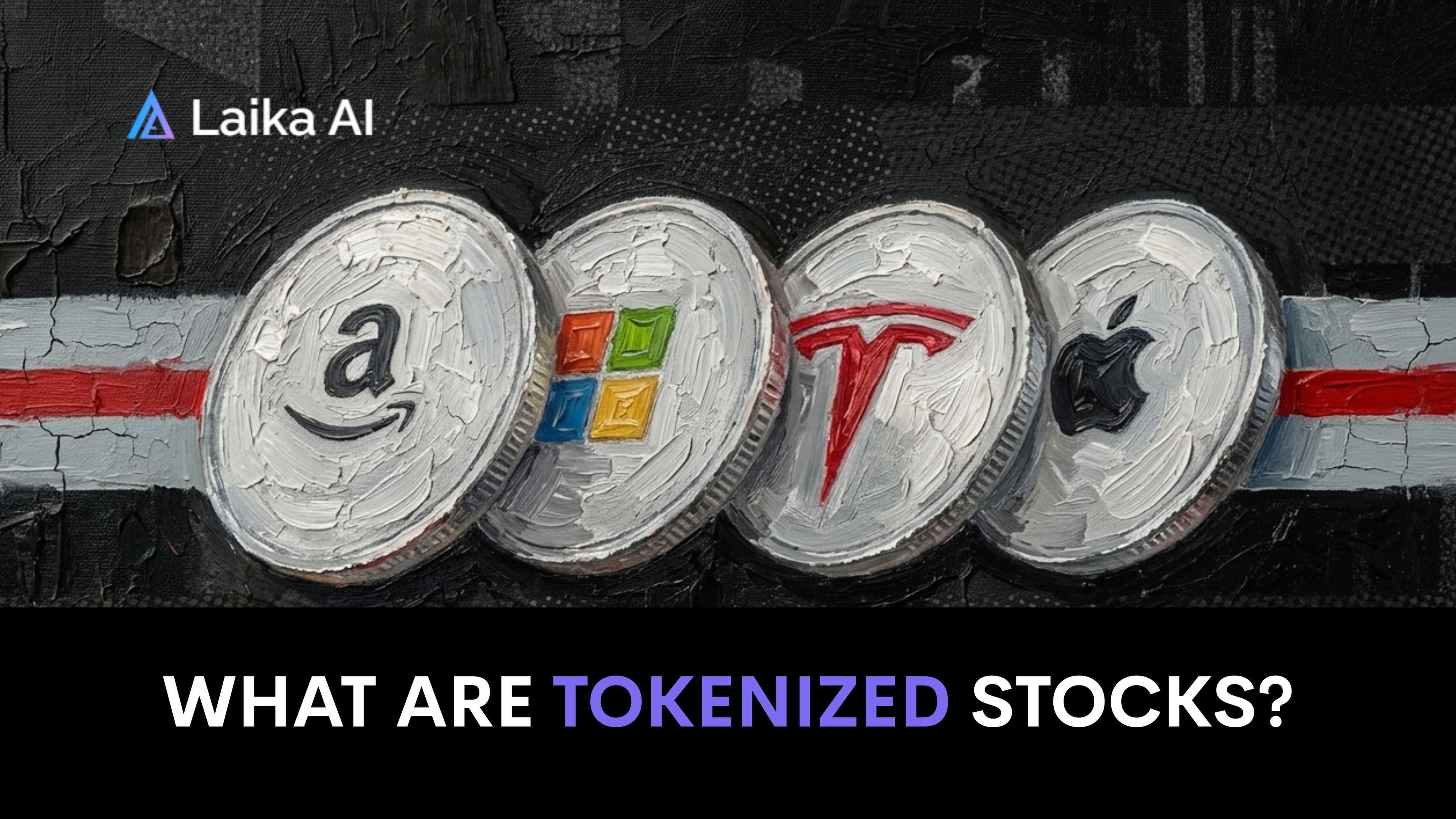
A tokenised stock is a blockchain-based digital token that represents ownership of a real-world company share. It mirrors the price of the underlying stock, can be traded 24/7 on crypto platforms, and allows fractional ownership down to fractions of a cent. The actual share is held by a regulated custodian on behalf of the token holder.
The issuer of a tokenised stock is a regulated financial entity, typically a licensed broker, trust company, or token issuer, that purchases the underlying share on a traditional exchange. That share is locked with a custodian in a segregated account. The issuer then mints a corresponding digital token on a blockchain such as Ethereum or Solana and makes it available for trading on crypto platforms.
In most jurisdictions, the token holder does not hold direct legal title to the share. They hold a contractual claim over the economic value of that share, including price exposure and in some cases dividend rights, through the issuing entity. This is a critical distinction from owning shares directly through a traditional broker.
The token is a digital record on a public blockchain, distinct from the underlying share but designed to track its price in real time via oracle networks or live price feeds. In DeFi and institutional contexts, tokenised stocks are classified as real-world assets (RWA), a category that refers to blockchain-based representations of off-chain financial instruments. The combination of blockchain settlement, custodian-held underlying assets, and fractional ownership makes tokenised stocks structurally different from both traditional equities and purely synthetic crypto instruments.
How Do Tokenised Stocks Work?
Tokenised stocks work through a three-step process. A regulated issuer purchases the underlying share and locks it with a custodian. A corresponding token is minted on a blockchain. That token is listed on a crypto trading platform where it trades in real time, mirroring the share price via an oracle or live price feed.
The full sequence in detail:
The issuer, a regulated entity such as a licensed brokerage or token issuer, purchases the underlying share on a traditional stock exchange such as the NYSE or NASDAQ.
The share is transferred to a regulated custodian and held in a segregated account. The custodian ensures the underlying asset is ring-fenced and cannot be used for any other purpose.
The issuer mints a digital token on a blockchain. Most tokenised stocks are issued on Ethereum, though Solana, Polygon, and Stellar are also used depending on the platform and protocol. Each token corresponds to one share or a defined fraction of one share.
The token is listed on a crypto trading platform. Users buy, sell, and hold the token as they would any other digital asset, with the price tracking the underlying share in real time.
The token price is maintained through oracle networks or live market data feeds that pull pricing from traditional exchanges, keeping the token value aligned with the real stock price at all times.
When a holder wants to exit, they sell the token to another buyer on the platform or, on platforms that support it, redeem it for a cash equivalent, with the custodian selling the underlying share and distributing proceeds.
This structure means the tokenised stock market is a blockchain-based wrapper around the traditional stock market, adding 24/7 tradability, near-instant settlement, and fractional ownership without replacing the underlying custodian and share infrastructure that traditional markets depend on.
Tokenised Stocks vs Traditional Stocks: What Is the Difference?
Tokenised stocks differ from traditional stocks across seven key dimensions including trading hours, settlement speed, fractional ownership, custody, geographic access, regulatory status, and dividend eligibility. Every row in the table below represents a structural difference, not a cosmetic one.
| FEATURE | TRADITIONAL STOCKS | TOKENISED STOCKS |
| Trading hours | Market hours only (e.g. 9:30am to 4pm ET on weekdays) | 24/7 on crypto platforms, including weekends and public holidays |
| Settlement time | T+2, meaning two full business days to settle | Near-instant on-chain settlement via blockchain |
| Fractional ownership | Limited and broker-dependent, not universally available | Yes, any fractional amount including micro-fractions of a single share |
| Custody | Broker holds shares in the investor's name or in street name | Regulated custodian holds the underlying share; token is held on-chain by user |
| Geographic access | Restricted by the broker's licensing jurisdiction | Global access, subject to platform availability and local regulation |
| Regulatory status | Fully regulated under securities law (SEC in US, FCA in UK) | Varies by jurisdiction; often under crypto regulations rather than securities law |
| Dividend eligibility | Yes, dividends paid directly to the registered shareholder | Platform dependent; some pass dividends, others offer price exposure only |
Settlement time, custody model, and regulatory status in particular carry material implications for investor protection, tax treatment, and risk exposure. A tokenised stock is not a shortcut to owning Apple shares. It is a different financial instrument that tracks Apple's price.
Where Can You Buy Tokenised Stocks?
Tokenised stocks are currently available on several major crypto platforms including Robinhood (EU), Kraken, Bybit, Gemini, and eToro. Ondo Finance offers tokenised US equities on-chain for DeFi users. Availability varies by country and the regulatory status of the platform in each jurisdiction.
| PLATFORM | COVERAGE | KEY FEATURE | AVAILABILITY |
| Robinhood EU | US equities: Apple, Tesla, NVIDIA and others | 24/7 trading on blockchain rails for European retail investors | EU only (US investors excluded) |
| Kraken | US and European equities in select markets | Partnerships with regulated issuers for price exposure | Select jurisdictions, not US retail |
| Bybit | Broad equities and derivatives suite | Listed as part of spot and derivatives product range | Jurisdiction-dependent, check local status |
| eToro | Real shares plus crypto assets | Regulated brokerage combining traditional equity and crypto | Available in multiple regions with real share custody |
| Ondo Finance | US Treasuries and US equities on-chain (OUSG) | DeFi-native RWA protocol on Ethereum and Solana | Global DeFi users; primarily institutional and crypto-native |
| Gemini | Tokenised stocks via licensed trust company | In-house regulated custodian through Gemini Trust Company | Jurisdiction-restricted; confirm local availability |
Before trading on any platform, verify that it holds the relevant securities licence in your country. The regulatory status of tokenised stocks is not uniform globally, and trading on an unlicensed or unregulated platform carries both legal and financial risk that platform branding does not mitigate.
Are Tokenised Stocks Regulated?
Tokenised stocks operate in a partially regulated environment. In the US, the SEC has not issued a comprehensive framework for tokenised securities as of 2025. Some platforms operate under existing securities law, others under crypto asset regulations. Regulatory status varies significantly by country and platform, making due diligence essential before investing.
The US Securities and Exchange Commission (SEC) has consistently treated tokenised versions of securities as securities themselves, subject to the same registration, disclosure, and investor protection requirements that apply to traditional stocks. As of 2025, no major US-based crypto exchange has received full SEC approval to offer tokenised stock trading to retail US investors. This is why platforms including Kraken, Bybit, and Robinhood EU restrict tokenised stock access for US-based users or require them to meet accredited investor thresholds.
The Financial Conduct Authority (FCA) in the UK applies a similarly cautious framework. Crypto asset firms offering tokenised securities to UK retail investors must be registered with the FCA under the Money Laundering Regulations and may face prospectus requirements depending on the structure and distribution of the product.
When a platform states that your underlying share is held with a regulated custodian, this means the custodian is licensed by a recognised financial authority, typically a bank, trust company, or licensed securities firm, and is legally required to segregate client assets from its own balance sheet. This segregation is the primary protection for investors if the trading platform itself becomes insolvent.
The collapse of FTX in November 2022 demonstrated what happens when custodianship and trading operations are not genuinely separated. Although FTX was not primarily a tokenised stock platform, its failure highlighted the systemic risk of platforms that commingle client assets with proprietary funds. Investors in tokenised stocks should verify that the named custodian is independently regulated, not a subsidiary or operational arm of the trading platform.
Before investing in any tokenised stock product, confirm:
|
Why Are Tokenised Stocks the Future of Investing?
Tokenised stocks represent a structural shift in how global capital markets operate, driven by the expansion of the real-world asset (RWA) sector, institutional adoption at scale, and the composability advantages that blockchain infrastructure brings to traditional equity products.
The tokenised RWA market, which includes tokenised stocks, bonds, real estate, and commodities, was valued at approximately $5 billion in on-chain assets in early 2024, according to data from RWA.xyz and Dune Analytics. Boston Consulting Group (BCG) has projected the broader tokenised asset market could reach $16 trillion by 2030, contingent on regulatory clarity and continued institutional infrastructure investment.
Institutional adoption is no longer speculative. BlackRock, the world's largest asset manager with over $10 trillion in AUM, launched its BUIDL tokenised money market fund on Ethereum in March 2024, directly validating the custodian-and-token model that underpins tokenised stocks. Franklin Templeton moved its OnChain US Government Money Fund to the Stellar and Polygon blockchains, managing hundreds of millions in tokenised assets through a regulated fund structure. These moves establish the infrastructure blueprint that tokenised equity products will follow as regulation catches up.
For investors outside the US and Europe, tokenised stocks represent a fundamental change in market access. A retail investor in India, Nigeria, or Brazil can gain price exposure to Apple, Tesla, or NVIDIA without a US brokerage account, without currency conversion intermediaries, and without waiting for local exchange listings of foreign equities. Protocols like Ondo Finance make this possible today on Ethereum and Solana for DeFi-native users.
Once a share is represented as a token on a blockchain, it becomes composable within DeFi infrastructure. It can be used as collateral in lending protocols, included in on-chain yield strategies, and transferred peer-to-peer across borders without clearing house delays. This programmability is a structural advantage that legacy market infrastructure cannot replicate and one that institutional players are actively building products around.
The 24/7 trading window removes one of the most persistent limitations of traditional equity markets. For global investors operating across time zones, the ability to react to earnings announcements, macroeconomic events, or geopolitical developments outside New York trading hours is a material improvement in market efficiency.
Track Tokenised Stock Movements with Laika AI Tracking tokenised stocks as part of your crypto research? Laika AI monitors the on-chain signals, platform announcements, and market movements that matter for tokenised asset investors. From RWA protocol activity to custodian updates and regulatory developments, Laika surfaces what matters before it moves markets.
Start monitoring at Laika AI |
Frequently Asked Questions
What are tokenised stocks?
Tokenised stocks are blockchain-based digital tokens that represent ownership of a real-world company share. The underlying share is held by a regulated custodian. The token gives the holder price exposure and, on some platforms, dividend rights. They trade 24/7, in fractions, on crypto platforms globally.
Are tokenised stocks the same as real stocks?
No. Tokenised stocks are not the same as owning shares through a traditional broker. The token holder holds a contractual claim over the economic value of the share, not legal title to it. The actual share is held by a custodian. This distinction affects voting rights, legal protections, and insolvency outcomes.
Do tokenised stocks pay dividends?
Some do, some do not. It depends entirely on the platform. Robinhood EU passes through dividend payments to tokenised stock holders. Other platforms provide price exposure only, with no dividend entitlement. Always check the platform's dividend policy before investing.
Can I buy tokenised stocks in India?
Yes, in principle. Platforms like Ondo Finance allow DeFi-native access to tokenised US equities from a crypto wallet, without a US brokerage account. Indian investors should verify compliance with FEMA regulations and local tax treatment for offshore digital asset holdings before trading on any platform.
What happens to tokenised stocks if the platform shuts down?
The outcome depends on whether the underlying shares are held by a genuinely independent, regulated custodian. If the custodian is properly segregated from the platform, assets should remain protected and be returned to holders or transferred elsewhere. If the custodian and platform are the same entity, as was effectively the case with FTX, the risk of loss is significantly higher.
What is the difference between tokenised stocks and ETFs?
A tokenised stock represents a single company share held by a custodian and issued as a token on a blockchain. An ETF is a pooled investment vehicle holding a basket of assets, listed on a traditional exchange. Tokenised ETFs also exist, such as tokenised S&P 500 products, following the same custodian-and-token structure as individual tokenised stocks.
Sources and Further Reading
Disclaimer: This article is for educational purposes only and does not constitute financial or investment advice. Tokenised stock availability and regulatory status changes frequently by jurisdiction. Always verify local regulatory requirements and platform licensing before investing.