Monstro DeFi is an innovative GameFi protocol that merges decentralized finance with monster-themed gaming mechanics. Launched in 2023, Monstro creates an ecosystem where users collect, breed, and battle NFT monsters while earning passive income through staking and liquidity provision.
The platform operates across multiple blockchains including Ethereum, Binance Smart Chain, and Polygon, positioning itself in the rapidly growing play-to-earn gaming sector.
The MONSTRO token serves as the native currency powering all ecosystem activities from purchasing monster NFTs and accessing game features to staking for rewards and participating in governance decisions. With a playful yet sophisticated approach, Monstro targets both crypto gamers seeking entertainment and DeFi users pursuing yield opportunities.
The Concept: GameFi Meets Monster Collection
Monstro DeFi reimagines traditional DeFi mechanics through gamification.
Key features of the ecosystem include:
- Monster NFT Collection: Unique digital creatures with varying rarity levels and attributes
- Breeding Mechanics: Combine monsters to create new offspring with inherited traits
- Battle System: PvP and PvE gameplay rewarding skill and strategy
- Staking Rewards: Lock MONSTRO tokens or NFTs to earn passive income
- Play-to-Earn Economy: Complete quests, win battles, and participate in events for token rewards
- Multi-Chain Infrastructure: Seamless cross-chain asset transfers and gameplay
The platform has attracted over 75,000 registered users and minted 250,000+ monster NFTs since launch, with approximately $15 million in total value locked across staking pools and liquidity pairs.
How Monstro's GameFi Technology Works
Monstro operates as a decentralized autonomous organization (DAO) with smart contracts governing all platform interactions. The technology stack combines NFT standards, automated market makers, and gaming servers to create a comprehensive ecosystem.
Solving the GameFi Sustainability Problem
Traditional GameFi projects face sustainability issues that often cause rapid collapses once user growth slows. Monstro positions itself as a project attempting to address these systemic weaknesses.
The Industry Challenge
Many GameFi projects suffer from:
- Token inflation: Unlimited play-to-earn rewards devalue native tokens
- Ponzi mechanics: New player deposits fund existing player withdrawals
- Unsustainable yields: 100%+ APYs collapse when player growth slows
- Gameplay secondary: Focus on earning over entertainment leads to player exodus
- Barrier to entry: High NFT prices ($100-$1,000+) exclude mainstream gamers
Monstro's Solution: Deflationary Tokenomics
Monstro applies deflationary mechanics to reduce inflation risk.
Key strategies include:
- Token burns: 2% of all in-game transactions permanently removed from supply
- NFT breeding costs: Burning MONSTRO tokens required for creating new monsters
- Seasonal resets: Periodic reward pool rebalancing prevents hyperinflation
- Tiered entry: Free-to-play option with lower earnings; premium NFTs for higher yields
Monstro's Solution: Dual Revenue Model
Monstro attempts to sustain yields through multiple revenue sources instead of relying only on new players.
Revenue sources include:
- Player Revenue: Transaction fees, breeding costs, marketplace commissions (3-5%)
- DeFi Revenue: Trading fees from MONSTRO liquidity pools (0.25-0.30%)
Revenue is partially redistributed to stakers, partially burned, and partially allocated to the development treasury.
Monstro's Solution: Gameplay Designed for Retention
Monstro prioritizes entertainment through:
- Strategic depth: Monster type advantages (fire > grass > water > fire), ability combinations, equipment systems
- Seasonal tournaments: Competitive PvP with $10K-50K prize pools in MONSTRO tokens
- Story mode: Single-player campaign with 50+ levels and boss battles
- Guild systems: Team-based competitions encouraging social interaction
- Cosmetic NFTs: Non-pay-to-win customization options generating revenue without affecting balance
MONSTRO Tokenomics and Utility
Token Overview (MONSTRO)
| Category | Details |
|---|---|
| Token Name | Monstro Token |
| Ticker | MONSTRO |
| Blockchain | Multi-chain (Ethereum, BSC, Polygon) |
| Token Standard | ERC-20 / BEP-20 |
| Total Supply | 500,000,000 MONSTRO (deflationary) |
| Circulating Supply | ~187,000,000 MONSTRO (37.4%) |
Token Distribution
| Allocation | Percentage |
|---|---|
| Play-to-Earn Rewards | 35% |
| Staking Rewards | 25% |
| Liquidity & Market Making | 15% |
| Team & Advisors | 12% (36-month vesting) |
| Marketing & Partnerships | 8% |
| Treasury & Development | 5% |
Staking Rewards
MONSTRO holders can earn yield through:
- Token Staking: Lock MONSTRO for 10-25% APY (variable based on pool size)
- NFT Staking: Stake monsters to earn passive MONSTRO (5-15% APY based on rarity)
- LP Staking: Provide liquidity to MONSTRO/ETH or MONSTRO/BNB pairs for 30-60% APY
Deflationary Mechanisms
Monstro reduces token supply through:
- 2% burn on all marketplace transactions
- 50% of breeding fees burned permanently
- Periodic buyback-and-burn from treasury (quarterly)
- Current burn rate: ~500,000 MONSTRO monthly
Risk Assessment (The "Reality Check")
Critical Concerns
1. GameFi Market Saturation
- 100+ monster-battler games launched since 2021
- Only 5-10 retain meaningful player bases after Year 1
- Player attention highly fragmented across GameFi sector
- Axie Infinity's decline (-95% from peak) demonstrates genre vulnerability
2. Token Economic Pressure
- Play-to-earn creates constant sell pressure from reward farmers
- 65% of players immediately sell earned tokens (industry average)
- Deflationary burns may not offset reward emissions long-term
- Staking APYs declining as TVL grows (from 40% to current 10-25%)
3. Small Market Cap Volatility
- $8M market cap extremely vulnerable to whale manipulation
- Top 10 holders control ~42% of circulating supply
- Low liquidity enables 20-30% price swings on $50K-100K trades
4. Development Team Anonymity
- Core team operates pseudonymously (security risk if project rug-pulls)
- No public LinkedIn profiles or verifiable track records
- Relies entirely on smart contract security, not team reputation
5. Gameplay Retention Uncertainty
- Current daily active users: ~3,500 (down from 8,000 peak)
- Average session time declining (18 min currently vs 32 min at launch)
- Limited content updates (last major release 3 months ago)
- Community sentiment cooling based on Discord/Telegram activity metrics
Positive Indicators
- Treasury holds $2.8M in stablecoins (35% of market cap, runway for 12-18 months development)
- No major exploits or security incidents in 20+ months operation
- Consistent monthly content roadmap published and mostly delivered
- Partnership with Polygon Studios for marketing support
How to Buy and Stake MONSTRO Token
Step 1: Acquire MONSTROStep 2: Stake MONSTRO for RewardsStep 3: Participate in GameFi Ecosystem
Expected Earnings (Casual Play, 1 Hour Daily)
- Story Mode: ~1-2 MONSTRO daily
- Daily Quests: ~0.5-1 MONSTRO
- Occasional PvP wins: ~0.5-1 MONSTRO
Total: 2-4 MONSTRO daily (~$0.08-0.18 at current prices)
Pros and Cons of Monstro DeFi
Pros
- Multi-Chain Flexibility - Operate on Ethereum, BSC, or Polygon based on fee preferences
- Deflationary Tokenomics - Burns reduce supply over time, creating scarcity
- Low Entry Barrier - Free-to-play option available; premium NFTs start at $5-10
Cons
- Highly Speculative - Small $8M market cap creates extreme volatility and manipulation risk
- Declining Player Activity - Daily active users down 56% from peak; retention concerns
- Anonymous Team - No verifiable public identities; relies on smart contract security
Conclusion: Monstro's Place in the 2025 GameFi Landscape
Monstro DeFi represents a mid-tier GameFi experiment attempting to solve play-to-earn sustainability through deflationary tokenomics and engaging gameplay. The project demonstrates competent execution, functional game mechanics, multi-chain infrastructure, and consistent development updates but operates in an extremely competitive and unforgiving sector.
Investment Perspective: MONSTRO is a high-risk microcap token suitable only for speculative portfolios. The 124% six-month gain reflects recovering sentiment in GameFi, but the -31% annual performance highlights the sector's volatility. Declining daily active users and small market cap present significant downside risks, though deflationary burns and staking rewards provide some fundamental support.
Final Verdict: Monstro DeFi is a speculative micro-cap GameFi play with modest technology execution but uncertain long-term viability. Allocate only risk capital (1-3% of portfolio maximum), treat as high-risk/high-reward lottery ticket, and maintain stop-losses at 30-40% to protect against total loss. The project offers entertainment value for casual gamers but lacks the competitive moats necessary for institutional-grade investment.
Frequently Asked Questions (FAQ)
What is Monstro DeFi?
Monstro DeFi is a GameFi protocol combining monster-themed NFT collection, breeding mechanics, PvP battles, and DeFi staking. Users earn MONSTRO tokens through gameplay and passive income via staking. The ecosystem operates across Ethereum, BSC, and Polygon blockchains.
How do I earn money with Monstro DeFi?
Earn through: (1) Playing games (story mode, PvP, quests) for 2-4 MONSTRO daily, (2) Staking MONSTRO tokens for 10-25% APY, (3) Staking monster NFTs for 5-15% APY, (4) Breeding and selling rare monsters on marketplace, (5) Providing liquidity for 30-60% APY.
Is Monstro DeFi safe?
Smart contracts audited by CertiK and PeckShield with no major exploits in 20 months. However, risks include: anonymous development team, small market cap volatility, potential token economic collapse, and GameFi sector uncertainty. Invest only disposable capital.
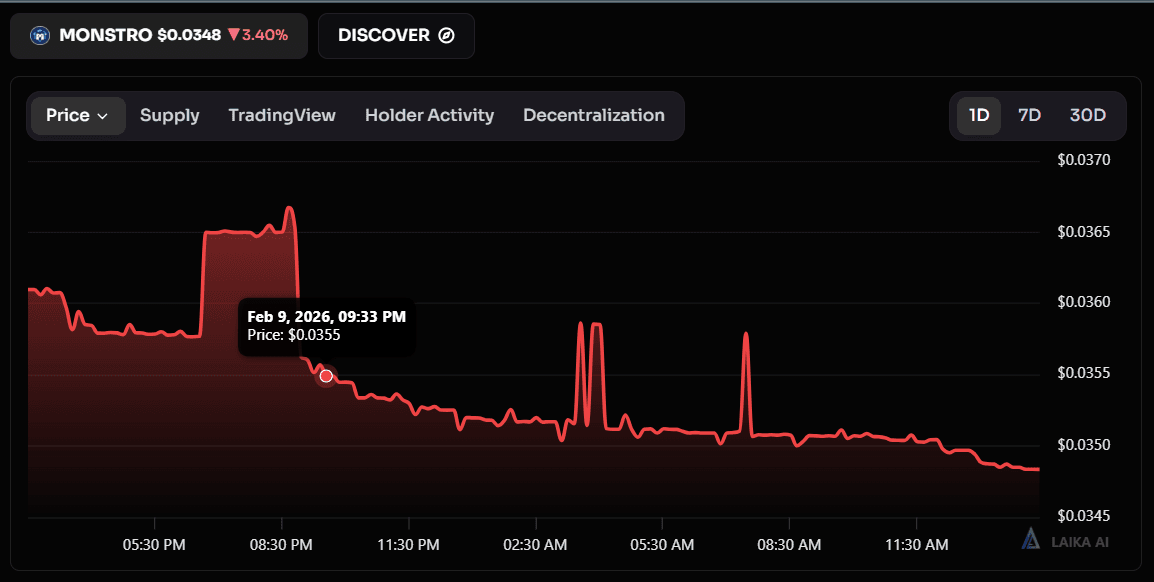
What is MONSTRO token's current price?
MONSTRO trades around $0.044 (February 2025) with $8.2M market cap. Price has recovered 124% over six months but remains -31% from launch. 24-hour volume averages $420K across PancakeSwap, Uniswap, and smaller exchanges.
Where can I buy a MONSTRO token?
Purchase on decentralized exchanges (PancakeSwap on BSC, Uniswap on Ethereum, QuickSwap on Polygon) or centralized exchanges (MEXC, Gate.io). Recommended route: PancakeSwap via BSC for lowest fees and highest liquidity. It requires a crypto wallet like MetaMask.