Monero (XMR) stands as the last true bastion of financial privacy in an increasingly transparent and surveilled digital world. While 2025 was marked by intense regulatory pressure, including widespread delistings from centralized exchanges such as Binance and Kraken across parts of Europe, it was also the year Monero proved its structural resilience.
As the network enters 2026, Monero is no longer positioned as a speculative privacy coin. It has matured into a hardened, privacy-by-default financial utility. With the successful rollout of the Cuprate node implementation and the upcoming FCMP++ (Full-Chain Membership Proofs) upgrade scheduled for Q1 2026, Monero is moving beyond probabilistic obfuscation toward mathematically provable untraceability.
What Is Monero?
Monero is a decentralized, open-source cryptocurrency built for privacy, fungibility, and censorship resistance. Unlike Bitcoin, where transaction histories, wallet balances, and payment flows are publicly visible, Monero ensures that:
- The sender remains hidden
- The receiver remains hidden
- The transaction amount remains hidden
Privacy in Monero is mandatory, not optional. Every transaction uses the same cryptographic protections, creating a single, uniform anonymity set across the entire network.
Why Monero (XMR) in pumping in January 2026?
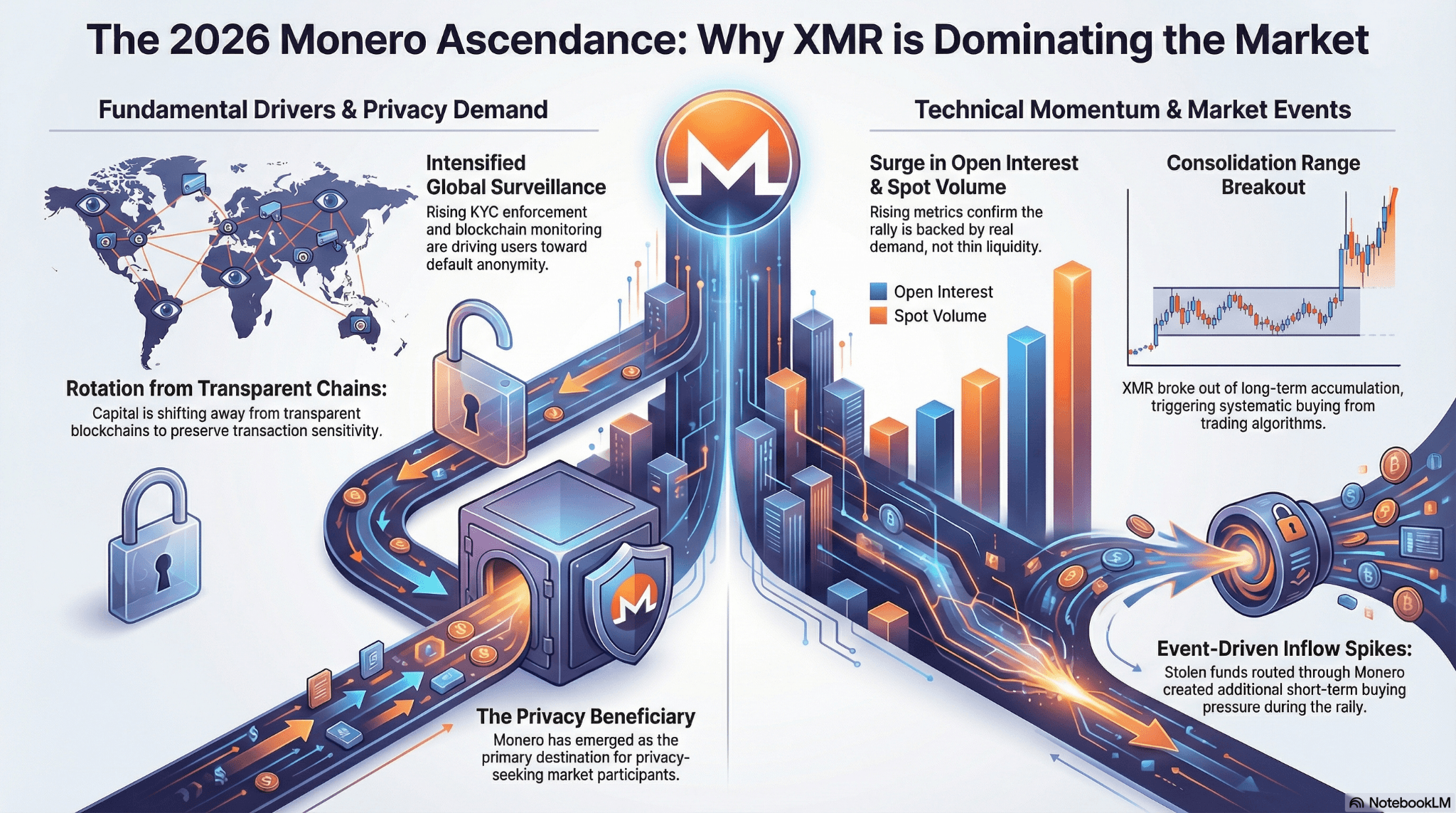
Monero (XMR) has been pumping in January 2026 due to a convergence of structural demand, market events, and technical momentum, rather than a single short-term catalyst. As global regulators intensify surveillance, KYC enforcement, and blockchain monitoring, traders and capital have increasingly rotated toward privacy-preserving assets. Monero, with its default anonymity and long-standing infrastructure, has emerged as the primary beneficiary of this shift, especially as transparent chains become less attractive for sensitive transactions.
At the same time, XMR broke out of a prolonged consolidation range, triggering systematic buying from traders, algorithms, and momentum-driven funds. Open interest and spot volumes rose in tandem, confirming that the move was supported by real demand rather than thin liquidity. The rally was further accelerated by a high-profile on-chain security incident where stolen funds were partially routed through Monero, creating additional short-term buying pressure in already tight markets.
Key drivers behind the move:
- Rising demand for on-chain privacy amid regulatory tightening
- Technical breakout from long-term accumulation zones
- Event-driven inflows amplifying an existing uptrend
Together, these factors explain why XMR has outperformed much of the broader crypto market in early 2026.
The 2026 Technological Pillars of Monero
FCMP++ (Full-Chain Membership Proofs)
Scheduled for Q1 2026, FCMP++ is Monero’s most important cryptographic upgrade since RingCT. It replaces traditional ring signatures with advanced membership proofs, expanding the anonymity set from a small group of decoys to nearly the entire blockchain.
This makes chain analysis and correlation attacks computationally impractical, pushing Monero closer to absolute transaction untraceability.
Cuprate Node Implementation
Launched in late 2025, Cuprate is a high-performance, Rust-based rewrite of the Monero node software.
Key improvements include:
- Initial blockchain sync times reduced by more than seven times
- Full nodes running on consumer-grade laptops in under 16 hours
- Lower hardware requirements, strengthening decentralization
Seraphis and Jamtis Upgrade
Currently in the final testing phase, Seraphis modernizes Monero’s transaction structure, while Jamtis introduces human-readable addresses.
Together, these upgrades:
- Improve wallet usability
- Reduce user error
- Make Monero easier to use for non-technical holders
Core Use Cases: Sovereignty Over Surveillance
In 2026, Monero has become the primary tool for individuals and communities that treat privacy as a fundamental right rather than a niche feature.
1. Circular Economies and Peer-to-Peer Commerce
As centralized payment processors expand monitoring and censorship, Monero adoption has grown in peer-to-peer markets worldwide. Merchants increasingly accept XMR for digital services, physical goods, and freelance work, drawn by low fees, fast confirmations, and privacy guarantees.
Monero functions as private digital cash in environments where surveillance has become the default.
2. Atomic Swaps and Trustless Liquidity
Following the delisting of XMR from major exchanges in 2024 and 2025, Monero liquidity shifted away from centralized platforms. Atomic swaps now allow users to exchange BTC or ETH for XMR directly from their wallets, without intermediaries or custody risk.
This ensures Monero remains liquid even behind regulatory barriers.
3. Fungibility and Protection Against Tainting
On transparent blockchains, coins can be blacklisted based on past transaction history. Monero eliminates this risk entirely. Because all XMR coins are indistinguishable, no coin can ever be flagged, censored, or discriminated against.
Fungibility is not a feature in Monero. It is the default.
4. Decentralized Mining with RandomX v2
With the January 2026 rollout of RandomX v2, Monero remains one of the few cryptocurrencies optimized for CPU mining.
RandomX v2:
- Favors consumer CPUs such as AMD Ryzen and Intel i9
- Maintains resistance to ASIC mining
- Keeps network security distributed among individuals rather than industrial farms
Market Performance and Financials
After gaining 119 percent in 2025, Monero has spent recent weeks consolidating below a major resistance level.
| Metric | Value |
|---|---|
| Market Capitalization | $8.3 Billion |
| Circulating Supply | 18.45 Million XMR |
| 24-Hour Trading Volume | $195 Million |
| Annual Inflation | Below 1 percent (tail emission of 0.6 XMR per block) |
Monero’s tail emission ensures miners are always incentivized to secure the network, avoiding the long-term security budget problem faced by Bitcoin. Explore Live Pricing and other Key financials here
Advantages, Risks, and Challenges
Advantages
- Mandatory privacy: Stronger and more consistent anonymity than opt-in privacy models such as Zcash or Dash
- ASIC resistance: Home mining remains viable
- Tail emission: Guarantees perpetual network security
Risks
- Exchange accessibility: Limited fiat on-ramps reduce ease of entry for retail users
- Regulatory stigma: Privacy coins continue to face political and regulatory hostility
Challenges
- Usability barrier: Running nodes and managing wallets still require technical familiarity
- Transaction size: Privacy increases data overhead, though Bulletproofs++ (expected late 2026) aims to reduce transaction sizes by roughly 30 percent
Monero Price Outlook: 2026 to 2030
2026 Outlook
If Monero breaks and holds above the $500 resistance level, technical extensions suggest a move toward previous highs.
- Target Range: $520 to $760
- Key Catalysts: FCMP++ activation and user-friendly atomic swap interfaces
2027–2028 Outlook
As central bank digital currencies expand globally, demand for private settlement is expected to increase.
- Target Range: $830 to $1,250
- Driver: Privacy-preserving alternatives to state-monitored payment systems
2030 Long-Term Scenarios
- Conservative Case: $2,100
- Bullish Case: $4,300 or higher
This assumes Monero becomes the global standard for private digital settlement, comparable to physical cash in the digital economy.
The Bottom Line
Monero has evolved from a niche privacy experiment into a foundational layer of digital sovereignty. In 2026, the question is no longer whether Monero can survive regulation, but whether any other blockchain can offer the same level of financial freedom.
By choosing cryptographic certainty over compliance and decentralization over convenience, Monero has built a moat that is extremely difficult to replicate.
If privacy is a right and not a crime, Monero is not optional.
Frequently Asked Questions
1. Is Monero completely anonymous?
Monero provides the strongest on-chain privacy available, but real-world anonymity still depends on user behavior. For example, withdrawing XMR directly from a KYC exchange links identity at the entry point.
2. What is Monero’s tail emission?
Monero permanently issues 0.6 XMR per block, ensuring miners are always incentivized and network security never degrades.
3. Can governments crack Monero?
Despite multiple bounties from organizations such as the Internal Revenue Service, there is no public evidence that Monero’s core privacy mechanisms have been compromised.
4. Is Monero legal to use?
In most jurisdictions, owning and using Monero is legal. Restrictions typically apply to exchanges and payment processors rather than the protocol itself.
Disclaimer: This article is provided for informational purposes only and should not be considered financial or investment advice. Always do your own research before engaging with cryptocurrencies or digital assets.