You have probably used dollars thousands of times, but have you ever wondered what actually makes that piece of paper in your wallet valuable? Or why does the US dollar dominate global finance when plenty of other countries have their own currencies?
Let me break down how the dollar system really works, without the confusing economic jargon.
What Makes a Dollar Worth Anything?
Here's something that trips people up: modern US dollars aren't backed by gold, silver, or anything physical. The last connection to gold ended in 1971. So what gives it value?
Three main things:
Government backing - The US Treasury issues currency, and the government accepts it for taxes. That creates automatic demand.
Trust and stability - People believe dollars will hold value tomorrow, next month, and next year. This confidence is huge.
Network effect - Because everyone accepts dollars, everyone wants dollars. It's a self-reinforcing cycle.
Think of it like this: a dollar is valuable because we all agree it's valuable. Sounds circular, but that's how all modern money works.
https://x.com/GoldTelegraph_/status/2016708055501865406?s=20
The Federal Reserve: The Dollar's Control Center
The Federal Reserve (the Fed) sits at the heart of the dollar system. Despite what some people think, it's not a private company or a government agency in the traditional sense. It's a hybrid created by Congress in 1913.
Here's what the Fed actually does:
Controls the money supply - The Fed can create new money or take money out of circulation. They do this mainly by buying and selling government bonds, not by literally printing cash.
Sets interest rates - When you hear about "the Fed raising rates," they're adjusting the cost of borrowing money throughout the economy. Higher rates generally slow things down; lower rates speed things up.
Regulates banks - The Fed watches over banks to make sure they're not taking crazy risks with your deposits.
The Fed walks a tightrope. Too much money creation leads to inflation. Too little causes unemployment and stagnation. They're constantly adjusting, trying to keep the economy stable.
How Dollars Move Through the Banking System
When you deposit cash at your bank, something interesting happens. The bank doesn't just stick that money in a vault. They're required to keep only a fraction (historically around 10%, though this has changed) and can lend out the rest.
Let's say you deposit $1,000. The bank keeps $100 and lends someone else $900. That person spends the $900, and it gets deposited in another bank. That bank keeps $90 and lends out $810. This keeps going.
Your original $1,000 has now become several thousand dollars in the economy. This is called fractional reserve banking, and it's why banks can fail. If everyone tries to withdraw money at once, they literally don't have it all.
The International Dollar System
Here's where things get really interesting. About 60% of foreign currency reserves worldwide are in US dollars. Why?
Oil is priced in dollars - If you're Japan and need to buy oil from Saudi Arabia, you need dollars for that transaction. This creates constant global demand.
International trade standard - Even if two countries are trading with each other, they often use dollars as the middle currency because everyone trusts it.
Haven - When things get shaky globally, investors buy US Treasury bonds (essentially IOUs from the US government). This is considered one of the safest investments on Earth.
This global dominance gives the US enormous advantages. We can borrow money more cheaply than anyone else. We can print dollars to pay for things, and the whole world absorbs some of the inflation.
Digital Dollars: How Most Money Actually Exists
Here's a mind-bender: only about 10% of US dollars exist as physical cash. The rest? Just numbers in computer systems.
When you check your bank balance on your phone, you're looking at digital records, not actual bills sitting somewhere. When you buy something with a credit card, money moves between accounts electronically, no physical dollars involved.
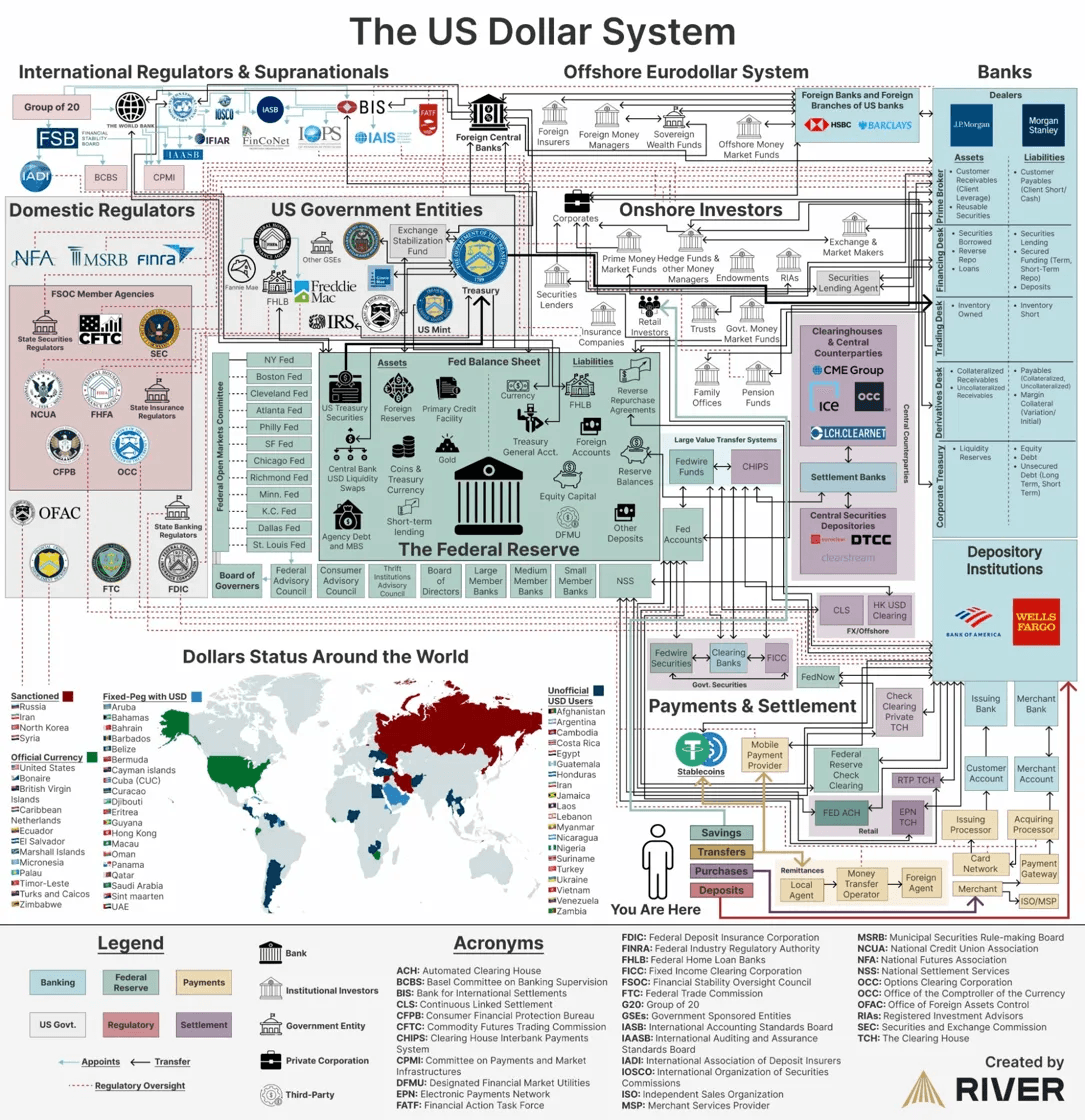
The payments infrastructure behind this is massive. Systems like Fedwire, CHIPS, and ACH move trillions of dollars daily. Credit card networks like Visa and Mastercard process countless transactions. Settlement happens through a complex web of clearinghouses and central depositories.
Your experience is simple: tap your card, payment goes through. Behind the scenes, a dozen different institutions are communicating to make that work.
Who Actually Creates Dollars?
This confuses people, so let's clarify:
Physical currency - The Bureau of Engraving and Printing makes paper money. The US Mint makes coins. But remember, this is only about 10% of the total dollars.
Digital money - The Federal Reserve creates the majority of new dollars through monetary policy. When the Fed buys government bonds from banks, it pays with newly created digital dollars. Just like that, new money exists.
Bank lending - Through fractional reserve banking, commercial banks effectively create money when they make loans.
So money creation happens at multiple levels, which is why "printing money" is actually a misleading phrase for what modern central banks do.
What Controls the Dollar's Value?
Several forces are constantly pushing and pulling on the dollar's worth:
Supply and demand - More dollars in circulation generally means each one is worth less. Less supply means more value per dollar.
Interest rates - Higher US interest rates attract foreign investment, increasing demand for dollars and pushing up the value.
Economic strength - When the US economy is strong, the dollar usually strengthens. People want to invest in growing economies.
Inflation - Rising prices erode purchasing power. What costs $1 today might cost $1.05 next year if inflation is 5%.
Global events - Wars, pandemics, financial crises—these drive people toward or away from the dollar depending on circumstances.
The Dollar's Achilles Heel: Debt
The US government has borrowed over $35 trillion. That's money the Treasury has to pay back (with interest). This debt is mostly in the form of Treasury bonds held by investors worldwide.
Some people worry that this debt will destroy the dollar. Others point out that:
The debt is in dollars that the US can print
Most debt is owned to Americans, not foreign countries
As long as the US economy keeps growing, the debt is manageable
The real risk isn't default, it's inflation. If the government tried to inflate away the debt by printing tons of money, the dollar's value would plummet.
Why the Dollar Dominates (For Now)
The dollar's global position isn't guaranteed forever. China is pushing its yuan for international trade. The euro is a major currency. Cryptocurrencies are challenging traditional money concepts.
But the dollar has serious advantages:
Deep, liquid financial markets
Rule of law and property rights in the US
Military and diplomatic power backing it up
Decades of institutional infrastructure
No viable replacement that everyone trusts
Could another currency overtake the dollar? Maybe eventually, but it would require massive shifts in global power and trust.
What This Means for You
Understanding how the dollar works helps you make better financial decisions:
Inflation matters - Your dollars lose purchasing power over time, which is why keeping everything in cash is risky.
Interest rates affect you - Whether you are getting a mortgage, car loan, or credit card, Fed policy directly impacts the rates you pay.
Global events hit your wallet - That war across the world or trade dispute can affect your job, investments, and prices at the store.
Banking isn't risk-free - Your deposits are insured (up to $250,000 per account), but the fractional reserve system means banks can fail.
The Bottom Line
The US dollar is a fascinating system built on trust, government backing, and global acceptance. It's not backed by gold or anything tangible; it's backed by the full faith and credit of the United States and the collective belief of billions of people worldwide.
That dollar in your pocket represents participation in one of the most complex financial systems ever created, involving everyone from the Federal Reserve to your local bank to international clearinghouses processing trillions daily.
It's a system that's evolved over centuries and continues to adapt. Whether it'll look the same in 50 years is anyone's guess, but for now, the dollar remains the undisputed king of global currency.
Understanding this system won't make you rich overnight, but it will help you navigate an economy where money, despite being mostly digital and unbacked by gold, somehow still works every single day.