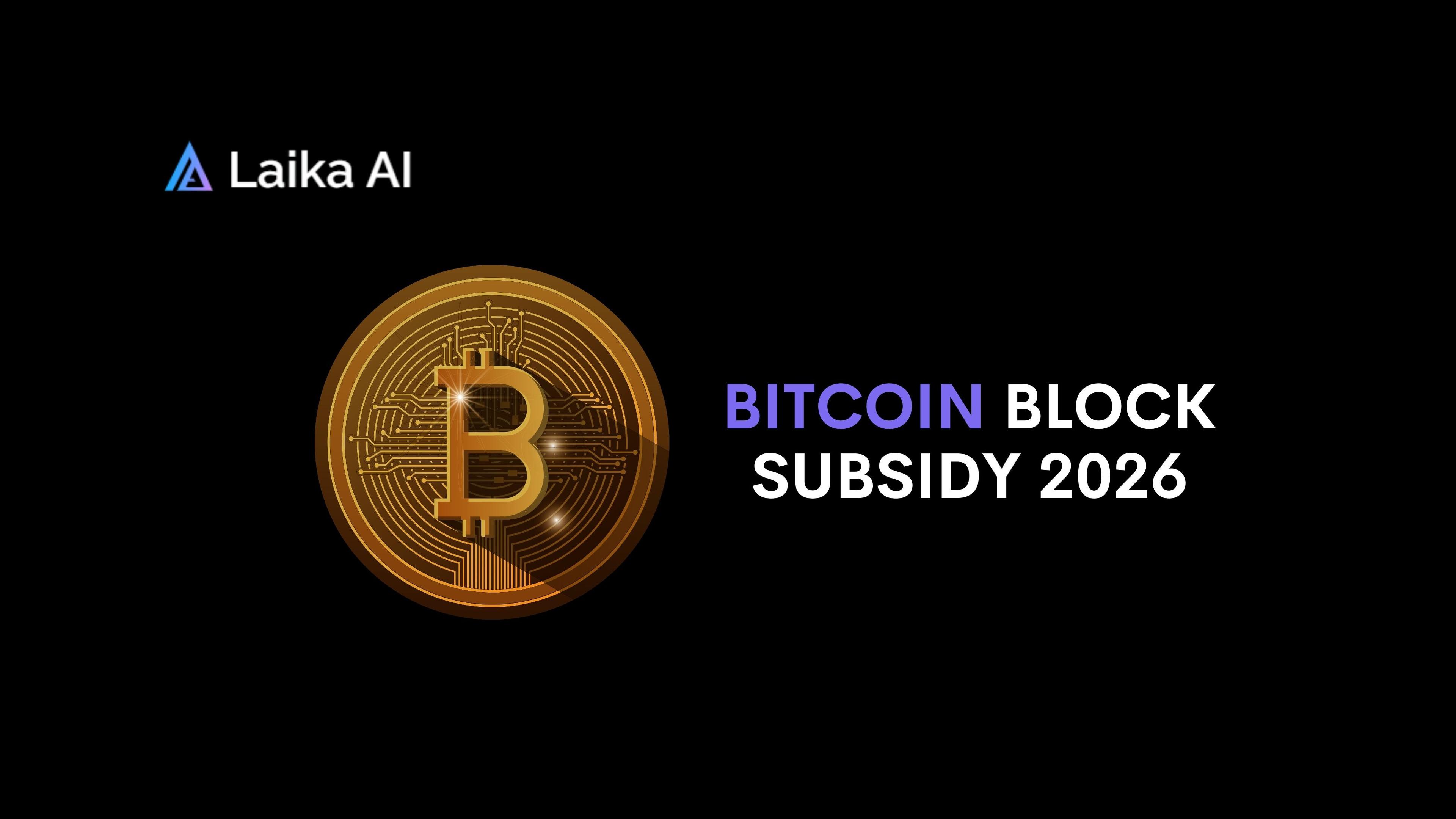
As we navigate the first quarter of 2026, Bitcoin has matured from a speculative experiment into a foundational institutional asset. Two years post-halving, the Bitcoin block subsidy 2026 stands at a lean 3.125 BTC, signalling a permanent shift in network equilibrium. For strategic investors and mining professionals, it's not about a lower Bitcoin block reward; it is a reckoning of efficiency and supply-side scarcity. In this report, we analyze how the current issuance rate is tightening the "digital gold" narrative, forcing a technological arms race in the mining sector and redefining risk-adjusted returns for the modern portfolio.
What Is the Bitcoin Block Subsidy?
To understand 2026, we must define the engine. The Bitcoin block subsidy is the amount of newly minted Bitcoin awarded to a miner who successfully solves a block. It is the primary incentive that secures the network.
Definition: The "subsidy" is the inflation component of the total block reward.
Total Block Reward: Block Subsidy + Transaction Fees.
Why it exists: It serves as a decentralized distribution mechanism, ensuring new coins enter circulation without a central bank, while simultaneously paying for the network's security (hashrate).
As we move toward the final 21 million BTC, the subsidy is designed to decay, shifting the responsibility of paying for security from the protocol (inflation) to the users (fees).
Bitcoin Block Subsidy Timeline: Leading to 2026
Bitcoin's issuance follows a strict, pre-programmed schedule for every 210,000 blocks (roughly every 4 years), and the subsidy is halved.
Bitcoin Block Subsidy in 2026
If you are looking at the network today, here is the mathematical reality of Bitcoin issuance in 2026.
Exact Block Subsidy: 3.125 BTC per block.
Daily BTC Issuance: Approx. 450 BTC per day (assuming 144 blocks/day).
Annual Issuance: Roughly 164,250 BTC per year.
Inflation Rate: The annual inflation rate is now well below 1% (approx. 0.84%), significantly lower than almost every fiat currency and even most central bank targets.
How the 2024 Halving Shapes 2026
The 2024 halving was a watershed moment. While the 2020 halving was characterized by retail "hype," the 2024 transition was the era of institutional absorption.
By 2026, we see the clear effects of this transition:
Supply Scarcity: With only 450 new BTC entering the market daily, the "demand wall" created by spot ETFs and corporate treasuries has made the market highly sensitive to supply.
Fee Market Maturity: Because the subsidy is lower, miners have become more dependent on transaction fees. Innovations like Ordinals and Layer 2 scaling solutions have become critical for keeping miner revenue sustainable during periods of low price volatility.
Security Resilience: Despite the subsidy being cut in half, Bitcoin's hashrate reached record highs in late 2025, proving that the network can remain secure even as the "inflation payment" shrinks.
For a deeper dive into how operational dynamics shifted specifically for miners during this period, see our analysis on Bitcoin mining 2026 after halving.
Miner Economics in 2026
Mining in 2026 is no longer a hobby; it is a cutthroat industrial arms race. With the block subsidy reduced to 3.125 BTC, the "hashprice" (the value of computing power) has tightened significantly.
Profitability Pressures: Miners with electricity costs above $0.07/kWh have largely been priced out. The winners in 2026 are those with "stranded" energy or high-efficiency ASIC miners (operating at <20 J/TH).
Consolidation: We have seen significant consolidation, where public mining companies are acquiring smaller farms to benefit from economies of scale.
AI Pivot: Interestingly, many miners in 2026 have retrofitted their data centers to host AI workloads alongside Bitcoin mining, using the AI revenue to subsidize their Bitcoin operations during bearish months.
Investors looking for real-time data on these shifts can utilize our specialized BTC crypto Bitcoin analysis tool to track on-chain signals.
Common Questions (FAQ)
1. What will the Bitcoin block reward be in 2026?
The block subsidy remains 3.125 BTC. The total reward will be slightly higher once you add the transaction fees collected in each block.
2. Is Bitcoin still inflationary in 2026?
Yes, but minimally. The inflation rate is approximately 0.8%, which is lower than that of gold. It will remain inflationary until roughly the year 2140.
3. Do miners still earn enough from subsidies in 2026?
For efficient miners, yes. However, the subsidy now accounts for a smaller portion of their total potential revenue compared to cycles a decade ago.
4. Will halvings continue after 2026?
Yes. The next halving is expected in April 2028, when the subsidy will drop to 1.5625 BTC.
Still have questions about how the 2028 halving will impact your specific setup? Ask the Laika AI Chatbot for a personalized profitability breakdown.
Conclusion
The Bitcoin block subsidy in 2026 is a signal of a maturing network. We are witnessing the gradual transition from a "growth-through-inflation" phase to a "security-through-utility" phase. As the subsidy continues its programmed decline, the value of the underlying asset and the robustness of the fee market will determine the network's future.
In 2026, the scarcity is real, the miners are efficient, and the protocol remains as predictable as ever. Understanding this issuance schedule is the first step in understanding why Bitcoin remains the world's premier digital reserve asset.
Disclaimer: The information provided in this blog is for educational purposes only and does not constitute financial, investment, or legal advice. Cryptocurrency mining and investing involve significant risk. Always conduct your own research before committing capital to the crypto market.