Tokenized stocks are blockchain-based tokens that track the price of a real, publicly traded share, and where to buy tokenized stocks depends almost entirely on where you live. Most of the platforms in this comparison explicitly exclude US residents. That single fact trips up more readers than any fee or catalog size ever will, so it's stated here first rather than three platforms into the article.
Kraken's xStocks is the largest platform by volume for non-US traders. Dinari is the only regulated route open to US investors. Ondo Stocks and Coinbase round out the field with different tradeoffs on catalog size and shareholder rights, and this kind of platform fragmentation isn't unique to stocks either. Our own Q1 2026 analysis of institutional crypto adoption tracks the same pattern of big finance moving into on-chain products region by region rather than all at once.
What Tokenized Stocks Actually Are
A tokenized stock is a digital token that represents economic exposure to a real share. What that token actually entitles you to depends entirely on which of three backing models issued it, and that distinction is the part most comparison pages bury deep in the piece rather than explaining upfront.
Our own explainer on how tokenized stocks work covers the mechanics in more depth. Here's the short version, because it decides everything else in this article.
The Three Backing Models
- Broker-dealer and transfer-agent backed. The issuer is a registered broker-dealer that actually holds the underlying share and passes through real shareholder economics, including dividends and sometimes voting rights. Dinari's dShares work this way, and Coinbase's own tokenized stocks now follow a version of this model too, issued through a dedicated special purpose vehicle rather than Coinbase's main exchange entity.
- Certificate-backed, 1:1. The token is fully backed by a real share held by a custodian, giving you verified price exposure but no shareholder rights like voting. Kraken's xStocks and Binance's bStocks both use this structure.
- Derivative or debt-tracker contracts. The token is a contractual claim against the issuer that tracks the stock's total return rather than a direct transfer of a backed asset. Robinhood's Classic Stock Tokens, issued through Robinhood Assets Jersey Limited, are structured as tokenized debt redeemable for cash rather than as a claim on a share itself.
Ondo Stocks sits closer to the first model than most certificate-backed platforms. It wires shareholder voting rights through a Broadridge partnership into more than 250 of its tokenized stocks, a feature that separates it from Kraken and Robinhood on that specific point.
Platform-by-Platform Breakdown
Kraken (xStocks): Best Overall for Non-US Traders
Kraken's xStocks platform has grown from 60 tokenized assets at its June 2025 launch to 100 as of March 2026, with a stated goal of expanding past 500 by the end of 2026. The platform has crossed $25 billion in cumulative transaction volume, including $3.5 billion in on-chain trading across Solana, Ethereum, and TON, and counts more than 80,000 unique on-chain holders.
Each xStock is issued by Backed Assets (JE) Limited under a Liechtenstein prospectus regulated by the FMA, a Jersey entity now part of the Kraken group, and is fully backed 1:1 by the underlying stock or ETF held by a licensed custodian. Trading carries no stated commission when buying with USD or USDG, though a spread still applies on execution, and tokens can be withdrawn to self-custody wallets rather than staying locked on the exchange, a real differentiator from Robinhood below.
Kraken does not offer xStocks to residents of the United States, United Kingdom, Canada, or Australia. The product is available in more than 110 other countries.
Robinhood EU: Best for Catalog Breadth, Worst for Portability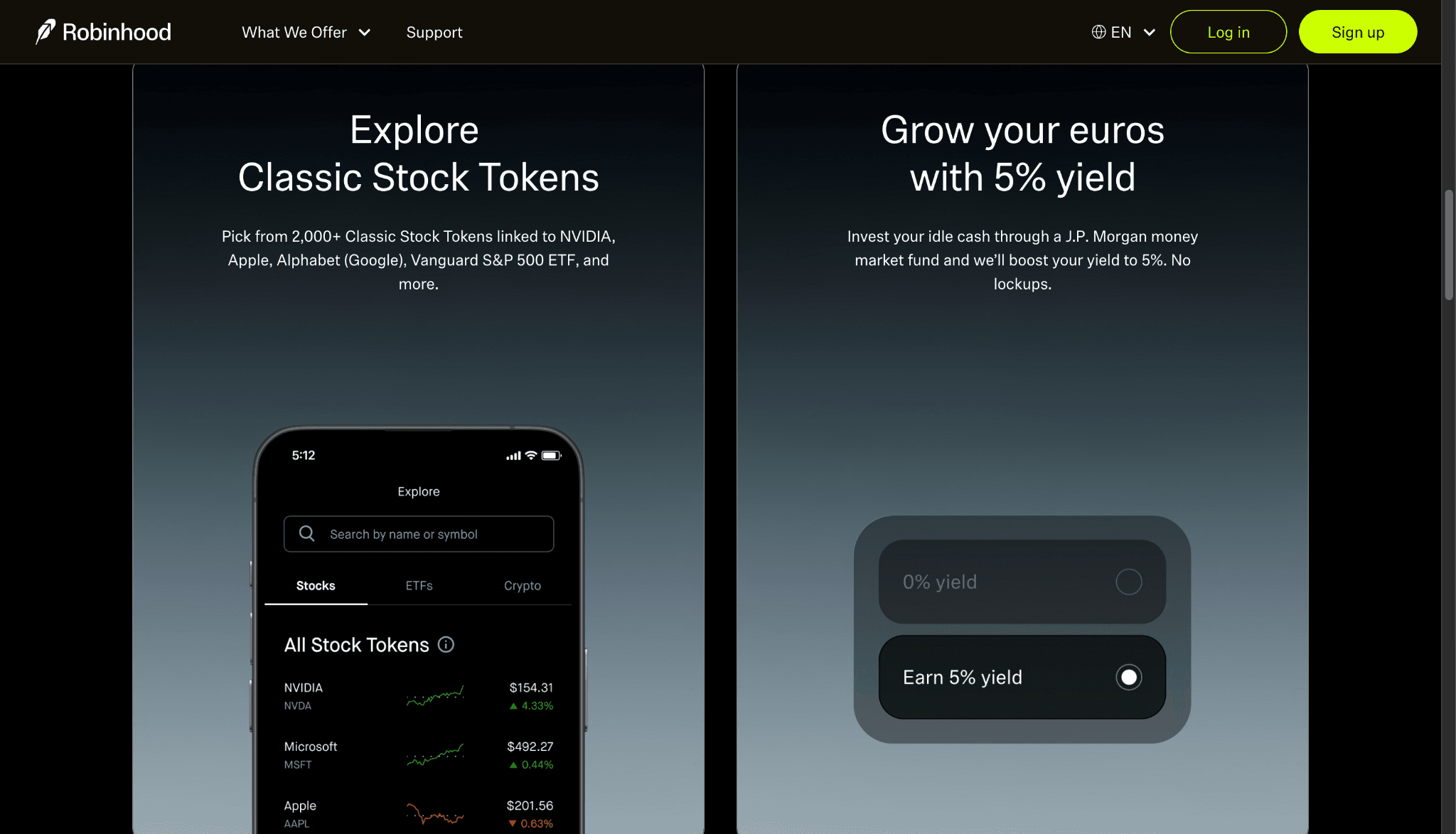
Robinhood's Classic Stock Tokens launched at a Cannes event on June 30, 2025 with more than 200 tokenized US stocks and ETFs, and the catalog has since expanded to more than 2,000 names, the broadest of any platform in this comparison. Entry starts at €1, and the tokens trade through Robinhood Europe UAB.
The structure matters here more than the size of the catalog. These tokens are issued as tokenized debt redeemable for cash rather than as a direct claim on a share, and Robinhood's own product documentation, reviewed as of August 20, 2026, states the tokens do not support transfers to an external wallet. That's a meaningful gap next to Kraken's self-custody support, and it's a detail most roundups leave out entirely. Robinhood charges no per-trade commission, but a 0.10% FX fee applies, rising to 0.30% on conversions completed during a narrow Friday evening window. The product is available across roughly 30 EU and EEA countries and is not offered to US residents. If you're deciding between this and Kraken specifically, our full breakdown of Robinhood's tokenized stocks in the EU covers the dividend handling and the OpenAI and SpaceX private-token episode that drew regulatory attention to the product.
Dinari (dShares): The Only Regulated Route for US Investors
Dinari is a Delaware-registered transfer agent and FINRA member broker-dealer, and that specific regulatory combination is what lets it sell tokenized US stocks directly to US persons, something none of the other major platforms in this piece can currently do. Dinari launched 724 tokenized US stocks on August 4, 2026, including the entire S&P 500, funded by USDC through a Circle partnership.
Dinari's dShares preserve traditional shareholder rights more fully than most competitors, including voting rights and native USDC dividend payments, since the company actually acquires the underlying securities in a custodial brokerage account on your behalf. The dShares catalog is also available in more than 85 jurisdictions outside the US, and unlike Robinhood's product, Dinari's tokens are built for on-chain transfer.
Ondo Stocks: Largest On-Chain Value, Broadridge Voting Rights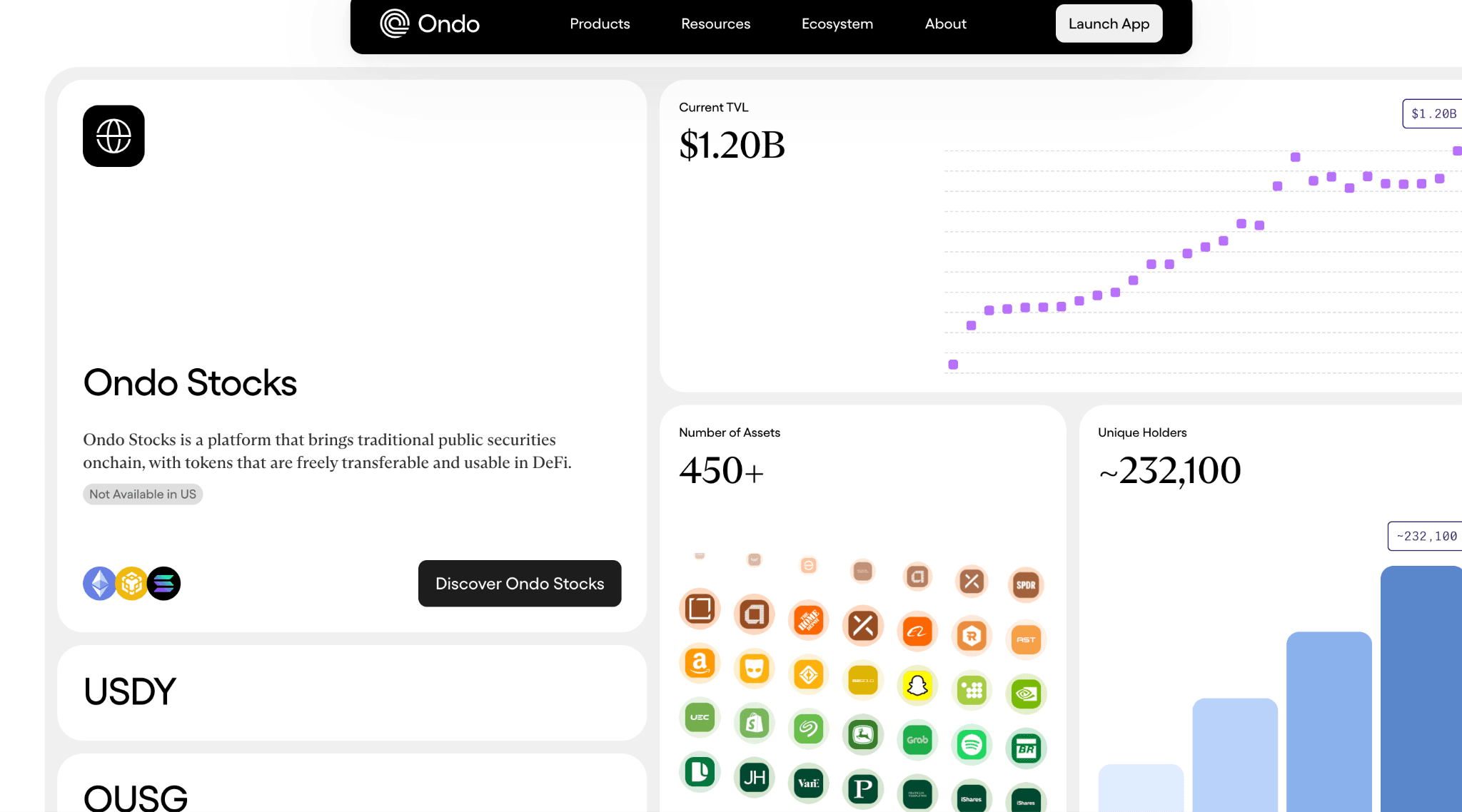
Ondo Stocks, previously called Ondo Global Markets, launched in September 2025 and now offers tokenized exposure to hundreds of US-listed stocks and ETFs. Every token is fully backed and collateralized by the corresponding share, and tokens can be redeemed to stablecoins for the underlying asset's cash value whenever redemption windows are open.
What separates Ondo from Kraken and Robinhood is the voting-rights structure covered above. Several exchanges, including MEXC, distribute Ondo-powered tokens at 0% stated trading fees, similar to Kraken's pricing.
Coinbase: Newest Entrant, Non-US Only So Far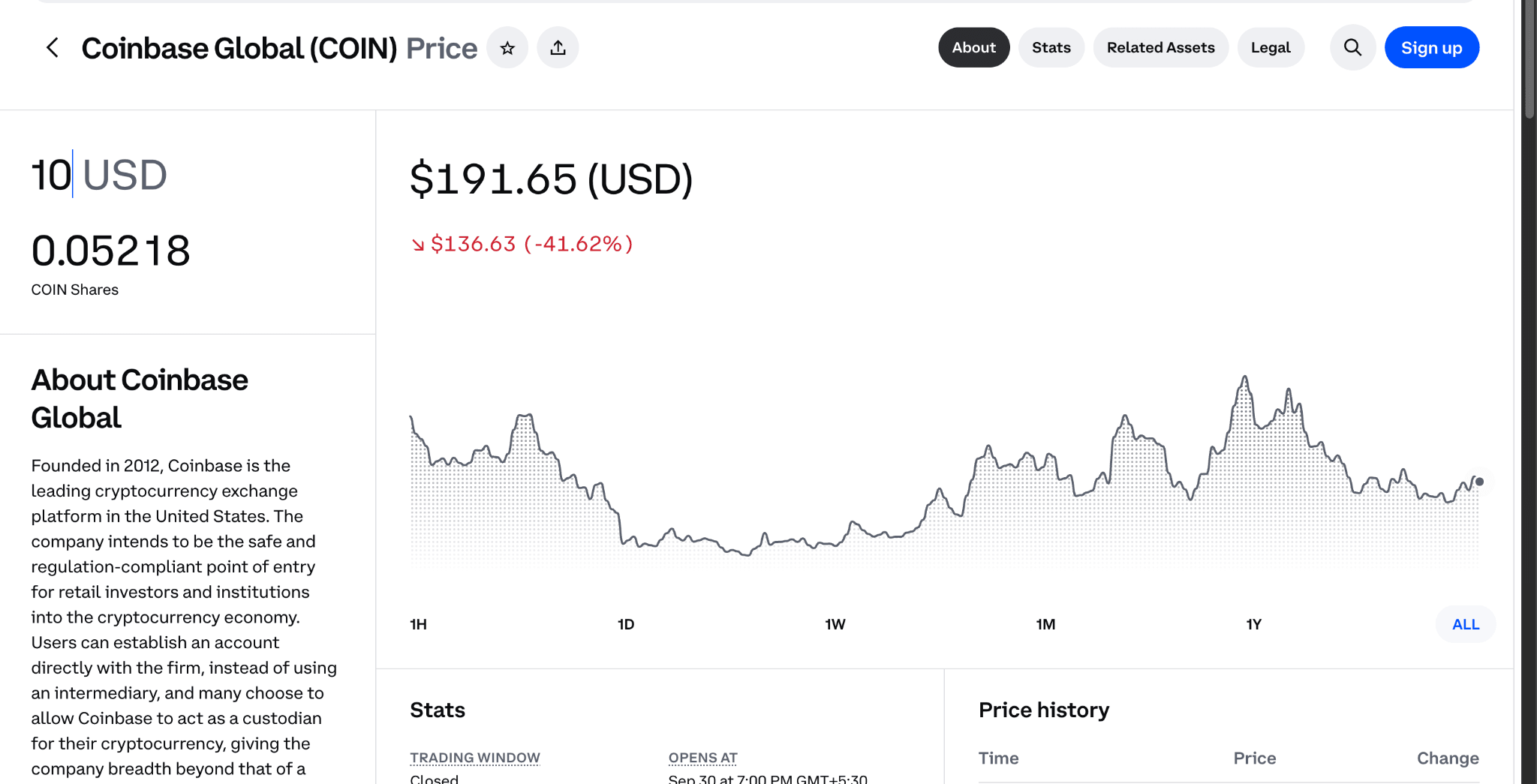
Coinbase debuted tokenized US stocks on its own Base network on August 24, 2026, starting with four tickers: Nvidia, Apple, Meta, and Alphabet. The catalog doubled to ten tickers by September 4, 2026, and the exchange has said more will follow. Trading volume crossed $1 billion within the product's first month, according to reporting from late September 2026.
The issuing entity is Coinbase Onchain SPV Ltd, incorporated in the Abu Dhabi Global Market in June 2026, and tokens are built on Base's B20 standard with no whitelist required to move them between wallets once minted. That no-whitelist design is closer in spirit to Kraken's self-custody model than to Robinhood's locked tokens, even though Coinbase's underlying backing structure leans toward the broker-dealer model. The product remains limited to non-US users for now.
Gemini: Best for EU Traders Who Want a Dinari-Backed Route
Gemini gives EU users access to tokenized US stocks through its Malta arm, regulated by the MFSA. The tokens themselves are Dinari-issued dShares recorded on Arbitrum, so Gemini functions as a distribution channel for Dinari's model rather than running its own separate backing structure. If a Gemini account is already part of your setup, it's worth knowing the exchange runs other on-chain markets too. Our review of Gemini's prediction markets product covers whether that's worth adding to the same account.
Binance (bStocks): Broad Catalog, Not Yet in the EU
Binance's bStocks are bought and sold through broker Alpaca, which also provides custody for assets underlying Ondo Stocks and xStocks. Binance advertises access to thousands of underlying securities, tokenized on demand, but bStocks are not currently available to EU users.
Comparison Table
Risks Specific to This Category
- No shareholder rights on most certificate-backed tokens. Kraken's xStocks and Robinhood's Classic Stock Tokens give you price exposure, not a vote or a direct legal claim on the company. Dinari and Ondo are the exceptions that preserve more of those rights.
- Regulatory uncertainty is still resolving in real time. The SEC issued formal guidance on tokenized securities on January 28, 2026, and the New York Stock Exchange announced its own tokenized securities platform plans on January 19, 2026, both signs that the framework governing this category is still being built rather than settled.
- Platform geofencing changes without much notice. Kraken's exclusion list, Robinhood's country list, and Coinbase's non-US-only rollout have all shifted as each company adjusts to local rules, so access you have today isn't guaranteed to stay that way.
- Portability varies more than most comparisons admit. Robinhood's tokens can't move to an external wallet at all, while Kraken, Dinari, and Coinbase all support some form of self-custody. That difference matters as much as fees for anyone planning to hold rather than actively trade.
- Smart contract and custody risk sit underneath every token. Before buying into any platform's tokenized stock, auditing the underlying smart contract is the same due-diligence habit worth applying here as anywhere else in crypto.
What US-Based Readers Can Actually Do Right Now
Dinari is currently the only platform in this comparison open to US persons directly, following its August 4, 2026 launch of 724 tokenized US stocks funded through USDC. That access, combined with preserved voting rights and dividend payments, makes it the practical starting point for a US reader rather than a compromise pick.
Coinbase's own tokenized stocks, while built by a US company, remain limited to non-US users as of this writing, and Kraken, Robinhood, and Binance all exclude US residents from this specific product regardless of whether you already hold an account with them for ordinary crypto trading. If Coinbase's broader product lineup interests you, our look at Coinbase's own prediction markets covers a different on-chain product the exchange has opened up in the same window as its tokenized stock launch.
If you're holding any of these tokens for the long term rather than trading them actively, a hardware wallet comparison is worth reading before you decide where self-custody makes sense, especially since Robinhood's own tokens don't give you that option at all.
Bottom Line
For most non-US readers, Kraken's xStocks is the strongest starting point on volume and self-custody support alone. For US readers, Dinari is currently the only regulated option, and it also happens to preserve more real shareholder rights than most of its non-US competitors.
Check your own country's access before comparing fees or catalog size, since that single filter eliminates most of this list for a large share of readers before anything else matters. And if portability matters to you as much as price, know going in that Robinhood's breadth comes with a real tradeoff: its tokens are the one product on this list you can't move off the platform.
For the fuller picture of Robinhood's specific infrastructure before comparing it against the rest, our explainer on Robinhood Chain and our piece on Robinhood Chain's stock tokens and 24/7 trading cover that platform's roadmap in more depth.
Frequently Asked Questions
Where can I buy tokenized stocks?
It depends on where you live. Non-US residents can buy through Kraken, Robinhood EU, Ondo Stocks, Gemini, or Binance, while US residents currently have one regulated option: Dinari, which launched 724 tokenized US stocks including the full S&P 500 on August 4, 2026.
Where is the best place to trade tokenized stocks?
For non-US traders, Kraken's xStocks leads on trading volume and catalog depth, having crossed $25 billion in cumulative transaction volume with more than 80,000 on-chain holders. For US traders, Dinari is currently the only regulated route available.
Is there a list of tokenized stocks available?
Yes, though it varies by platform. Kraken publishes its xStocks catalog directly on its own site, Dinari lists its 724 dShares including the full S&P 500, and Ondo Stocks maintains its own list on app.ondo.finance covering hundreds of names.
Are tokenized stocks safe?
Safety depends heavily on the backing model. Certificate-backed tokens like xStocks are fully collateralized by a Custodied share but carry no shareholder rights, while broker-dealer models like Dinari's preserve more traditional protections. Regulatory guidance is also still developing, with the SEC issuing formal guidance on tokenized securities only in January 2026.
Are tokenized stocks legal?
Yes, where properly regulated, though the rules differ sharply by jurisdiction and by issuer structure. Dinari operates as an SEC-registered broker-dealer and transfer agent to serve US investors legally, while Kraken's xStocks and Robinhood's tokens operate under separate non-US regulatory frameworks and explicitly exclude US residents as a result.