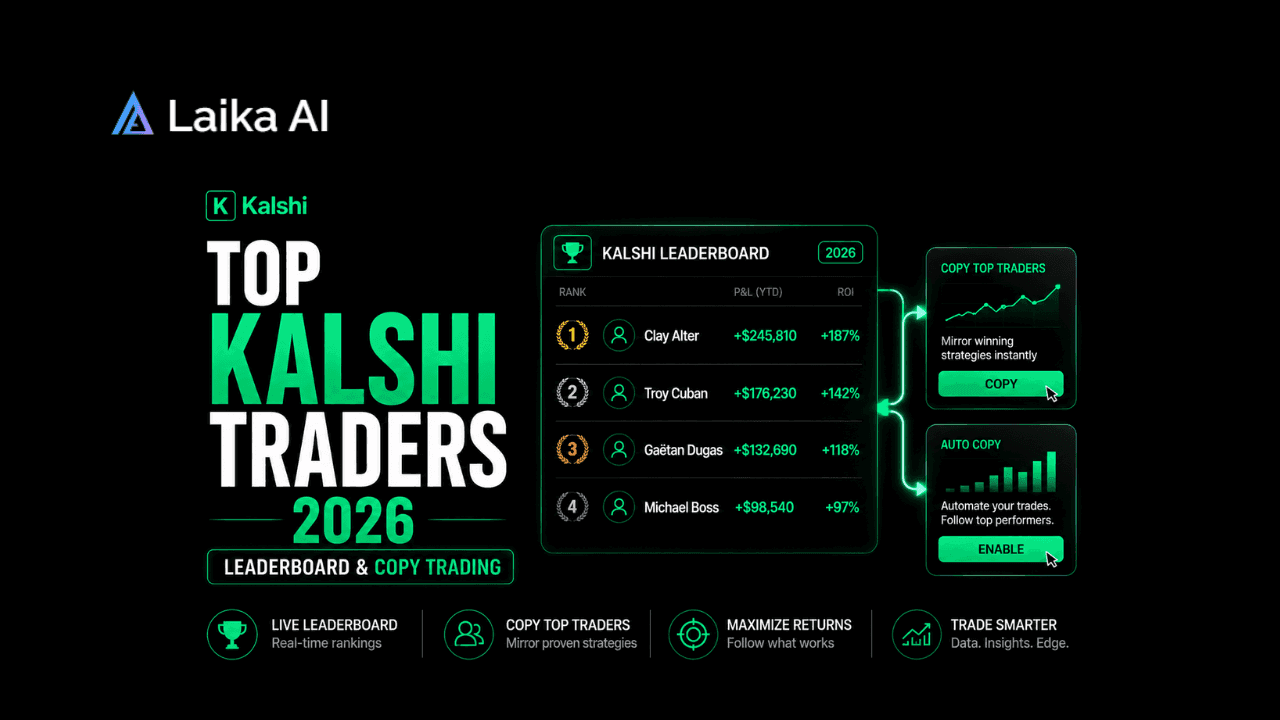
Somewhere on Kalshi right now, a trader with an anonymous handle is sitting on a six or seven-figure profit that anyone can see, and a real name that basically nobody can. That gap, visible numbers, hidden identity, is the whole story behind the Kalshi leaderboard, and it's also why "just copy the top trader" turns out to be a much messier idea on Kalshi than it sounds.
This piece covers how the leaderboard actually works, what its rankings can and can't tell you, what kind of strategies tend to show up near the top, and the honest state of copy trading on Kalshi in 2026, native and third-party both. If you're brand new to how a Kalshi contract prices before any of this leaderboard talk makes sense, How Does Kalshi Work? A Complete Beginner's Guide covers the fundamentals this article builds on.
What the Kalshi Leaderboard Actually Shows, and What It Doesn't
Here's the thing worth settling before anything else: a high rank on the kalshi leaderboard is not the same thing as skill, and pretending otherwise is how people lose money copying strangers. Kalshi's own help documentation describes the leaderboard as a feature that lets traders "track your trading performance and compete against other traders," with users automatically opted out by default and free to opt in whenever they like. That opt-in structure matters more than it first appears, since it means the leaderboard you see is a self-selected sample of traders willing to show their numbers publicly, not a full census of everyone active on the exchange.
That selection bias cuts in a specific direction. A trader who blew up their account quietly opts out, or never opted in to begin with. A trader riding a hot streak has every reason to stay visible. Add in the fact that Kalshi rankings can be filtered by narrow timeframes, daily and weekly windows included, and you get a leaderboard that's genuinely useful for spotting activity and specialization, but a poor tool for judging long-run skill on its own. A trader who nailed one high-volume election week can sit at the top of a weekly board without that result telling you anything about their next hundred trades.
Sample size is the other quiet problem. Prediction markets settle in binary outcomes, so a trader can go on a real streak through nothing but variance, the same way a coin can land heads eight times in a row without the coin being unfair. None of this means the leaderboard is useless. It means reading it the way you'd read a small sample of poker hand results: interesting, worth watching, not proof of an edge yet.
How to Read the Leaderboard
Kalshi's leaderboard sorts by a handful of criteria rather than one single number, and understanding which one you're looking at changes what the ranking actually means.
Timeframes stack on top of that: daily, weekly, monthly, yearly, and all-time views are all available, and switching between them can completely reshuffle who's on top. A trader dominating the daily volume board might be a market maker quietly running the same low-risk strategy hundreds of times a day, which looks nothing like the trader topping the yearly profit board off two or three large, correctly-timed political bets.
Visibility is opt-in on top of all that. Some accounts show a public handle and an avatar; others stay anonymous with a generic profile image, a distinction third-party monitoring tools have started flagging explicitly so researchers can separate "verified public trader" from "anonymous rank entry." That combination, opt-in participation plus a choice between staying anonymous or not, is worth keeping in mind every time a leaderboard screenshot circulates on social media as proof of someone's genius.
What Top Traders' Strategies Tend to Reveal
Kalshi doesn't publish trader identities or strategy breakdowns as an official leaderboard feature, so most of what's known about specific top traders comes from interviews and outside reporting rather than the platform itself. A handful of names have surfaced this way in 2026, and taken together they're a genuinely useful cross-section of what "winning" on Kalshi actually looks like in practice.
A few things stand out looking at this group as a whole rather than trader by trader. The split between solo operators and small firms is real and roughly even, Michael Boss and Gaëtan Dugas both describe themselves as individual, hands-on traders, while Jonathan Stall-Ryan and Samuel Wood-Solloff are running something closer to a small trading desk with staff and multi-platform positions. Speed is another dividing line. Boss's 60-trades-a-minute pace sits at one extreme, closer to market making than directional betting, while Gaëtan Dugas's approach, digging into a specific niche like music-chart data for an edge other traders aren't bothering to research, sits at the other. And then there's Brandon, a sixth-grade teacher earning six figures on the side, a reminder that this isn't exclusively a professional-trader phenomenon even though the biggest numbers on the list do skew toward people with a finance or quant background. For traders weighing whether to build the kind of infrastructure Stall-Ryan's firm runs on rather than trading manually the way Boss does, Kalshi FIX 4.4 Protocol for Algorithmic Traders: Complete Setup Guide covers the institutional-grade connection those setups actually use.
Kalshi's own market categories span Politics, Sports, Crypto, Economics, Companies, Science and Technology, and a category informally called "Mentions," the broadcast and speech-based markets covering whether a specific word gets said on air. Traders who consistently show up near the top of a single category tend to be running a repeatable edge in that narrow lane rather than a general market-beating instinct. A trader who dominates Mentions markets is likely running fast, disciplined reactions to live events. A trader who tops the yearly Politics board is more likely sitting on a smaller number of large, high-conviction positions held over weeks or months.
Volume leaders and profit leaders are frequently not the same accounts, and that split is itself instructive. A trader who moves tens of millions of dollars through the exchange without cracking the profit leaderboard is probably running thin-margin, high-frequency strategies, closer to market-making than directional betting. A trader with modest volume but outsized profit is the opposite: fewer trades, bigger conviction, more risk concentrated in each position. Neither approach is inherently better, they're just different games, and conflating them is one of the fastest ways to misread what a leaderboard rank is actually telling you.
Does Kalshi Support Copy Trading Natively?
No, and it's worth being direct about that rather than burying it. Per Kalshi's own account structure, trading on the platform is member-to-member and largely anonymous by design, there's no built-in follow or auto-copy feature, and no public trader identity page the way a brokerage social-trading product might offer. That's a meaningful structural difference from something like eToro, where copy trading is a first-party feature.
What exists instead is a layer of third-party tools built on top of Kalshi's public API, and the honesty of that layer varies a lot depending on who's building it. Kalshi's API documentation confirms programmatic access to your own orders, portfolio, and trade history, plus public market data like order books, through a REST API, with WebSocket streaming and a FIX 4.4 interface available for lower-latency, institutional-style connections. That's a real, developer-grade API. It just wasn't built to expose other users' strategies for copying, since Kalshi's account privacy model doesn't surface that data publicly the way an on-chain platform would.
That last point is worth sitting with for a second, because it's the actual root of why kalshi copy trading works so differently than the equivalent search on a crypto-native platform. On a blockchain-based exchange, every wallet's trade history is public by default, so a copy tool just watches the chain. Kalshi accounts are private financial accounts under a CFTC-regulated structure, closer to a brokerage account than a public wallet, so there's no equivalent open ledger for a third-party tool to read from.
Third-Party Copy Trading Tools
A handful of services have built copy-style products anyway, mostly by asking users to voluntarily connect their own account or by running signal-based automation rather than literal wallet mirroring. Offerings in this space have included paid monthly copy bots, Telegram-based bots that manage a non-custodial wallet and mirror a chosen trader's moves, and hosted strategy builders that compile plain-language rules into automated trades. Coverage of this space has been consistently blunt about verification: public track records on these tools are frequently short, self-reported, and unaudited by any third party, which is a very different thing from a regulator-verified performance history.
If you're evaluating any Kalshi copy trading bot, a few questions do most of the filtering work. How long is the track record, and does it include a losing stretch, not just a hot one? Does the tool mirror with limit orders or market orders, since chasing a moving price with a market order is a fast way to eat slippage that erases whatever edge you were copying in the first place? And does the subscription cost, plus Kalshi's own trading fees, plus slippage, still leave room for profit after all three are subtracted? A copy signal that's only profitable before fees isn't actually a signal.
Is there an API for the Kalshi Leaderboard?
Not an official one, at least not yet. Kalshi's public developer documentation, hosted at trading-api.readme.io, covers markets, events, orders, portfolio, and exchange data in detail, but a dedicated leaderboard endpoint isn't part of that published surface as of this writing. Developers who want programmatic leaderboard data have mostly turned to scraping services that pull the public leaderboard page directly and structure it into usable output, filterable by category and timeframe the same way the leaderboard itself is.
That gap matters for anyone building serious tooling around top trader data specifically, as opposed to general market data, which the official API does support well. If you're comfortable working directly against Kalshi's REST and WebSocket endpoints for market data, order books, and your own portfolio, that part of the developer experience is mature and well documented. Leaderboard data specifically just isn't first-party yet, which is exactly the kind of gap third-party scraping tools tend to fill until an official endpoint shows up.
Risks of Blindly Copying Leaderboard Traders
A few risks show up again and again once you start actually looking at what happens when someone copies a leaderboard trader without doing any homework first.
- Survivorship bias. You're only ever looking at traders who chose to stay visible and who happen to be winning right now. The traders who tried the same strategy and lost simply aren't on the board.
- Small sample sizes. A daily or weekly leaderboard position can reflect a handful of trades. That's not enough data to separate genuine edge from a good week.
- Category mismatch. A trader dominating Sports markets has a completely different skill set than one dominating Politics or Economics. Copying their trades in a category they don't specialize in defeats the purpose.
- Slippage on mirrored trades. By the time you see a public trade and act on it, the price has often already moved, especially on lower-liquidity Kalshi markets, which erodes whatever edge the original position had. How to Copy Kalshi Whale Trades Without Buying Into the Top digs into a narrower, more targeted way around this problem than mirroring a whole leaderboard position.
- Unverified third-party tools. Because Kalshi doesn't support copy trading natively, every copy tool is a third-party layer with its own security, cost, and reliability tradeoffs, and self-reported returns on these services deserve real skepticism until independently verified.
- Fees stacking on fees. Kalshi's own trading fees apply regardless of whether a trade was your idea or a copied one, and a paid copy-bot subscription sits on top of that, so the underlying edge has to clear both costs before it's actually profitable for you.
None of that means the leaderboard is worthless, or that every third-party tool is a scam. It means treating a rank as a starting point for research rather than a signal to act on immediately, which is roughly the same discipline serious traders apply to any performance claim they didn't personally verify.
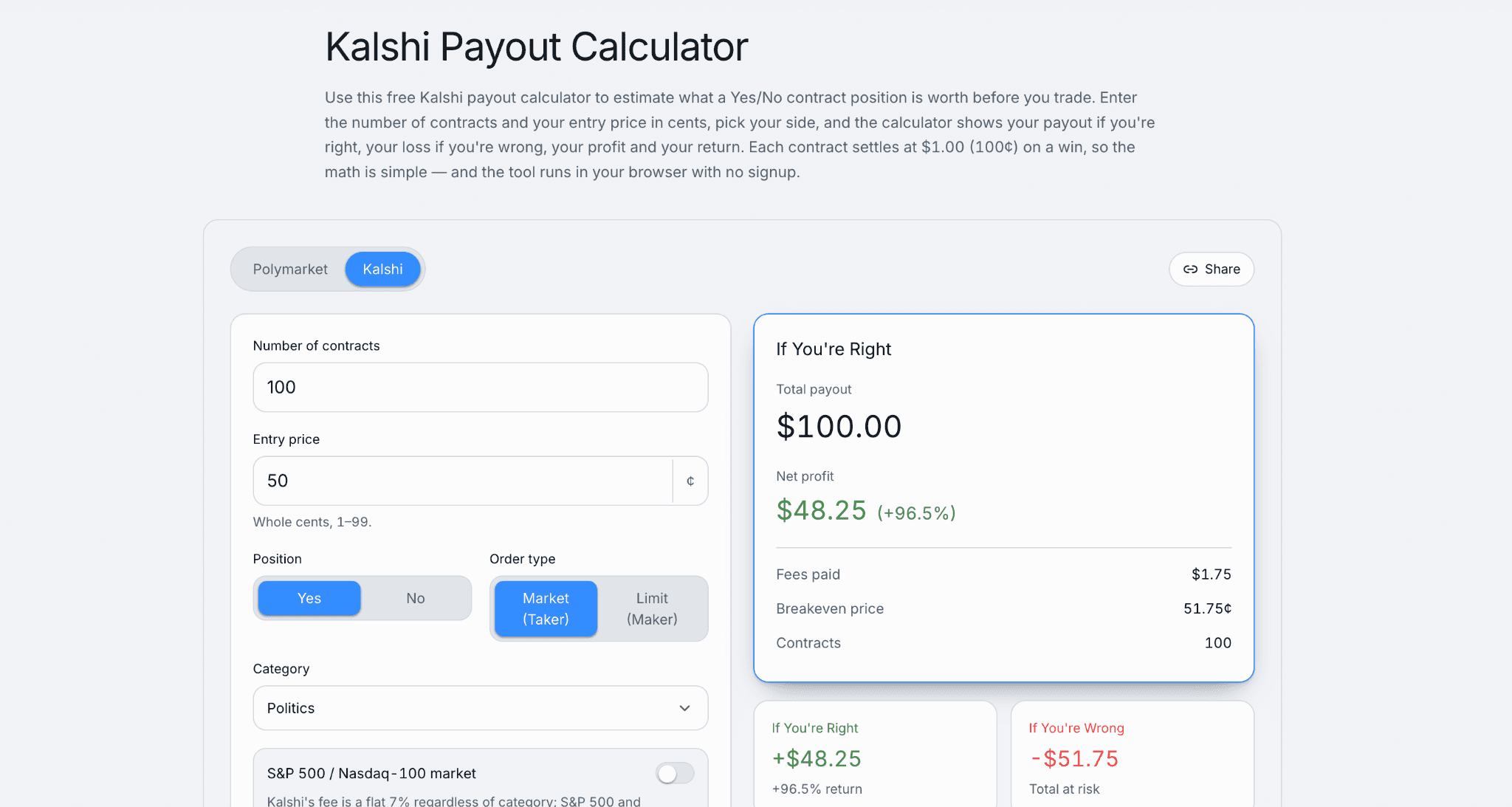
Try the Kalshi Payout Calculator to estimate your returns before every trade and make more informed trading decisions.
Kalshi vs. Polymarket: A Structural Difference Worth Knowing
If you've spent any time researching this on the Polymarket side, the ground rules are genuinely different, which is worth flagging before you assume the same copy-trading tools work identically across both platforms. Polymarket runs on public blockchain infrastructure, so every wallet's trade history is visible on-chain by default, which is exactly what makes native-feeling copy trading tools possible there in the first place, a contrast the sibling piece Top Polymarket Traders 2026: Leaderboard & Copy Trading walks through in more depth.
The Bottom Line
The Kalshi leaderboard is real, genuinely useful for spotting active traders and category specialists, and worth checking regularly if you want a sense of where volume and conviction are concentrated on the platform. It is not a skill certification, and treating a high rank as one is the single most common mistake people make with it. Native copy trading doesn't exist on Kalshi by design, a consequence of the platform's private, brokerage-style account structure rather than an oversight, and every copy tool built around that gap is a third-party layer that needs its own scrutiny before you connect an account or a dollar to it.
If you're going to follow a top trader's moves in any form, do it with the same due diligence you'd apply to following a stock picker: check the track record's length, check for a losing stretch, and understand exactly what you're paying in fees before assuming the edge is real. For traders who'd rather build a repeatable process than chase leaderboard names at all, Kalshi Prediction Market: 7 Strategies That Work in 2026 is a more durable starting point than any single trader's résumé.
FAQs
What is the Kalshi leaderboard?
The Kalshi leaderboard is an opt-in feature that ranks traders by profit, volume, or prediction accuracy across different timeframes, from daily to all-time. Users are automatically opted out by default and can choose to opt in and display their performance publicly.
Does Kalshi support copy trading?
Not natively. Kalshi accounts are private and trading is member-to-member, so there's no built-in follow or auto-copy feature. Kalshi copy trading currently only exists through third-party tools that connect to Kalshi's public API or ask users to link their own accounts.
Who are the top traders on Kalshi?
Kalshi itself doesn't publish trader identities, so most named top Kalshi traders have come from outside interviews and reporting rather than the platform. Examples reported in 2026 include Michael Boss, a former professional poker player cited by The Wall Street Journal for running 60 trades a minute, and Gaëtan Dugas, a self-identified Top 100 trader who built an edge around niche data categories like music charts. Rankings on the leaderboard itself shift by category and timeframe, so the "top" trader looks different depending on whether you're viewing profit, volume, or a specific market category.
Is there a bot for Kalshi copy trading?
Yes, several third-party services offer a Kalshi copy trading bot, including Telegram-based bots that manage a non-custodial wallet and paid subscription services that mirror a chosen trader's positions. None of these are official Kalshi products, and public track records on most of them are short and self-reported, so verify before connecting an account.
Is there an API for the Kalshi leaderboard?
Not an official one as of this writing. Kalshi's public API documentation covers markets, orders, portfolio, and exchange data in depth, but a dedicated Kalshi leaderboard API isn't part of the published endpoint list. Third-party scraping tools have filled that gap in the meantime.
What are people saying about Kalshi copy trading on Reddit?
Kalshi copy trading reddit discussion tends to echo the same caution found in third-party reviews: skepticism toward unverified paid copy bots, interest in building custom tooling against Kalshi's official API instead, and general agreement that Kalshi's private account structure makes copy trading meaningfully harder than it is on blockchain-based platforms like Polymarket.