
Survivor Season 50 marks a milestone anniversary for one of television's longest-running reality competition shows. The season features returning players, new twists, and heightened strategic gameplay that makes predicting the winner more challenging than typical seasons.
Polymarket hosts prediction markets where you can trade on who will win Survivor Season 50, betting on your favorite contestants or identifying undervalued players the market is mispricing. Unlike traditional entertainment betting, Polymarket prices update continuously based on episode outcomes, player performance, and social media sentiment creating opportunities for informed traders.
This guide covers current Survivor Season 50 winner odds on Polymarket, analysis of top contenders and their winning probability, how reality TV prediction markets work, strategies for profitable Survivor betting, and why entertainment markets differ from political or sports predictions.
Understanding Survivor Prediction Markets
Reality TV prediction markets function differently than sports or political markets due to unique characteristics of pre-recorded programming.
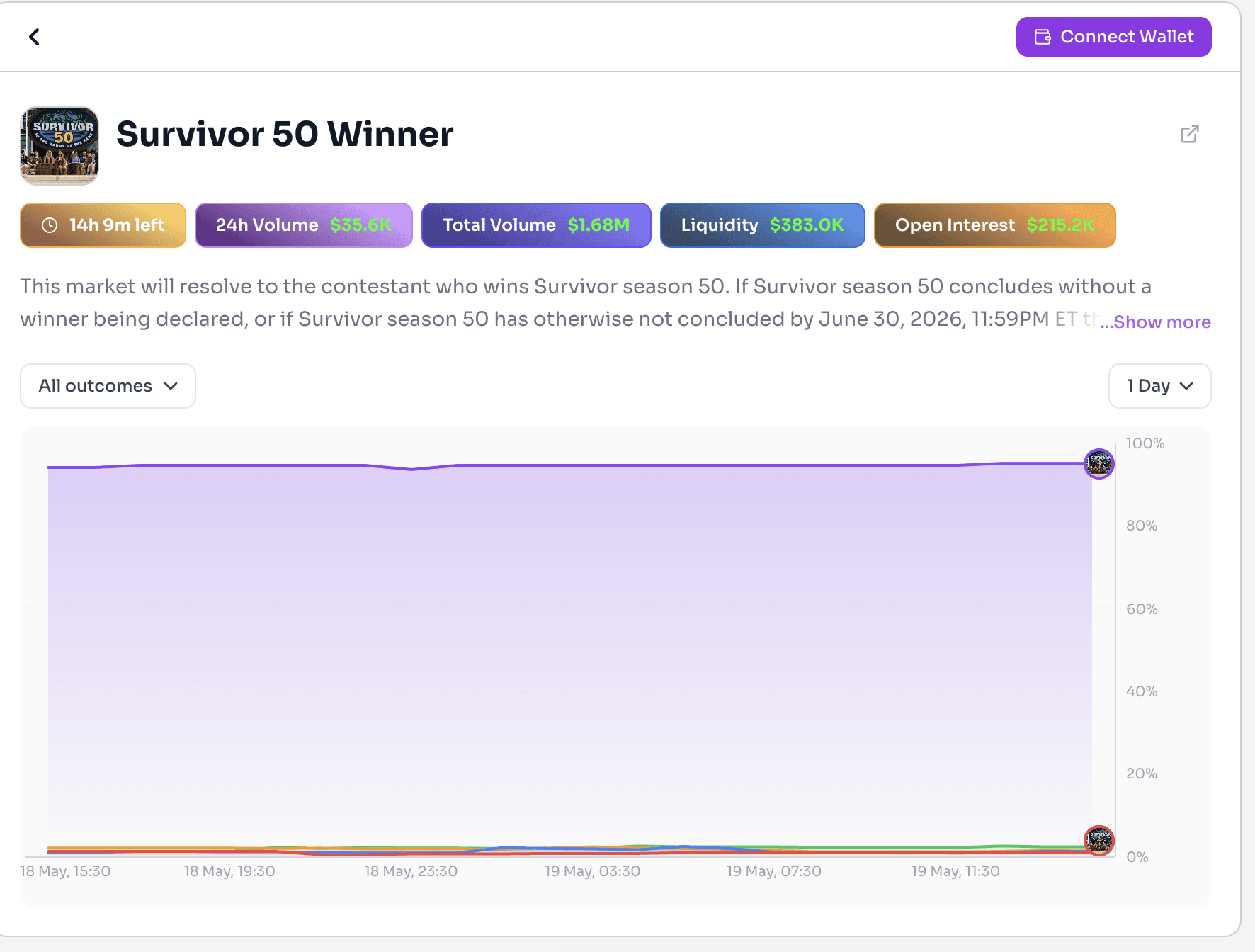
How Survivor Markets Work
Market Structure
- Single market: "Who will win Survivor Season 50?"
- Each contestant has separate YES/NO contracts
- YES contracts pay $1.00 if that player wins final Tribal Council
- NO contracts pay $1.00 if that player does NOT win
- Prices range from 0.01 to 0.99 representing implied win probability
Example Trade
You believe Player A is undervalued at 12 cents (12% probability)
- You buy 500 Player A YES contracts for $60
- Player A wins Survivor Season 50
- Contracts settle at $1.00 each = $500 total payout
- Your profit: $440 (minus 2% Polymarket fee)
Key Differences from Other Prediction Markets
Pre-Recorded Programming: Survivor films months before airing. The winner is already determined when markets open, though unknown to the public. This creates information asymmetry risk if spoilers leak.
Episode-by-Episode Evolution: Unlike election night or sports games resolving in hours, Survivor unfolds over 13-14 weeks with weekly episodes. Market prices evolve throughout the season as contestants are voted out and alliances shift.
Spoiler Risk: Dedicated spoiler communities attempt to identify winners through social media analysis, filming location sightings, and contestant behavior patterns. Spoiler information occasionally leaks affecting market prices.
Edit Analysis: Survivor editors craft narratives foreshadowing eventual winners. Players receiving positive airtime, strategic confessionals, and hero edits typically have higher winning probability than invisible or villain-edited players.
Survivor Season 50 Format and Cast Considerations
Understanding season format helps predict likely winner characteristics.
Expected Season 50 Format
50th Anniversary Season (Speculation)
- All-returnee cast featuring legendary players
- Extended episode count (potentially 90+ days)
- New advantage twists and game mechanics
- Likely emphasis on "old school vs new school" gameplay themes
Cast Selection: CBS typically brings back fan favorites, strategic legends, and players from diverse Survivor eras for milestone seasons. Season 50 may feature:
- Winners from previous seasons
- Fan-favorite non-winners with strong gameplay
- Mix of old-school players (Seasons 1-20) and new-school players (Seasons 30-49)
- International Survivor legends if format allows
Historical Patterns for All-Returnee Seasons
Winner Characteristics (All-Star Seasons)
- Medium-threat level: Big threats get voted out early, weak players lose jury votes
- Social-strategic balance: Pure strategic players struggle with bitter juries
- Adaptability: Players who adjust to new-school twists outperform rigid strategists
- Previous winning not required: Many all-star winners are non-winners from prior seasons
Examples
- Survivor All-Stars (S8): Amber (non-winner) beat Rob (eventual legend)
- Heroes vs Villains (S20): Sandra (previous winner) won again
- Winners at War (S40): Tony (previous winner) won with aggressive gameplay
- Second Chance (S31): Jeremy (non-winner) used new-school tactics
These patterns suggest Season 50 winner likely falls in the "medium threat with strong social game" category rather than obvious legends targeted early.
Current Survivor Season 50 Hypothetical Odds Analysis
Since Season 50 specific cast is not confirmed as of May 2026, this section provides frameworks using hypothetical returnee archetypes.
Top-Tier Favorites (If Cast)
Player Archetype: Strategic Mastermind
- Hypothetical odds: 15-20 cents
- Profile: Previous winner known for strategic dominance
- Risk: Massive threat level means likely early boot
- Value assessment: Often overpriced due to popularity not actual win probability
Example: If Tony Vlachos or Parvati Shallow were cast, they might open at 18-20 cents despite being immediate targets. Historical data shows massive threat players rarely survive deep in all-returnee seasons.
Trading Strategy: Fade (sell) big names at inflated prices. They rarely win due to target size.
Player Archetype: Social Strategist
- Hypothetical odds: 10-15 cents
- Profile: Strong social player with moderate strategic reputation
- Risk: May lack flashy resume for jury votes
- Value assessment: Often properly priced or undervalued
Example: Players like Michele Fitzgerald or Erika Casupanan who won through strong social gameplay rather than flashy moves. These players survive longer and win closer jury votes.
Trading Strategy: Buy if under 12 cents. Social-strategic balance performs well in returnee seasons.
Mid-Tier Contenders
Player Archetype: Under-the-Radar Strategist
- Hypothetical odds: 6-10 cents
- Profile: Strong player without huge target, adaptable gameplay
- Risk: May lack winner edit if invisible early
- Value assessment: Best risk-reward category
Example: Players who finished 4th-6th in previous seasons showing strong gameplay without winner notoriety. These players balance threat level with capability.
Trading Strategy: Best value bets. Buy at 7-9 cents for optimal risk-reward.
Player Archetype: Physical Threat
- Hypothetical odds: 5-8 cents
- Profile: Challenge dominator, weaker social-strategic game
- Risk: Targeted at merge, struggles with jury management
- Value assessment: Typically overpriced
Example: Challenge beasts like Ozzy Lusth or Joe Anglim. They make deep runs but rarely win due to lacking social-strategic dimensions.
Trading Strategy: Sell (bet NO) when overpriced above 8 cents.
Dark Horses and Long Shots
Player Archetype: Old-School Legend
- Hypothetical odds: 3-6 cents
- Profile: Iconic player from Seasons 1-15, outdated gameplay style
- Risk: Cannot adapt to new-school advantages and idol plays
- Value assessment: Usually properly priced or overpriced due to nostalgia
Trading Strategy: Avoid exceptionally adaptable old-school player.
Player Archetype: New-School Advantage Hunter
- Hypothetical odds: 3-5 cents
- Profile: Finds idols and advantages, lacks social finesse
- Risk: Jury views as cheap gameplay not respected strategy
- Value assessment: Low win probability despite flashy game
Trading Strategy: Fade. Advantage hunters rarely win on returnee seasons.
Factors That Move Survivor Market Odds
Understanding what drives price changes helps identify trading opportunities.
Episode Performance
Significant Confessionals: When players receive substantial confessional airtime (particularly strategic or emotional content), odds improve 2-5 cents as markets interpret this as winner edit signaling.
Immunity Wins: Challenge victories boost odds 1-3 cents temporarily, though physical dominance long-term often predicts jury loss not victory.
Survived Tribal Council: Narrowly surviving elimination votes typically drops odds 3-8 cents as markets view the player as vulnerable with eroding social position.
Edit Analysis and Visibility
Winner Edit Indicators:
- Personal content (family, backstory, emotional moments)
- Strategic confessionals explaining gameplay
- Positive tone and music during confessionals
- Consistent visibility across episodes
When players consistently receive these edit markers, odds gradually improve 10-20+ cents over season arc.
Invisible Edit: Players receiving minimal airtime see odds drop as absence suggests editors consider them unimportant to season narrative (typically because they don't win).
Social Media and Spoiler Speculation
Post-Show Behavior: Alert traders monitor contestant social media for clues:
- Weight changes (indicates how long they lasted)
- Follow patterns (winners often follow more cast members)
- Interview availability (early boots more available, finalists under NDA longer)
Spoiler Community Intel: Dedicated spoiler sites (Survivor Sucks, Reddit r/SpoiledSurvivor) aggregate evidence attempting to determine winners. When spoiler consensus forms, market prices shift dramatically.
Risk: Spoilers are often wrong. Trading purely on spoilers without independent verification loses money when speculation proves incorrect.
Advantage Possession
Players shown finding immunity idols or advantages see temporary odds boosts 2-4 cents, though this rarely predicts winners as advantage-heavy games typically lose jury votes.
Using Laika Labs for Survivor Market Trading
Monitoring tools improve Survivor trading efficiency and profitability.
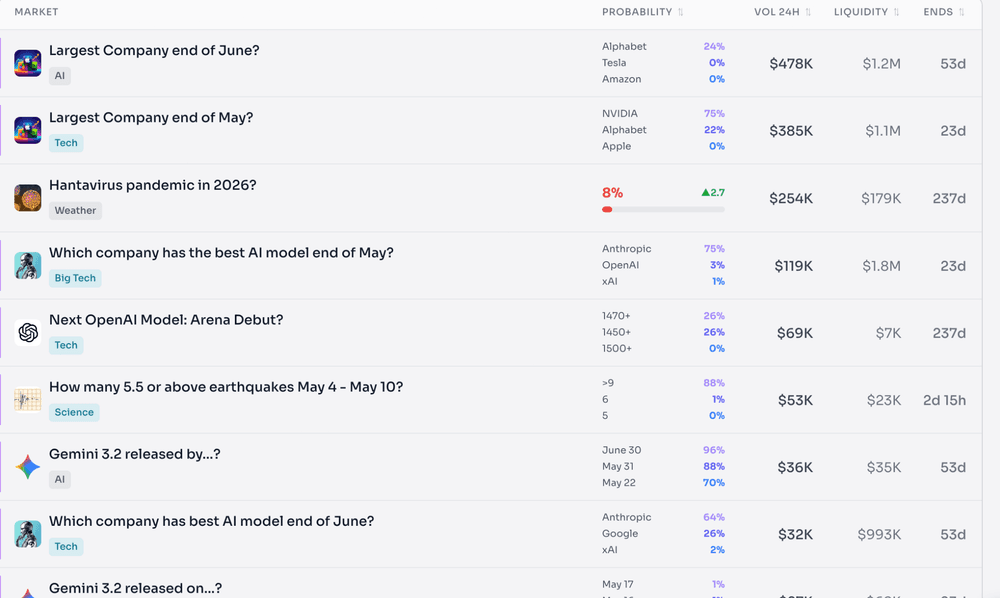
Real-Time Price Alerts
Laika Labs provides alerts when Survivor market prices move 5+ cents, indicating:
- Episode airing with significant gameplay
- Spoiler information leak
- Whale position entered/exited
- Social media buzz affecting odds
These alerts let you react to opportunities without constant manual monitoring.
Whale Position Tracking
See when sophisticated traders (whales with $5,000+ positions) enter or exit Survivor markets.
Value
- Whale buying at 8 cents may signal insider edit analysis
- Whale selling at 25 cents may indicate negative information
- Following smart money improves probability of picking winners
Historical Price Data
Review how similar Survivor contestants' odds evolved over previous seasons.
Application: Compare current player's price trajectory to previous winners. If following a similar pattern (slow rise from 12 to 35 cents over episodes 1-8), validates winner edit theory.
Market Liquidity Analysis
Check order book depth before placing large positions avoiding slippage in thin markets.
Survivor markets typically show
- $5,000-15,000 total liquidity for major contenders
- $1,000-5,000 for mid-tier players
- $500-2,000 for long shots
Avoid positions exceeding 10% of available liquidity to prevent moving prices against yourself.
Frequently Asked Questions
How do Survivor prediction markets work on Polymarket?
Survivor markets are winner-takes-all contracts where you buy YES shares of players you believe will win the final Tribal Council. Shares pay $1.00 if that player wins, $0 if they do not. Prices from 0.01 to 0.99 reflect implied win probability. Markets stay open throughout the season with prices adjusting after each episode based on edit, gameplay, and elimination outcomes.
When is the best time to bet on the Survivor winner?
Optimal timing is after episode 1-2 when initial edit patterns emerge but before consensus forms around favorites. Early season odds are most inefficient offering best value. Avoid betting pre-premiere when no information exists. Also avoid finale night unless you have strong jury psychology understanding and fast execution capabilities for live trading.
Can you actually profit from Survivor betting markets?
Yes, systematic traders using edit analysis, winner archetype identification, and spoiler fade strategies achieve 15-25% returns across Survivor seasons. This requires treating it as an analytical exercise not fandom. Key is identifying undervalued players at 8-12 cents who show winner edit markers that casual markets participants miss or underprice.
Does Laika Labs help with Survivor prediction markets?
Laika Labs provides price movement alerts when Survivor odds shift significantly, whale position tracking showing large trader activity, historical price data for pattern analysis, and liquidity monitoring ensuring sufficient order book depth before placing positions. These tools improve trading efficiency and help identify opportunities faster than manual monitoring.
For traders managing multiple Survivor positions throughout the season, Laika Labs provides monitoring tools tracking price movements, whale positions, and market liquidity helping identify opportunities and manage risk without constant manual tracking across 13-14 week seasons.