Ore (ORE), often searched as Orecoin, has successfully transitioned from an experimental proof-of-work project into a cornerstone of the Solana DeFi landscape. Unlike traditional PoW assets such as Bitcoin that rely on ASIC-heavy infrastructure, Ore was designed to be mined by anyone with a laptop or smartphone.
By 2026, Ore is no longer just a mining experiment. It has evolved into a high-velocity, revenue-backed, deflationary system where on-chain participation directly fuels long-term scarcity. With a fixed supply cap, aggressive buyback-and-burn mechanics, and expanding DeFi integrations, ORE is increasingly viewed as Solana’s digital gold experiment.
What Is Ore Coin (ORE)?
Ore (ORE) is a fair-launch cryptocurrency built on the Solana blockchain that reimagines proof-of-work for a modern, high-throughput environment. Instead of raw computational dominance, Ore mining rewards participation, execution speed, and on-chain coordination.
There was:
- No pre-mine
- No venture capital allocation
- No team token reserve
Every ORE token in circulation has been earned by miners through open participation, making Ore one of the few genuinely fair-launch assets in the Solana ecosystem.
Ore Supply and Tokenomics Explained
Ore’s long-term value thesis is built on engineered scarcity.
Key Ore Supply Metrics (2026)
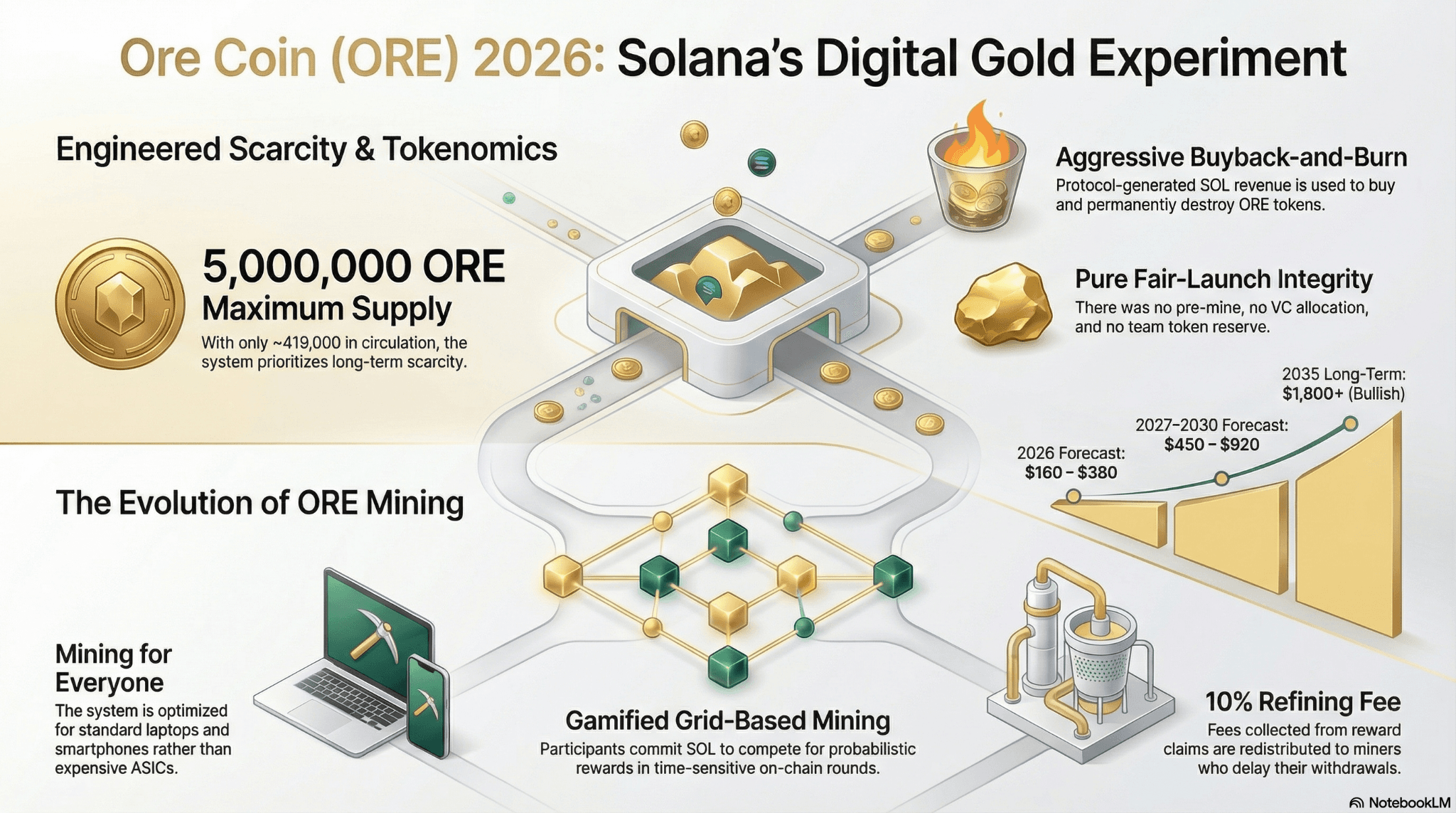
- Maximum supply: 5,000,000 ORE
- Circulating supply: ~419,000 ORE
- Emission model: Declining issuance
- Burn mechanism: Funded by protocol-generated SOL revenue
SOL fees generated through mining participation are used to buy ORE from the open market. Approximately 90% of those tokens are permanently burned, while the remaining portion is distributed to long-term stakers.
This creates a powerful feedback loop where higher participation results in lower effective supply. Ongoing changes in supply dynamics and market conditions can be tracked through the Ore coin market overview.
How Ore Coin Mining Works in 2026
Ore mining has evolved significantly from its early command-line-only phase.
The Ore V2 Mining Model
Ore V2 uses a gamified grid-based mining system, where participants commit SOL to compete for ORE rewards. Instead of brute-force hashing, miners submit time-sensitive transactions that are validated on-chain.
Key characteristics:
- Only a minority of participants win each round
- Rewards are probabilistic, not guaranteed
- Mining resembles a competitive on-chain game rather than traditional PoW
This makes Ore mining an active, high-variance strategy, not passive income.
How to Mine Orecoin (ORE)
Mining Ore in 2026 is far more streamlined than in its early days.
Web-Based Mining (Beginner Friendly)
This is the easiest way to get started.
Requirements
- Solana-compatible wallet (Backpack or Phantom)
- Small amount of SOL for transaction fees
Process
- Connect your wallet to the official mining interface
- Deposit SOL for participation
- Start mining or enable Autominer
For a complete walkthrough covering wallet setup, mining modes, fees, and beginner strategies, follow this Orecoin mining guide.
CLI Mining (Advanced Users)
CLI mining is preferred by power users running VPS setups or optimizing execution speed.
Requirements
- Rust and Cargo
- Solana CLI
- High-performance RPC provider
While CLI mining offers greater control, it also introduces higher complexity and operational risk.
Ore Coin Mining Fees and Incentives
Ore’s fee structure is designed to discourage short-term selling.
- Refining fee: ~10% when claiming rewards
- Redistribution model: Fees are redistributed to miners who delay claiming
- Incentive alignment: Holding mined ORE on-chain increases relative rewards
This mechanism reduces immediate sell pressure while rewarding long-term participants.
Is Ore Coin Mining Profitable in 2026?
Ore coin mining profitability depends on three variables:
- ORE market price
- SOL committed per mining round
- Success rate within the grid
As of early 2026, the protocol generates substantial daily revenue, but outcomes vary widely. Skilled and well-capitalized miners can outperform costs, while casual participants face high variance.
A deeper breakdown of returns, historical trends, and future expectations is covered in our analysis of Ore coin mining profitability and price prediction.
Ore (ORE) Price Prediction: 2026–2035
2026 Forecast: DeFi Utility Expansion
With the launch of ORE lending pools, the token is moving beyond mining rewards into productive capital. The upcoming Ethereum bridge (wORE) further expands liquidity access.
Target Range: $160 – $380
2027–2030 Forecast: The Scarcity Squeeze
By 2030:
- Emissions decline sharply
- The 2028 halving reduces new supply
- Daily buybacks materially shrink effective circulation
ORE increasingly functions as a base-layer asset for Solana-native mining and participation dApps.
Target Range: $450 – $920
2035 Long-Term Outlook
Bullish Scenario: $1,800+
If Ore maintains participation, consistent buybacks, and relevance as Solana’s primary hard-money experiment, effective supply could fall well below the nominal cap.
Advantages of Ore Coin
- Fair launch with zero insider allocation
- Aggressive deflation via protocol-funded burns
- Accessible mining via laptops and smartphones
- Deep integration with Solana’s low-cost infrastructure
Risks and Challenges
Solana Network Dependency
Mining requires frequent on-chain transactions. Any Solana congestion or downtime directly impacts rewards.
High-Variance Model
Most participants lose SOL in each round. Mining is competitive, not guaranteed.
Sustainability Risk
If participation declines, protocol revenue drops, weakening deflationary pressure.
Frequently Asked Questions (FAQs)
Is Ore (v1) the same as Ore (v2)?
No. Ore (v1) was the original proof-of-work experiment. Ore (v2) is the current live version with redesigned tokenomics, a fixed 5 million supply cap, and a revenue-sharing model.
What is the current Ore supply?
As of early 2026, total supply is capped at 5 million ORE, with approximately 419,000 ORE in circulation. Ongoing burns continue to reduce effective supply.
Do I need a GPU or ASIC to mine Orecoin?
No. Ore mining is optimized for CPUs and mobile devices. You can mine using a standard laptop or high-end smartphone.
What are the mining fees?
Claiming mined ORE incurs a refining fee of around 10%, which is redistributed to miners who delay claiming.
Is Orecoin mining still profitable?
It can be, but profitability varies widely depending on market conditions, SOL fees, and mining success rate. Outcomes are not guaranteed.
Can Ore become Solana’s digital gold?
Ore is often described as digital gold due to its capped supply and deflationary design. Whether it achieves that status depends on long-term participation and sustained demand.
Final Verdict: Is Orecoin Worth Watching?
Ore is not trying to replace Bitcoin.It is not competing with Ethereum.
Ore is an experiment in on-chain scarcity, fair distribution, and participation-driven economics. For users who understand the mechanics and risks, it remains one of the most structurally interesting assets in the Solana ecosystem.
Whether it becomes true digital gold or remains a niche experiment depends on one thing: continued participation.
Disclaimer: This article is provided for informational purposes only and should not be considered financial or investment advice. Always do your own research before engaging with cryptocurrencies or digital assets.