The digital asset market is shifting from speculative cycles toward infrastructure-led adoption. Within this transition, Hedera (HBAR) has moved beyond its early positioning as an enterprise experiment and into the core of institutional capital allocation.
A key driver of this shift is the Hedera ETF ecosystem. Since the introduction of spot HBAR ETFs, capital flows into regulated Hedera products have remained structurally positive, signaling long-term accumulation rather than short-term trading behavior. While retail sentiment continues to fluctuate, institutional participation increasingly treats Hedera as foundational infrastructure for tokenized real-world assets (RWAs).
What Is the Hedera ETF?
A Hedera ETF is a spot exchange-traded fund that holds physical HBAR tokens in a regulated trust structure. It allows traditional investors to gain exposure to the Hedera Hashgraph network through standard brokerage accounts without managing private keys or digital wallets.
This structure has opened access for retirement funds, family offices, and wealth managers, transforming HBAR from a crypto-native asset into a regulated financial instrument suitable for institutional portfolios.
If you want an earlier primer on what a Hedera ETF is and how it stood in 2025, read our beginner guide on What Is Hedera (HBAR)?.
Technical Structure and Flow Dynamics in HBAR
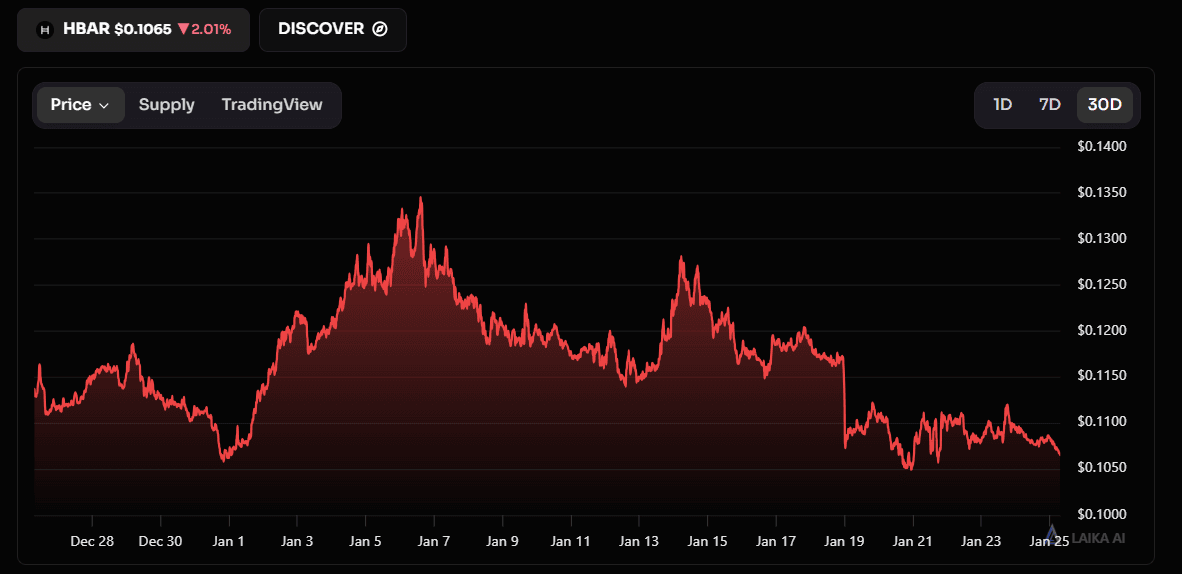
W-base formation: HBAR is forming a W-shaped base near the $0.102 support level, with a neckline around $0.135. A confirmed breakout above the neckline implies a measured upside move toward approximately $0.176, representing roughly 31 percent potential upside.
Key resistance convergence: The 50-day exponential moving average (EMA), currently near $0.127, has consistently rejected prior rallies in the 8 to 16 percent range. This moving average now converges with the neckline, reinforcing the $0.127–$0.135 zone as a critical resistance area.
ETF inflows: HBAR-linked ETF products recorded weekly inflows of approximately $1.46 million, indicating continued institutional accumulation through regulated investment vehicles.
Spot market divergence: Over the same period, spot market outflows increased by roughly 150 percent to around $2.22 million, suggesting short-term traders are reducing exposure while longer-horizon capital accumulates.
Market implication: The divergence between ETF inflows and spot outflows aligns with a consolidation and ownership-transition phase rather than a structural breakdown, with directional resolution dependent on sustained demand near the neckline zone.
The Hedera ETF Landscape in 2026
The First-Mover Advantage
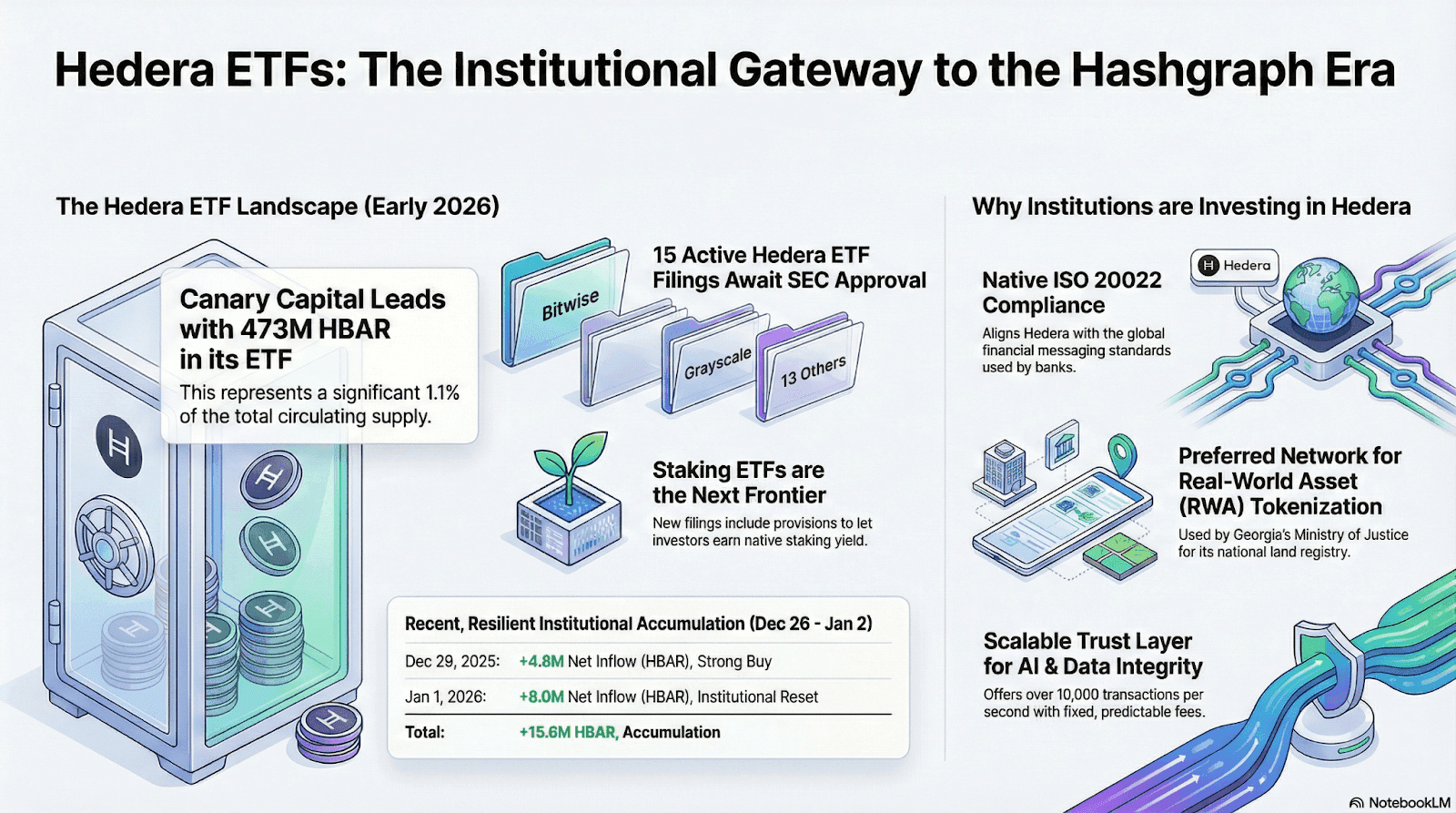
Canary Capital remains the dominant player in the Hedera ETF market. Its spot HBAR ETF currently holds approximately 473 million HBAR, representing around 1.1 percent of the circulating supply. This is a notable milestone for a network once viewed as too enterprise-focused for public market participation.
Pending Hedera ETF Filings
As of early January 2026, there are 15 active Hedera ETF filings under review by the U.S. Securities and Exchange Commission. Asset managers such as Bitwise and Grayscale have already included HBAR in diversified altcoin products, with standalone spot ETF approvals expected to reach final decisions in Q1 2026.
The Hedera Staking ETF Debate
A defining discussion in early 2026 centers on Hedera staking ETFs. Unlike Bitcoin ETFs, newer HBAR filings include provisions allowing funds to stake their underlying tokens. This would enable ETF holders to earn native staking yield in addition to price appreciation, mirroring mechanisms recently approved for Solana and Ethereum staking ETFs.
Latest Hedera ETF Inflows (December – Present)
Despite HBAR trading within a sideways consolidation range, Hedera ETF flows indicate strong institutional resilience.
| Period / Date | Net Inflow (HBAR) | Estimated USD Value | Sentiment |
|---|---|---|---|
| Week ending mid-January (highest 2026) | ≈+1.46M HBAR | ~$1.5M | Continued accumulation via ETF flows |
| Recent daily spot ETF flow | ≈+0.82M HBAR | ~$817,770 | Bullish inflow contributing to sentiment |
| Dec 24, 2025 | ≈+0.90M HBAR | ~$900,000 | Break in flat flows |
| Latest cumulative reading | ≈+83.7M HBAR (total) | ~cumulative $ value | Strong long-term accumulation (flat weeks included) |
Cumulative inflows into HBAR-linked products have now surpassed $83.7 million, recovering from the mid-December slowdown.
For additional flow metrics and a detailed breakdown of Hedera ETF capital movements, see Laika’s analysis of how ETF inflows hit $70 million amid a price dip. Hedera ETF Inflows Hit $70M as Hedera Coin Dips to $0.177
Why Institutions Are Buying the Hedera ETF
Institutional demand for the Hedera ETF is driven by infrastructure relevance rather than narrative speculation. Hedera increasingly functions as the trust layer of the internet.
ISO 20022 Compliance
By 2026, global financial messaging has fully transitioned to ISO 20022 standards. Hedera is among the few distributed ledger technologies that are natively compliant, making it attractive to central banks, payment processors, and ETF issuers focused on regulatory alignment.
Real-World Asset Tokenization
Hedera has emerged as a preferred network for high-value RWA tokenization. In December 2025, the Ministry of Justice of Georgia completed the migration of its national land registry to Hedera, echoing similar initiatives in Dubai. In parallel, institutional pilots involving tokenized money market funds have used the Hedera Guardian for auditability and compliance verification.
Sovereign AI and Data Integrity
With the rise of sovereign AI frameworks, governments are increasingly using Hedera to log AI training data, compliance proofs, and autonomous system audits. The network’s throughput of over 10,000 TPS and fixed USD-denominated fees make it uniquely scalable for tamper-proof data verification.
HBAR Crypto & Price Analysis – Hedera
Advantages, Risks, and Challenges of the Hedera ETF
Advantages
Hedera’s governing council, which includes Google, IBM, and Repsol, provides corporate-grade stability unmatched in most public networks. Fixed USD-denominated fees ensure predictable operating costs for enterprise and government users.
Risks
Regulatory bottlenecks remain a concern. While the Canary Capital ETF is active, SEC backlogs could delay approvals for larger issuers such as BlackRock or Fidelity until late 2026.
Challenges
Despite high transaction volumes, Hedera’s DeFi ecosystem lags behind Solana and Base in liquidity depth. Additionally, its compliance-first positioning makes it less attractive to momentum-driven retail traders, resulting in slower price discovery.
The Bottom Line on the Hedera ETF
Hedera has emerged from 2025 as a clear institutional favorite. Persistent inflows into the Canary Capital Hedera ETF, combined with sovereign-level adoption in Georgia and Dubai, indicate long-term strategic positioning rather than speculative demand.
While short-term price action remains range-bound, institutional accumulation continues. For investors seeking regulated exposure to scalable, enterprise-grade blockchain infrastructure, the Hedera ETF represents one of the most structurally sound entry points into next-generation finance.
Frequently Asked Questions About the Hedera ETF
1. Can I hold a Hedera ETF in a retirement account?Yes. If supported by your brokerage, Hedera ETFs can be held in IRAs and 401(k)s.
2. How do Hedera ETF inflows affect HBAR price?ETF issuers must acquire spot HBAR, reducing exchange supply and supporting price stability during market downturns.
3. Is Hedera more secure than traditional blockchains?Hedera’s Hashgraph consensus is asynchronously Byzantine Fault Tolerant, the highest security standard for distributed systems.
4. Where can I track Hedera ETF flow data?Live institutional flow metrics and network health indicators are available through AI-driven crypto analytics platforms.
Disclaimer: This article is provided for informational purposes only and should not be considered financial or investment advice. Always do your own research before engaging with cryptocurrencies or digital assets.