Laika AI
Last Updated
May 6, 2026

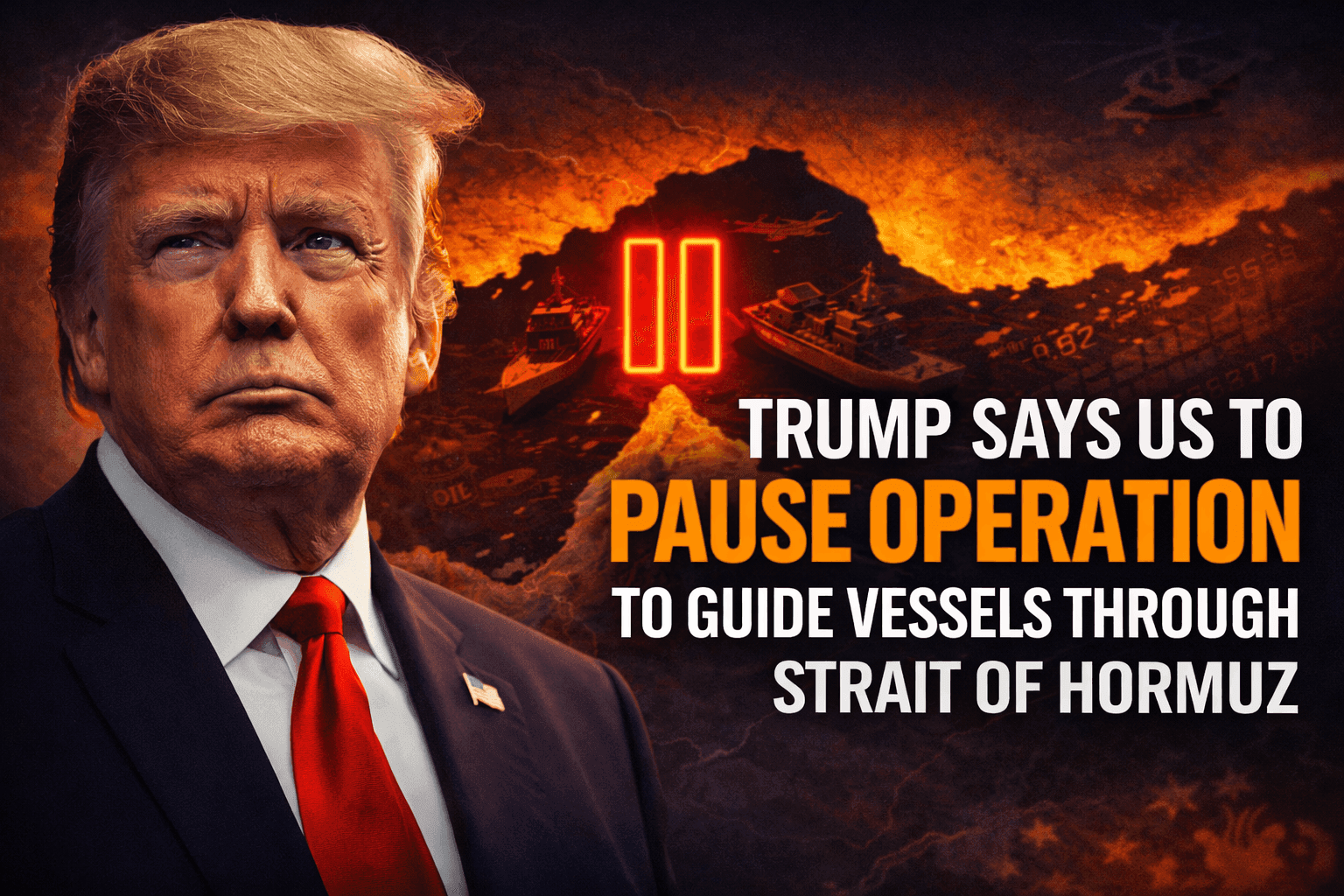
Former President Donald Trump has indicated that US operations aimed at reopening the Strait of Hormuz will be paused, a statement that arrives as Iran moves to reassert Islamic Revolutionary Guard Corps control over the waterway and reverse the brief reopening that had occurred during a ceasefire window, leaving global oil markets facing a renewed period of uncertainty over one of the world's most consequential maritime corridors.
Trump's public statement indicated that the operation to reopen the Strait of Hormuz would be paused, a characterization that has not been independently verified by US military or governmental sources at the time of this report. What has been confirmed is that the US blockade of the region remains, in Trump's own words, in full force, suggesting that the pause refers specifically to active reopening efforts rather than any withdrawal of American naval presence from the area.
US Central Command has continued its active patrol operations in the Strait, enforcing maritime security and maintaining oversight of navigation through the waterway. The gap between Trump's public framing and the operational reality on the ground reflects the broader ambiguity that has characterized US communication around this situation, leaving market participants and regional observers to interpret signals that do not always align cleanly with each other.
The lack of independent substantiation for the pause announcement has added a layer of uncertainty to an already complex situation. Whether the pause represents a genuine strategic recalibration, a negotiating posture designed to create diplomatic space, or a statement that does not correspond to any formal operational change remains unclear, and that ambiguity is itself a market-relevant factor given how sensitively energy prices respond to perceived shifts in US policy toward the Strait.
No comments yet. Be the first!
Running in parallel to Trump's pause signal is a concrete and consequential development on the Iranian side. Iran has reversed the temporary reopening of the Strait that had been permitted during a ceasefire period involving Israel and Hezbollah, returning the waterway to its previous status under IRGC authority. Under this restored framework, naval authorization is required for passage through the Strait, and tolls are imposed on vessels seeking transit.
The reimposition of IRGC control over Strait access represents a meaningful escalation from the brief period of relative openness that the ceasefire had created. It closes a window that international shipping operators had begun to cautiously utilize and reintroduces the authorization and toll requirements that add friction, cost, and uncertainty to transit operations for the roughly 20% of the world's daily oil supply that passes through the waterway.
Iranian officials have framed the reversion as a response to ongoing US enforcement actions in the region, which have reportedly included the blockade of Iranian ports. The sequencing of actions and responses between Washington and Tehran in this corridor has taken on a back-and-forth quality that makes it difficult to identify a stable equilibrium toward which the situation is moving.
The current Strait of Hormuz situation is unfolding against the backdrop of broader US-Iran negotiations that had produced a two-week ceasefire agreement. Ceasefires of this nature in the context of US-Iran relations are inherently fragile instruments, dependent on both sides reading the other's actions within the framework of the agreement rather than through the lens of pre-existing adversarial postures.
The reimposition of IRGC control over the Strait and Trump's pause announcement both raise questions about whether the ceasefire framework retains operative force or whether it has effectively been superseded by the actions each side has taken since its establishment. A ceasefire that does not prevent either side from taking actions that the other reads as escalatory is a ceasefire in name only, and the current trajectory of events in the Strait does not suggest that the underlying tensions have been meaningfully reduced by the negotiation process.
As the broader strategic picture around Iran policy continues to shift, the intersection of military posture, diplomatic signaling, and energy market consequences has become one of the most closely watched dynamics in global macro analysis, a tension that Laika AI's coverage of how Trump's Iran strategy and the Hormuz standoff are reshaping NATO relationships and Bitcoin's macro positioning has examined in detail as these developments unfold across multiple asset classes simultaneously.
The Strait of Hormuz carries approximately 20% of the world's daily oil supply through its narrow transit corridor, a concentration of energy flow that makes it the single most consequential maritime chokepoint in the global energy system. Any disruption to free transit through the Strait, whether through physical blockade, imposed authorization requirements, military engagement, or the threat thereof, translates rapidly into upward pressure on oil prices and elevated volatility across energy markets.
The current situation combines multiple disruption risk factors simultaneously. IRGC authorization requirements create operational uncertainty for tanker operators. The US blockade of Iranian ports restricts supply flows from a significant producing nation. Trump's pause signal introduces ambiguity about whether active American efforts to ensure free transit will continue. Each of these factors individually would be sufficient to move the energy market sentiment. Together, they create a risk environment that traders and investors are pricing with considerable caution.
Precautionary production and logistics curtailments at facilities in Saudi Arabia and other Gulf states, which had been implemented in response to earlier incidents in the region, add a supply-side dimension to the disruption risk that compounds the transit uncertainty. Energy market participants who were already navigating elevated volatility from macro factors, including inflation pressures and central bank policy uncertainty, are now contending with a geopolitical risk layer that has no clear resolution timeline.
The key indicators that will determine whether the current Strait of Hormuz situation stabilizes or escalates further include the pace and content of US-Iran diplomatic communications, any changes to CENTCOM operational posture in the region, Iranian statements about the conditions under which IRGC transit requirements might be modified, and the response of major oil-importing nations, particularly in Asia, to the elevated transit risk environment.
For market participants tracking the situation, the distinction between rhetoric and operational reality will continue to matter enormously. Trump's public statements about the pause have moved markets even in the absence of independent confirmation, reflecting how sensitive energy price formation is to perceived shifts in US policy toward the Strait. As Laika AI's analysis of how US stock futures and broader markets have responded to Project Freedom and the evolving Hormuz standoff under Trump illustrates, the financial market consequences of developments in this corridor extend well beyond the energy sector into equities, currencies, and risk sentiment globally.
The diplomatic and military situation in the Strait of Hormuz is moving quickly, and the next formal statement from either CENTCOM or Iranian military authorities will be the most important near-term data point for assessing which direction the operational reality is heading.