Laika AI
Last Updated
May 6, 2026

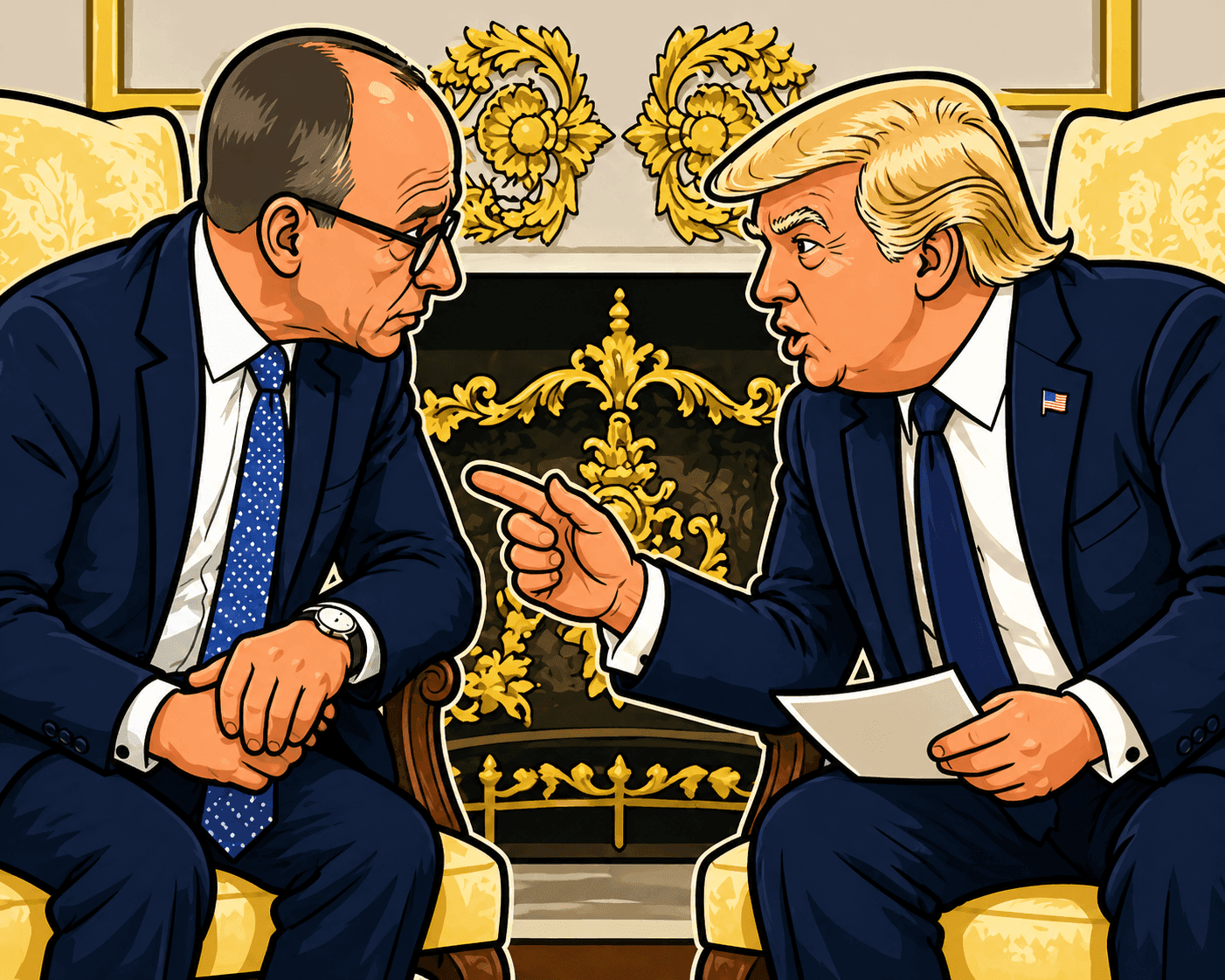
A public dispute between President Donald Trump and German Chancellor Friedrich Merz over the United States' approach to the Iran conflict has surfaced a deepening fracture in transatlantic relations at a moment when NATO allies are already pulling back from US military requests. The closure of the Strait of Hormuz is keeping global oil markets in a state of acute uncertainty.
The exchange began with Merz, speaking in his capacity as German Chancellor, characterizing the United States as being humiliated by Iranian leadership during the ongoing conflict and negotiations. His assessment was direct and unusually pointed for a sitting European head of government commenting on an active US military engagement: Iran, he argued, has proven stronger than anticipated, while Washington has failed to demonstrate a convincing strategic approach to the situation.
Trump's response came through Truth Social, his preferred platform for direct public communication, and matched Merz's directness with equal force. The German Chancellor, Trump wrote, does not know what he is talking about. The brevity of the rebuttal carried its own message: the US president was not interested in engaging with the substance of the critique but in dismissing its author's credibility as a foreign policy commentator on American military affairs.
The public nature of the exchange is itself significant. Disagreements between US presidents and European leaders are common in private diplomatic channels but rarely surface as direct social media confrontations between heads of government. The willingness of both Merz and Trump to make their disagreement visible rather than containing it within diplomatic frameworks signals that the tensions underlying this specific dispute run deeper than a single policy disagreement.
No comments yet. Be the first!
Merz's comments did not emerge from a vacuum. His assessment of American strategy in the Iran conflict reflects a broader European perspective that has been building since Operation Epic Fury launched in February 2026. European leaders, including those in the UK, Spain, and Italy, have been notably hesitant to endorse US military requests related to the Iran operation, a pattern of allied reluctance that represents a meaningful constraint on Washington's ability to frame the conflict as a unified Western response to an Iranian threat.
That reluctance reflects genuine divergence in strategic interests rather than simple anti-American sentiment. European economies are more directly exposed to energy price volatility from Gulf disruptions than the United States, which has substantially greater domestic energy production capacity. European financial institutions have deeper historical commercial relationships with Iranian entities that predate current sanctions regimes. And European populations have shown consistently lower appetite for military engagement in the Middle East than American public opinion has historically supported.
Merz's criticism also draws on a pattern of concern he has expressed throughout his tenure. His comments at the Munich Security Conference earlier in 2026, where he suggested that America's claim to global leadership is being challenged and may already be lost, established him as one of the most willing European leaders to articulate explicitly what many of his counterparts express only through diplomatic hedging. The Iran remarks represent a continuation of that pattern rather than a departure from it.
Beneath the diplomatic confrontation between Trump and Merz lies a material economic reality that gives the strategic disagreement its market-moving significance. Iran's effective closure of the Strait of Hormuz, the narrow waterway through which approximately 20% of global daily oil supply transits, has created an energy market environment that European economies are experiencing with particular intensity.
Germany, as a major industrial economy with significant energy import dependency, faces direct exposure to elevated oil and gas prices generated by Hormuz disruption in ways that the United States, as a net energy exporter, does not. When Merz criticizes American strategy in Iran, he is partly expressing the economic frustration of a leader whose country is absorbing significant energy cost increases as a consequence of a military operation his government did not sanction and cannot meaningfully influence.
The divergence between American and European strategic interests in the Iran conflict is therefore not purely ideological. It has concrete economic dimensions that make European leaders genuinely resistant to aligning with US military strategy, regardless of their public positions on alliance solidarity.
For financial markets, the visible fracture in transatlantic relations over Iran strategy introduces a category of geopolitical risk that compounds the existing uncertainty around the conflict's duration and resolution. A unified NATO response to the Iran situation, even if primarily rhetorical, would provide a degree of alliance stability that markets could factor into their risk assessments. A public dispute between the US president and a major European leader, accompanied by allied reluctance to support US military requests, undermines that stability and introduces questions about the coherence of Western policy in a region that controls critical energy infrastructure.
Bitcoin and the broader crypto market are sensitive to this dimension of geopolitical risk through the same macro channels that connect the conflict to energy prices, inflation expectations, and central bank policy. A deepening NATO rift that prolongs the conflict without resolution keeps the geopolitical risk premium elevated across risk assets, suppresses the risk-on sentiment that drives crypto market outperformance, and maintains the safe-haven rotation dynamics that have characterized market behavior since the conflict began.
Oil futures, dollar strength relative to the euro, and any signals from NATO diplomatic channels about allied coordination on Iran will serve as the leading indicators of whether the Trump-Merkel confrontation represents a temporary public spat or the visible edge of a more durable strategic fracture with lasting market consequences.