Laika AI
Last Updated
May 6, 2026

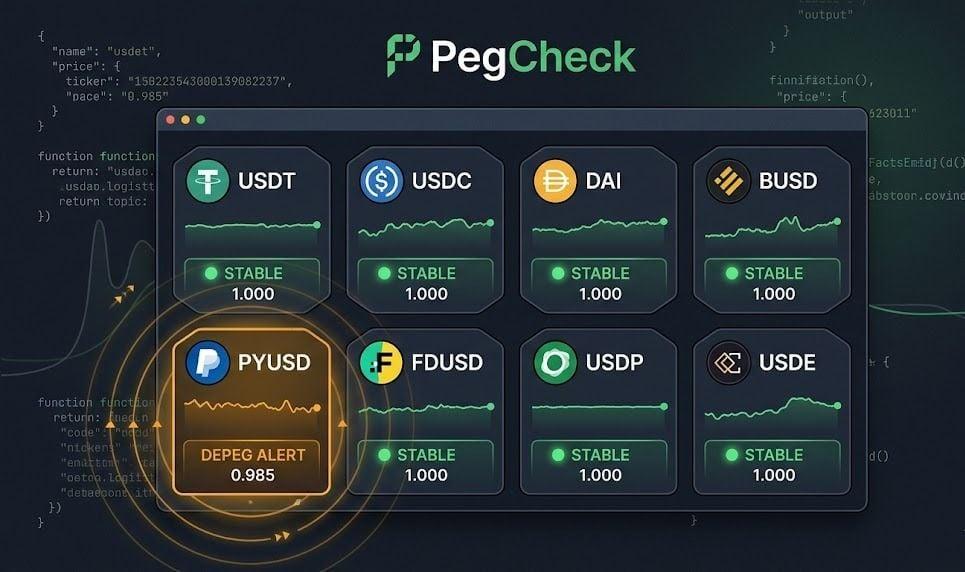
PegCheck has entered beta testing as a purpose-built stablecoin health monitoring API that aggregates pricing data from more than 1,000 sources to track the peg status of eight major stablecoins in real time, offering developers building wallets, exchanges, and DeFi applications a turnkey depeg detection solution with webhook alerting and full price history access.
The history of stablecoin depegging events has demonstrated repeatedly that the infrastructure supporting real-time peg monitoring has lagged behind the pace of stablecoin adoption in DeFi and centralised exchange environments. When TerraUSD collapsed in 2022, when USDC briefly depegged during the Silicon Valley Bank crisis in 2023, and during the smaller but significant deviations that have affected TUSD and other stablecoins in subsequent periods, developers building on stablecoin-dependent infrastructure faced the same problem: reliable, aggregated, real-time peg status data was not available through a simple API that could be integrated into their applications without significant custom development work.
PegCheck has been built specifically to fill that gap. Available at pegcheck.uk and now open for beta testing with a 30-day free trial requiring no credit card, the platform provides a REST API that developers can integrate in minutes and immediately begin receiving the peg status data that their applications require to make informed decisions about stablecoin exposure and user protection.
The decision to enter beta testing rather than a full production launch reflects a development philosophy that prioritises reliability over speed to market, a particularly appropriate posture for infrastructure that will be used to detect financial risk events where false positives and missed detections both carry real consequences for end users.
No comments yet. Be the first!
The scope of PegCheck's initial monitoring coverage spans eight of the most widely used stablecoins in the current market: USDT, USDC, USDS, PYUSD, FDUSD, RLUSD, TUSD, and Ethena. The selection covers the dominant dollar-pegged assets across centralised and decentralised issuers, ensuring that the majority of stablecoin volume in DeFi protocols and exchanges falls within the monitoring scope from day one.
The data aggregation methodology is the technical foundation on which PegCheck's reliability claims rest. Rather than relying on a single price feed or a small number of sources, the API aggregates median pricing from more than 1,000 data points drawn from reputable platforms, including CoinGecko, CoinMarketCap, Binance, Kraken, and DefiLlama. The median aggregation approach is specifically designed to suppress the false positive problem that has plagued simpler monitoring approaches.
During periods of market volatility, individual price feeds can briefly deviate from consensus due to liquidity conditions specific to a single venue, data transmission delays, or temporary order book imbalances that do not represent genuine peg instability. A monitoring system that triggers on any single-source deviation will generate alert fatigue that causes developers and traders to ignore genuine depeg signals. PegCheck's median aggregation across 1,000-plus data points requires a consensus of sources to diverge before the system flags a depeg event, dramatically reducing false positive rates while maintaining sensitivity to genuine peg breakdowns.
Price updates occur every five minutes, a cadence that early users have noted is well-calibrated for risk monitoring purposes. High-frequency trading systems require sub-second data, but the risk management and circuit breaker use cases that PegCheck targets operate on timescales where five-minute updates provide actionable information without the infrastructure cost of continuous real-time polling.
For developers building applications that need to react to depeg events rather than simply display peg status, the webhook alert system is the feature that transforms PegCheck from a data source into an operational infrastructure component. Webhooks deliver instant notifications to a developer-specified endpoint the moment PegCheck's aggregated data crosses the threshold that constitutes a depeg event, enabling automated responses that do not depend on a human monitoring a dashboard.
The practical applications of webhook-driven depeg alerts span a wide range of DeFi and fintech use cases. Lending protocols can automatically pause new borrowing against a depegging stablecoin collateral type before the price deviation creates undercollateralized positions. Wallet applications can surface warnings to users holding or about to transact in a stablecoin experiencing peg instability. Exchanges can temporarily suspend withdrawal processing in a depegging stablecoin to prevent imbalanced net asset value calculations. Treasury management tools can trigger hedging or rebalancing actions when a held stablecoin begins showing peg stress.
Each of these use cases previously required individual development teams to build and maintain their own monitoring infrastructure, a redundant effort across the industry that PegCheck's shared API model eliminates through a single integration point.
Beyond real-time monitoring and alerting, PegCheck provides access to full price history with depeg event flagging, enabling the historical analysis that risk managers and protocol developers need to understand how specific stablecoins have behaved during past stress periods and how those behaviours correlate with broader market conditions.
Historical depeg data is valuable for protocol design decisions around which stablecoins to accept as collateral, what collateralization ratios to require for different stablecoins, and how to structure circuit breakers that activate at appropriate thresholds rather than arbitrary price levels. With PegCheck's flagged depeg event history, developers can examine exactly when and how severely different stablecoins deviated from their pegs during identifiable market stress events and build their risk parameters accordingly.
Early beta feedback has been constructive, with users highlighting the median pricing approach and API reliability as the standout characteristics. Comprehensive developer documentation at pegcheck.uk/developers covers integration guidance, endpoint specifications, and webhook configuration in sufficient detail for teams to move from signup to production integration within a single development session, a friction reduction that is important for a tool whose value depends on widespread adoption across the DeFi development community.