Laika AI
Last Updated
April 24, 2026
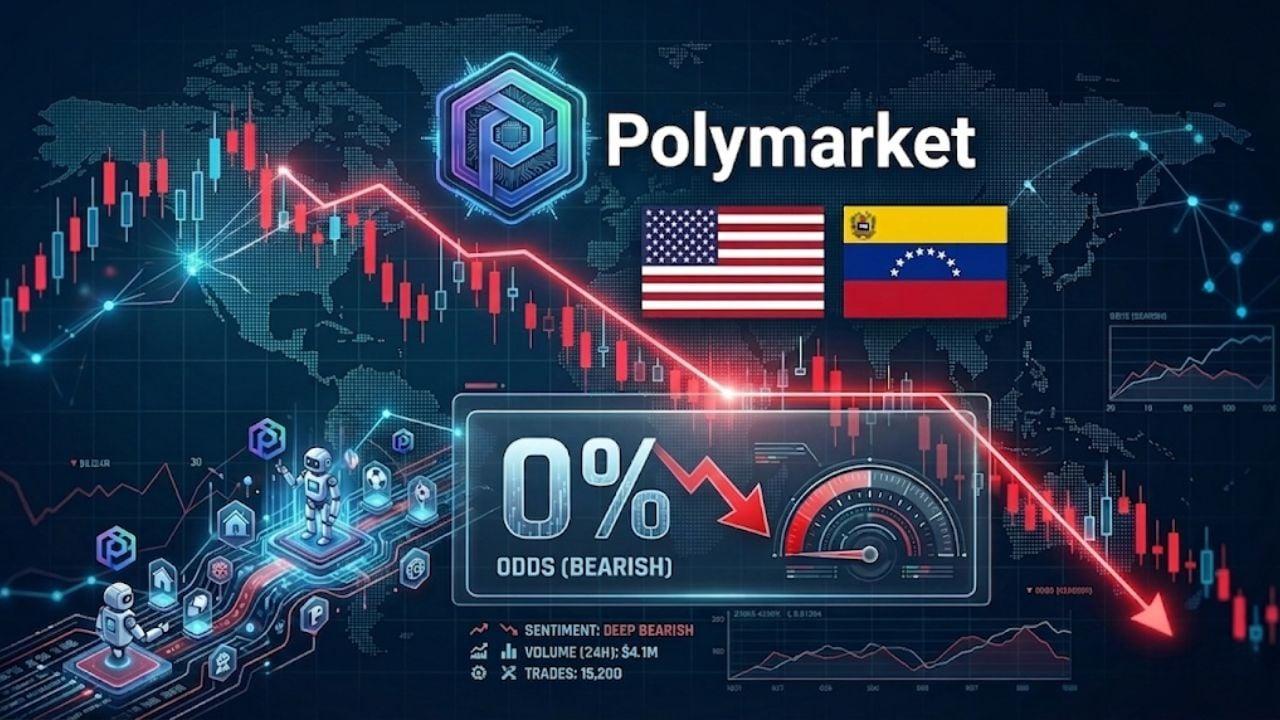
As geopolitical tensions between the United States and Venezuela draw global attention, prediction market traders on Polymarket are betting heavily against a formal war declaration from Congress. Two active markets on the crypto-based platform track the likelihood of official US military action, and both show bettors assigning near-zero odds to such an outcome before mid-2026.
Polymarket data reflects strong social sentiment around US foreign policy, with users wagering real crypto on political outcomes. The platform has become a key barometer for macro market expectations on geopolitical events, blending DeFi infrastructure with real-world event forecasting.
The first Polymarket contract asks whether the US will officially declare war on Venezuela in 2025. The resolution criteria are strict. The market resolves to "Yes" only if Congress passes a formal declaration of war between December 15 and December 31, 2025.
Current odds show a 0% probability for "Yes," with bettors pricing "No" at 100%. This suggests Polymarket participants see no credible path to congressional action in the final weeks of 2025. The market structure requires a formal act of Congress, not executive military action or sanctions, which keeps the bar for "Yes" resolution high. This type of high-conviction pricing is not unique, as seen in other Polymarket contracts like on sports outcomes.
No comments yet. Be the first!
A second Polymarket market extends the timeline to June 30, 2026. It uses the same resolution terms: a formal war declaration enacted by Congress. Here, the odds shift slightly. "Yes" sits at 1.45%, while "No" holds 98.55%.
The divergence between the 2025 and 2026 contracts illustrates how prediction market traders weigh near-term versus medium-term congressional risk. While both outcomes are deemed highly unlikely, the longer window gives a marginal uptick in perceived probability. Still, the overwhelming Polymarket consensus is that the US will not declare war.
Unlike traditional polls, Polymarket aggregates financial stakes with crowd sentiment. Bettors risk USDC on outcomes, creating incentives for accurate forecasting. The platform has gained traction for election and policy predictions, and its US Venezuela war markets are now part of that trend. Institutional interest is also growing, highlighted by moves like 5CC Capital’s $35M VC fund backed by Polymarket and Kalshi CEOs to support prediction markets.
Resolution for both markets depends on credible reporting confirming a formal Congressional act. Without that, both resolve "No." This ties market behavior directly to legislative procedure and the broader political landscape. Analysts tracking social sentiment note that prediction platforms often react faster than traditional media to shifts in diplomatic rhetoric.
Several factors likely influence the heavy "No" bias. Congress has not formally declared war since World War II, preferring Authorizations for Use of Military Force. The tensions with Venezuela have centered on sanctions, oil policy, and diplomatic pressure rather than direct military confrontation.
Polymarket traders appear to be pricing in institutional inertia and the high political cost of a formal war declaration. Even as headlines fluctuate, the prediction market structure forces focus on specific legal criteria, not general conflict risk.