Laika AI
Last Updated
April 24, 2026

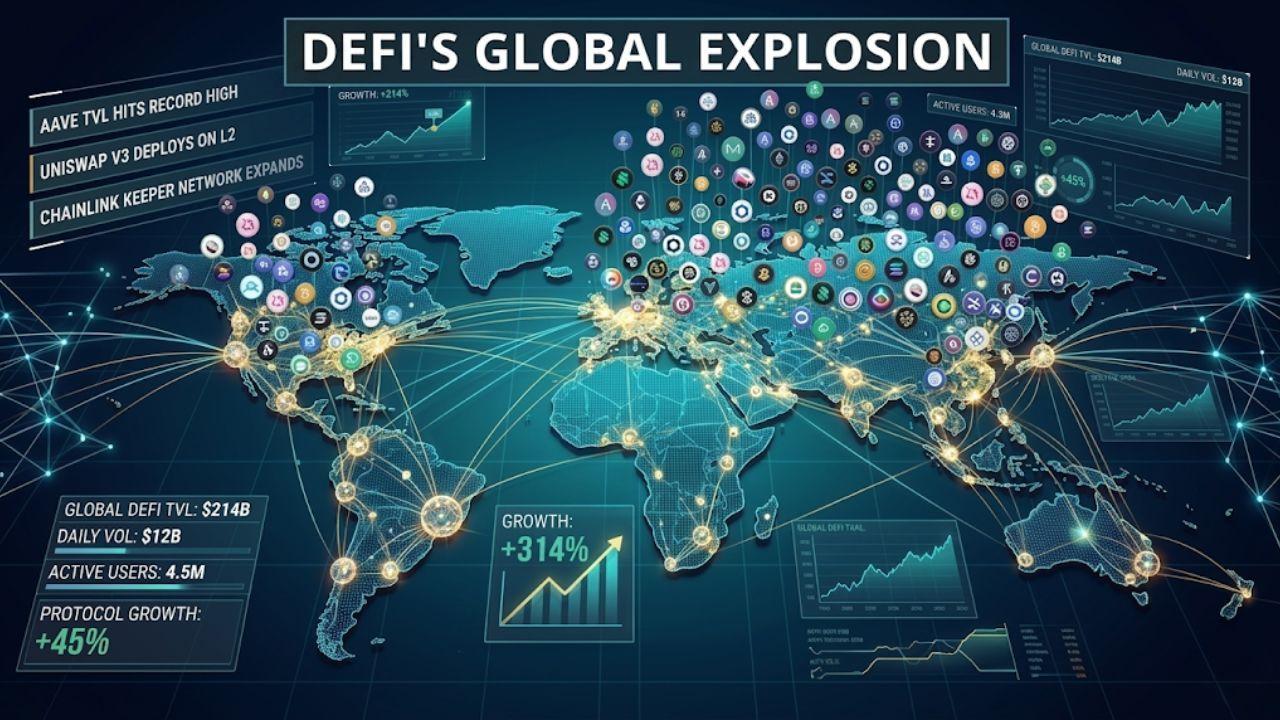
The decentralised finance sector has reached a major inflexion point in 2026, with more than 500 DeFi protocols now operational across 200 blockchains, according to new ecosystem-tracking data.
The figure marks a sharp departure from the early years of DeFi, when Ethereum-based protocols accounted for the vast majority of total value locked and user activity. Today, the landscape reflects deep maturation and diversification, driven by the rise of alternative Layer 1 networks, scalable Layer 2 solutions, and growing interoperability between chains. Major protocols continue to anchor growth, with Lido surpassing $10 billion in DeFi TVL as liquid staking gains dominance.
Analysts point to three core trends behind the expansion. First, alternative Layer 1 blockchains like Solana, Avalanche, and Aptos have matured, offering lower fees and higher throughput that attract both developers and users. Second, Layer 2 rollups on Ethereum and Bitcoin have unlocked new design space for DeFi services while maintaining base-layer security. The Ethereum ecosystem is also planning ahead for security, with the Ethereum Foundation outlining a StrawMap quantum-resistance roadmap. Third, cross-chain interoperability protocols have improved, allowing assets and data to move more freely between ecosystems.
No comments yet. Be the first!
This shift has fueled demand for specialized DeFi services tailored to specific use cases. From real-world asset tokenization to gaming finance and institutional lending desks, protocols are no longer just competing to be general-purpose money markets. Instead, they target distinct user bases with custom features and compliance tooling.
The distributed ecosystem brings clear benefits. Users now enjoy greater competition, faster innovation, and broader choice in DeFi services than at any point in the sector’s history. New primitives like intent-based trading, modular lending, and on-chain derivatives have emerged as developers address gaps in capital markets infrastructure.
However, the same expansion creates challenges. The fragmentation of liquidity across hundreds of protocols and chains can reduce capital efficiency and increase slippage for large trades. For retail users, navigating 200 blockchains introduces complexity in wallet management, bridging, and security practices. Aggregators and cross-chain routers have become essential, but they add another layer of smart contract risk.
Despite these hurdles, the pace of new protocol launches shows no signs of slowing. Venture data indicates that seed-stage DeFi funding remained steady through Q1 2026, with a focus on app-specific chains, zero-knowledge tooling, and AI-integrated yield strategies.
Industry observers say this growth trajectory confirms that DeFi has moved beyond its experimental phase. Once a niche corner of crypto, it now represents a significant component of the broader financial technology landscape. Total value locked across all chains sits near $180 billion, and monthly active wallets interacting with DeFi protocols crossed 25 million in March 2026.
The next phase of DeFi growth will likely hinge on solving the liquidity fragmentation problem. Chain abstraction, shared sequencing layers, and solver networks are being tested as ways to unify user experience without sacrificing the benefits of specialization.
Regulatory clarity is another variable. Jurisdictions in Asia and the Middle East have advanced frameworks for DeFi services, while U.S. and EU policy remains in flux. Clearer rules could accelerate institutional participation across the 200 blockchains now hosting DeFi protocols.
For now, the data paints a picture of an ecosystem that is both larger and more complex than ever. With 500 protocols live and new teams deploying weekly, decentralized finance in 2026 looks less like a single market and more like a global network of interconnected financial experiments.