Laika AI
Last Updated
April 20, 2026

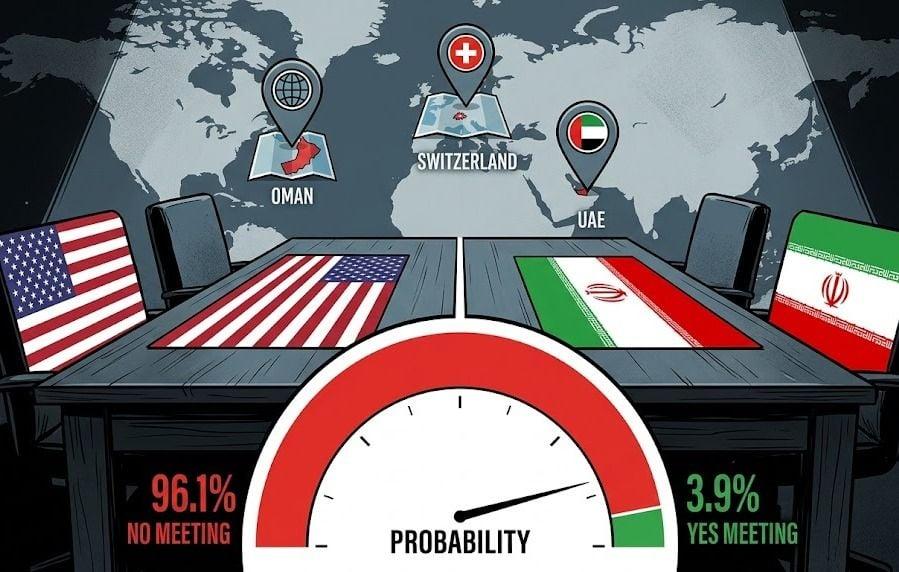
A prediction market tracking the likelihood of a formal in-person diplomatic meeting between the United States and Iran by June 30, 2026, is currently pricing the probability of no qualifying engagement occurring at 96.1%, reflecting deep market skepticism about the pace of diplomatic progress despite the fragile ceasefire that has paused active hostilities between the two nations.
The prediction market's resolution criteria are specific and demanding. A qualifying meeting is defined as an in-person diplomatic engagement between authorized representatives of both the United States and Iran that is either publicly acknowledged by the respective governments or reported by credible media sources. The deadline is June 30, 2026, at 11:59 PM Eastern Time. If no such meeting occurs by that threshold, the market resolves in favor of the no-meeting outcome, regardless of how close negotiations may have come to producing one.
That specificity matters because it excludes several categories of diplomatic activity that might superficially appear to be progress. Back-channel communications, third-party mediated exchanges such as the Pakistan-hosted Islamabad talks, written proposal exchanges, and public statements of willingness to negotiate all fall outside the resolution criteria unless they culminate in a confirmed in-person engagement between authorized representatives of both governments. The market is not pricing diplomatic activity broadly, but a very specific class of direct bilateral meetings.
At 96.1% for no meeting and 3.9% for a meeting occurring at some venue, the current distribution reflects the aggregated judgment of participants who have assessed the gap between where US-Iran relations stand today and the threshold required for a direct bilateral diplomatic meeting to materialize within the remaining window.
No comments yet. Be the first!
The 96.1% probability assigned to no qualifying meeting is not an expression of permanent diplomatic impossibility but a time-bound assessment of what is achievable before a specific deadline, given current conditions. Several structural factors are driving the market's skepticism.
The Islamabad talks that ran for 21 hours in early April concluded without an agreement, demonstrating that even facilitated marathon negotiations mediated by a trusted third party in Pakistan could not produce a breakthrough in a single session. The gap between American and Iranian negotiating positions, as characterized by both sides publicly, involves fundamental disagreements on nuclear program permanence, compensation for conflict losses, security guarantees, and the scope of sanctions relief. Closing a gap of that magnitude in a timeframe that allows for a formal bilateral meeting to be scheduled, confirmed, and conducted before June 30 represents an extremely compressed diplomatic timeline.
Iran's public framing of the negotiations as obstructed by American double standards and hegemonic tendencies signals that Tehran is not in a posture of eager conciliation. At the same time, the Trump administration has maintained maximalist stated objectives that leave limited room for the kind of mutual concession that typically enables a formal bilateral meeting to be agreed upon. When both parties are publicly characterize their counterpart's position as the primary obstacle to progress, the conditions for scheduling a direct meeting are not favorable.
Within the 3.9% probability assigned to a meeting occurring, the market has distributed its confidence across several potential venues, with Oman and Switzerland emerging as the most favored locations at 0.85% and 0.6%, respectively.
Both choices reflect historical precedent rather than current intelligence. Oman has served as a backchannel diplomatic venue for US-Iran communications on multiple occasions, most notably during the preliminary negotiations that preceded the 2015 Joint Comprehensive Plan of Action. Its geographic proximity to Iran, established diplomatic relationships with both Washington and Tehran, and track record of hosting sensitive communications make it the natural first choice for participants speculating about where a meeting might occur if one does take place.
Switzerland carries a different kind of historical precedent as a traditional neutral venue for high-stakes diplomatic engagements between adversarial states. Geneva in particular has hosted landmark arms control negotiations and diplomatic breakthroughs across multiple decades, making it a credible speculative venue for a US-Iran meeting even though it has not featured prominently in the current conflict's diplomatic architecture.
The UAE and Saudi Arabia register at 0.5% and below, reflecting their geographic relevance to the conflict and existing relationships with both parties, but also the complications their own regional positioning introduces into hosting a bilateral meeting of this sensitivity. Iraq appears at similarly minimal odds. Direct meetings in Iran, the United States, or major European capitals are priced at negligible levels, reflecting the political and logistical barriers to either party hosting the other on home territory at this stage of the conflict.
For digital asset markets, a prediction market pricing near-certain diplomatic stagnation between the US and Iran through the end of June carries a clear macro implication. The geopolitical risk premium that has been embedded in oil prices, currency safe-haven positioning, and broader risk asset sentiment throughout the conflict is unlikely to decompress meaningfully in the near term if the market's assessment proves accurate.
Bitcoin's correlation to geopolitical risk events has been a defining feature of its price action throughout the Iran conflict cycle. A prolonged period without diplomatic progress keeps the macro backdrop unsettled in ways that suppress sustained risk-on positioning in crypto markets, particularly for altcoins and DeFi protocols most sensitive to liquidity conditions. The 96.1% no-meeting probability is therefore not just a political data point but a forward-looking signal about the macro environment that crypto traders will be incorporating into their positioning frameworks through the second quarter of 2026.