Laika AI
Last Updated
April 14, 2026

XDC Network has successfully introduced its XDC 2.0 upgrade, bringing advanced Byzantine fault tolerance mechanisms and specialized compliance tools designed for regulated financial applications. The upgrade significantly strengthens network security and positions the chain as a preferred infrastructure for institutional adoption in global trade and finance. Investors tracking the project's trajectory can find a detailed breakdown ofXDC Network's price outlook through 2026 and beyond as the protocol matures.
As an enterprise-grade, EVM-compatible blockchain, XDC Network already offers low fees, fast finality, and strong staking rewards through its native XDC token. The latest protocol changes build on these foundations while addressing key requirements from institutions seeking reliable hybrid public-private solutions.
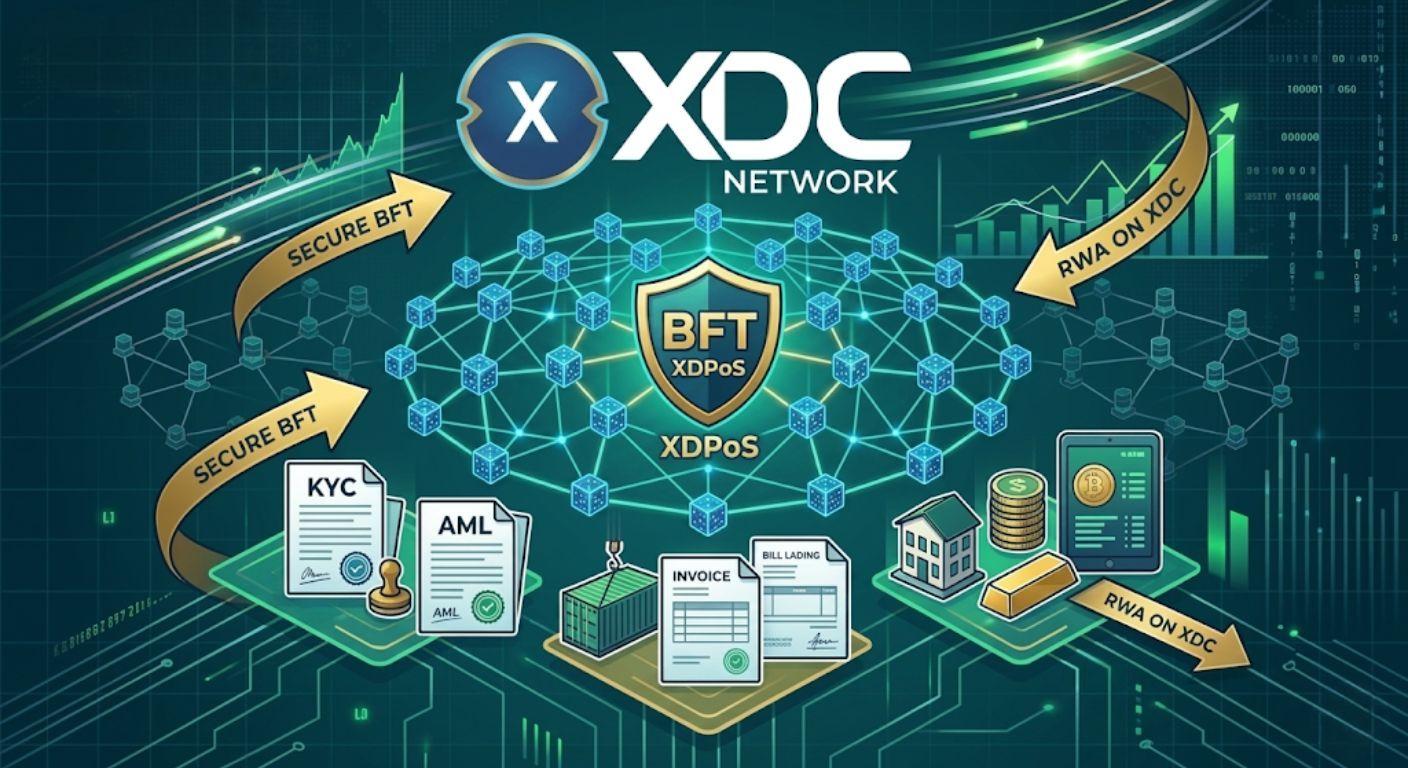
At the heart of the XDC 2.0 upgrade lies a major improvement to the consensus layer. The network now features more robust Byzantine fault tolerance capabilities built upon advanced protocols such as Chained HotStuff. This ensures the system can maintain integrity even under adversarial conditions where up to one-third of validators might act maliciously.
The Delegated Proof-of-Stake operations benefit from deterministic finality, with transactions achieving irreversible confirmation in approximately six seconds. Forensic monitoring tools embedded in the consensus engine allow the network to identify and prove malicious behavior on-chain, enabling swift accountability measures, including slashing of stakes.
No comments yet. Be the first!
These security upgrades reduce the risk of forks and enhance overall network resilience. A committee of 108 master nodes, selected through a verifiable process, forms the core of the Byzantine fault tolerant system, balancing decentralization with military-grade protection.
Beyond security, the XDC 2.0 upgrade introduces specialized compliance features optimized for trade finance and real-world asset (RWA) tokenization. These tools facilitate seamless integration with institutional standards such as KYC and AML requirements.
Privacy-preserving Layer 2 subnets allow sensitive financial data to remain confidential while still benefiting from the main chain's security and settlement guarantees. This hybrid architecture appeals to banks, trade financiers, and asset managers looking to digitize assets without compromising regulatory obligations. The push for compliant blockchain infrastructure mirrors a wider industry shift, withinstitutional crypto adoption accelerating as regulators provide greater clarity and enterprises seek production-ready settlement layers.
The compliance enhancements make XDC Network particularly attractive for tokenized trade instruments, supply chain finance, and other regulated applications where auditability and legal certainty are essential.
The upgrade encompasses enhancements across more than 108 protocol elements, including staking mechanics, reward distribution, and governance participation via the XDC token. These changes maintain the network's signature advantages of low transaction costs and high throughput while elevating its suitability for large-scale deployments.
Developers building on the EVM-compatible platform gain access to a more stable and predictable environment. Existing decentralized applications, especially those focused on tokenized assets, can now operate with greater confidence in the underlying infrastructure. Interoperability with Oracle networks remains a complementary consideration for many institutional builders, and resources such as aChainlink price prediction analysis offer useful context on the valuation of data infrastructure that often pairs with enterprise blockchain deployments.
Validators and node operators were required to update their software to remain in consensus following the activation. The network has confirmed smooth operation post-upgrade with no major disruptions reported.
With these improvements, XDC Network solidifies its role as a leading platform for the digitization of global trade and finance. The combination of enterprise-grade security, regulatory-friendly tools, and high performance creates a compelling offering for institutions exploring blockchain adoption.
The XDC token continues to play a central role through staking rewards and governance rights, aligning incentives between network participants and long-term holders. This upgrade reinforces the project's focus on practical utility without sacrificing the core principles of decentralization.
Industry observers note that such targeted enhancements could accelerate partnerships with traditional financial entities seeking efficient settlement layers for tokenized real-world assets.
The successful rollout of XDC 2.0 marks another milestone in the evolution of the XDC ecosystem. Future development efforts are expected to focus on expanding the subnet architecture and deepening integrations with institutional workflows.
As the broader blockchain industry moves toward greater regulatory clarity and institutional participation, platforms like XDC Network that proactively address compliance and security stand to gain significant traction.
Users, developers, and institutions are encouraged to explore the updated documentation and test the enhanced features available on the mainnet. The upgrade delivers a more secure, compliant, and efficient foundation for the next wave of on-chain financial innovation.