Laika AI
Last Updated
May 6, 2026

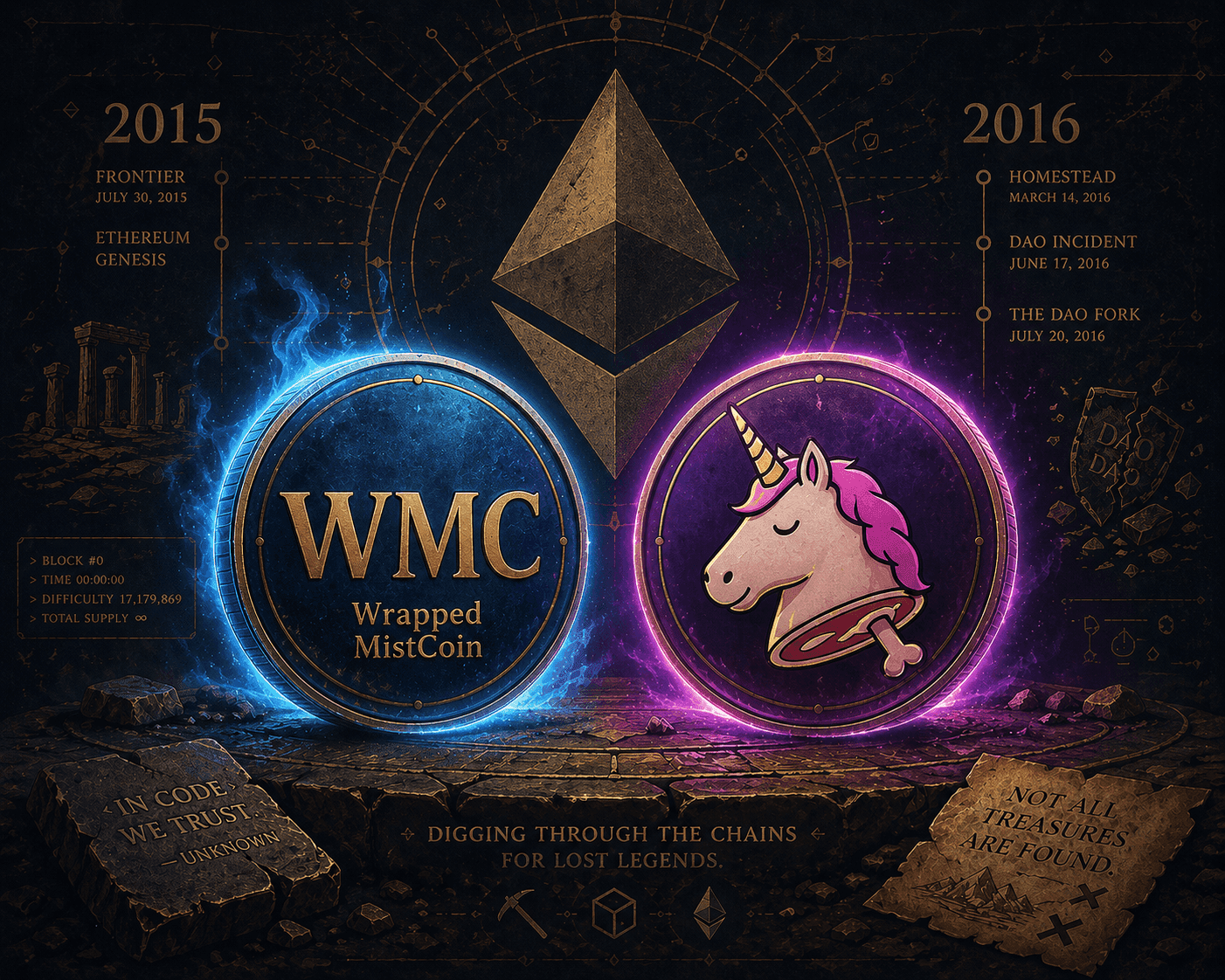
Two of Ethereum's oldest tokens, Wrapped MistCoin and Unicorn Meat, are still trading actively in 2026, drawing renewed attention from collectors, historians, and speculative traders who see value not just in their price action but in what they represent as living artifacts of blockchain's earliest experimental chapter.
To understand why Wrapped MistCoin and Unicorn Meat occupy a unique position in the current market, it helps to understand what the Ethereum ecosystem looked like before standardization took hold. The ERC-20 token standard, which underpins virtually every fungible token operating on Ethereum today, was not formally proposed until late 2015 and did not gain widespread adoption until well into 2017. The tokens that existed before and alongside that standardization effort were built differently, often using bespoke smart contract logic that reflected the experimental spirit of the network's earliest days.
MistCoin, the original asset that Wrapped MistCoin is built around, was launched in November 2015, placing it among the first wave of tokens ever deployed on Ethereum. Its connection to Fabian Vogelsteller, a foundational contributor to the Ethereum ecosystem and one of the architects of the ERC-20 standard itself, gives the token a provenance that few assets in the space can claim. Owning or trading WMC carries a direct link to the period when Ethereum's smart contract capabilities were first being explored and formalized.
WMC functions as a wrapped version of the original MistCoin, a structure that allows the underlying asset to be made compatible with modern decentralized finance infrastructure, including Uniswap liquidity pools. Without the wrapper, MistCoin's pre-standard architecture would limit its accessibility on contemporary platforms. The wrapping mechanism bridges the historical and the current, giving the token a functional presence in today's DeFi landscape.
No comments yet. Be the first!
At present, WMC is trading at approximately $1.91 with a market capitalization of around $998,000 and a 24-hour trading volume of approximately $10,400. Those numbers place it firmly outside the category of high-liquidity assets, but they confirm that a consistent and engaged group of participants is actively exchanging the token. For context, a market cap approaching $1 million with ongoing daily volume represents a meaningful level of sustained interest for an asset that predates most of the infrastructure used to trade it.
Unicorn Meat carries a different kind of origin story. Launched in April 2016 by Alex Van de Sande, a designer and developer who made significant contributions to the Ethereum Foundation and the Mist browser, the token was created as an April Fools' joke. Its ticker, rendered as an emoji rather than a conventional alphanumeric string, was itself a statement of irreverence toward the conventions of token design at the time.
What makes Unicorn Meat technically interesting beyond its name is a mechanic known as a one-way ETH grinder, a feature that allows ETH to be converted into the token but not redeemed in reverse. This asymmetric structure was unusual and playful at the time of launch and continues to define the token's character as something that exists outside the typical financial logic of cryptocurrency assets.
Despite its origins as a joke, Unicorn Meat is trading at approximately $0.0105 with a market cap of around $1.05 million and a 24-hour trading volume of roughly $72,600. Its trading volume actually exceeds that of WMC by a significant margin, suggesting that the novelty and narrative around Unicorn Meat are generating more active short-term speculation, even if both tokens occupy similar market cap territory.
The investor calculus around tokens like WMC and Unicorn Meat sits at an unusual intersection. Some participants approach them as digital collectibles, comparable in spirit to early NFTs or physical memorabilia from a formative period in technology history. The argument is straightforward: scarcity plus provenance plus a compelling narrative equals an asset worth holding.
Others engage with them as thin-liquidity speculative positions, where small capital flows can move prices meaningfully and where awareness of the narrative can drive short-term volume spikes. The trading volume figures for both tokens support this interpretation. Unicorn Meat's $72,600 in 24-hour volume suggests active short-term interest, while WMC's $10,400 reflects a quieter but still present base of participants.
The liquidity caveat matters here. Both tokens operate in markets shallow enough that a moderately sized exit position could move the price in ways that larger, more liquid assets would absorb without difficulty. Participants treating either token as a speculative vehicle need to account for that dynamic when sizing positions or planning exits.
The renewed attention on WMC and Unicorn Meat reflects a pattern that has become more visible as the cryptocurrency market matures. Early projects that survived infrastructure shifts, bear markets, and years of declining attention are increasingly being revisited through the lens of historical significance rather than pure financial utility.
This tendency mirrors what happens in other collecting categories as markets age: provenance and origin story begin to carry weight independent of functional value. Ethereum's early experimental period produced a relatively small number of tokens that are still traceable, tradeable, and narratively connected to known figures in the ecosystem. That scarcity of genuine historical assets, combined with the accessibility of decentralized trading platforms, creates the conditions for a small but persistent collector and speculator market to exist around tokens like these.