Laika AI
Last Updated
April 9, 2026

Vice President JD Vance confirmed on Wednesday that the United States and its allies have agreed to halt military operations against Iran, forming the basis of what he described as a fragile truce that has produced a two-week ceasefire tied directly to the reopening of the Strait of Hormuz, the world's most critical oil shipping chokepoint.
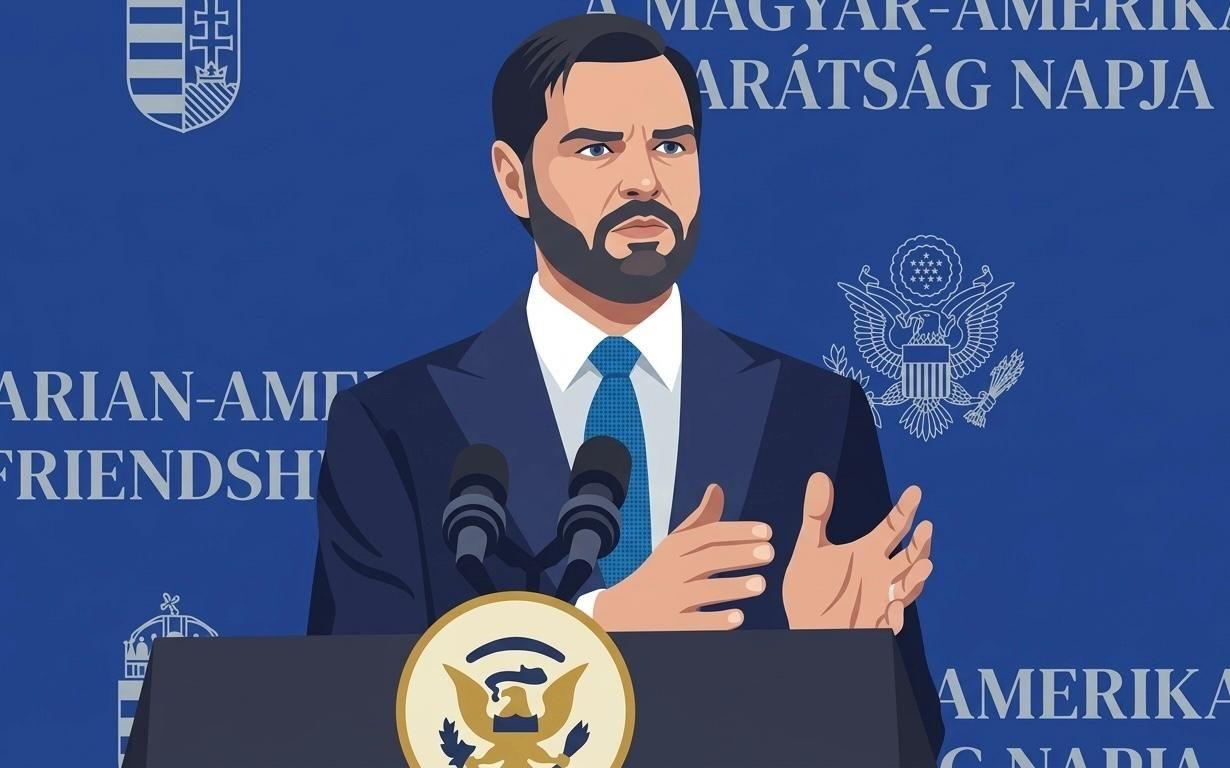
Speaking at a conference in Hungary, Vice President JD Vance framed the ceasefire agreement as both a diplomatic achievement and a conditional arrangement that carries significant risk of collapse. He stated that President Donald Trump is impatient to make progress on a broader deal and made clear that the truce's durability depends entirely on Iran's willingness to negotiate in good faith going forward.
Vance's warning was direct: the fragile truce would hold if Iran engaged honestly with the peace process but would collapse immediately if Tehran chose to lie, cheat, or obstruct its implementation. The language reflects an administration that views the ceasefire not as a resolution but as a structured pause, with the underlying conflict dynamics fully intact and capable of reigniting on short notice.
The choice of a European conference venue for the announcement carries its own diplomatic signal, reinforcing allied coordination in the US posture toward Iran and providing an international audience for terms that the administration clearly wants witnessed beyond domestic media coverage.
The structural foundation of the two-week ceasefire is the condition that Iran agrees to the complete, immediate, and safe opening of the Strait of Hormuz to international shipping. The strait, through which approximately 20% of global daily oil supply transits, had been partially closed by Iranian forces in response to Israeli attacks on Lebanon, a move that sent immediate shockwaves through energy markets and dramatically escalated the economic stakes of the broader conflict.
No comments yet. Be the first!
Iran's Supreme National Security Council confirmed that it would cease defensive operations for the duration of the ceasefire, provided that attacks on Iranian forces and territory also halt, with coordination through its armed forces to ensure safe passage through the strait across the two-week window.
Pakistani Prime Minister Shehbaz Sharif, whose government played a significant role in facilitating the truce through back-channel mediation, stated that the ceasefire applies everywhere, including Lebanon, and took effect immediately upon announcement. Pakistan's involvement as a mediating party introduces a regional diplomatic dimension to the agreement that could prove important if the Friday peace talks require ongoing facilitation from a party trusted by both sides.
The ceasefire did not emerge from a vacuum. The United States had previously received a 10-point peace proposal from Iran, which was initially characterized by Trump as significant but insufficient when it arrived ahead of the April 8 deadline. The terms of the ceasefire agreement suggest that the proposal, while not meeting all American requirements in its original form, was viewed as sufficiently workable to serve as a foundation for structured negotiations.
Formal peace talks between the two sides are scheduled to begin Friday, with the 10-point proposal serving as the opening framework. The talks will need to address a set of US objectives that go beyond the immediate ceasefire, including the permanent elimination of Iran's air force capability, a verifiable block on Iran's nuclear development pathway, and the severing of Iranian financial and logistical support for regional proxy networks.
Those objectives represent a demanding negotiating agenda that is unlikely to be resolved within the two-week ceasefire window, making the durability of the truce and the pace of Friday's initial talks the most critical near-term variables for assessing whether this diplomatic opening leads somewhere durable.
The partial reopening of the Strait of Hormuz provides immediate relief to energy markets that had been pricing in significant supply disruption risk. Oil futures are expected to ease from recent elevated levels as the physical risk to tanker transit through the strait decreases, though the cautious and conditional nature of the ceasefire means that traders are unlikely to fully unwind the geopolitical risk premium until compliance is demonstrated across a meaningful portion of the two-week window.
Iranian compliance with the Hormuz opening terms, tracked through satellite imagery of tanker movements and shipping insurance rate adjustments, will serve as the most reliable real-time indicator of whether the truce is holding in practice as well as in principle.
For digital asset markets, the ceasefire announcement removes the most acute tail risk that had been weighing on Bitcoin and the broader crypto market through the peak of the conflict escalation. Geopolitical risk premiums that had compressed risk appetite and pushed capital toward safe-haven assets begin to unwind when a credible de-escalation signal emerges, and a confirmed two-week ceasefire with Hormuz reopening qualifies as exactly that kind of signal.
Bitcoin is positioned to test upside resistance levels if the relief rally that typically follows major geopolitical de-escalation events materializes. Ethereum and altcoins, which tend to underperform Bitcoin during risk-off periods, could see proportionally larger recoveries as risk appetite returns and capital rotates back into higher-volatility digital asset positions.
Stablecoin flows, DeFi activity metrics, and perpetual futures funding rates will collectively indicate how aggressively the market is repricing risk in response to the ceasefire. Any statement from Trump on Truth Social reinforcing the deal's terms, or any early positive signals from Friday's talks, could accelerate the risk-on rotation and provide Bitcoin with the macro tailwind it needs to challenge key resistance levels in the sessions ahead.