Laika AI
Last Updated
May 6, 2026

As artificial intelligence tools become more deeply embedded in financial workflows, a growing number of traders are drawing a clear line between what they want AI to do and what they insist on doing themselves, using machine intelligence to scan, summarize, and surface information while keeping the judgment calls firmly in human hands.
Modern markets move on information, and the volume of that information has grown far beyond what any individual trader can monitor in real time. Earnings reports, central bank communications, geopolitical developments, regulatory announcements, and sentiment shifts across social platforms all have the potential to reprice assets within minutes of becoming public. For traders operating without institutional research teams or algorithmic infrastructure, keeping pace with that flow has become one of the most persistent operational challenges in the market.
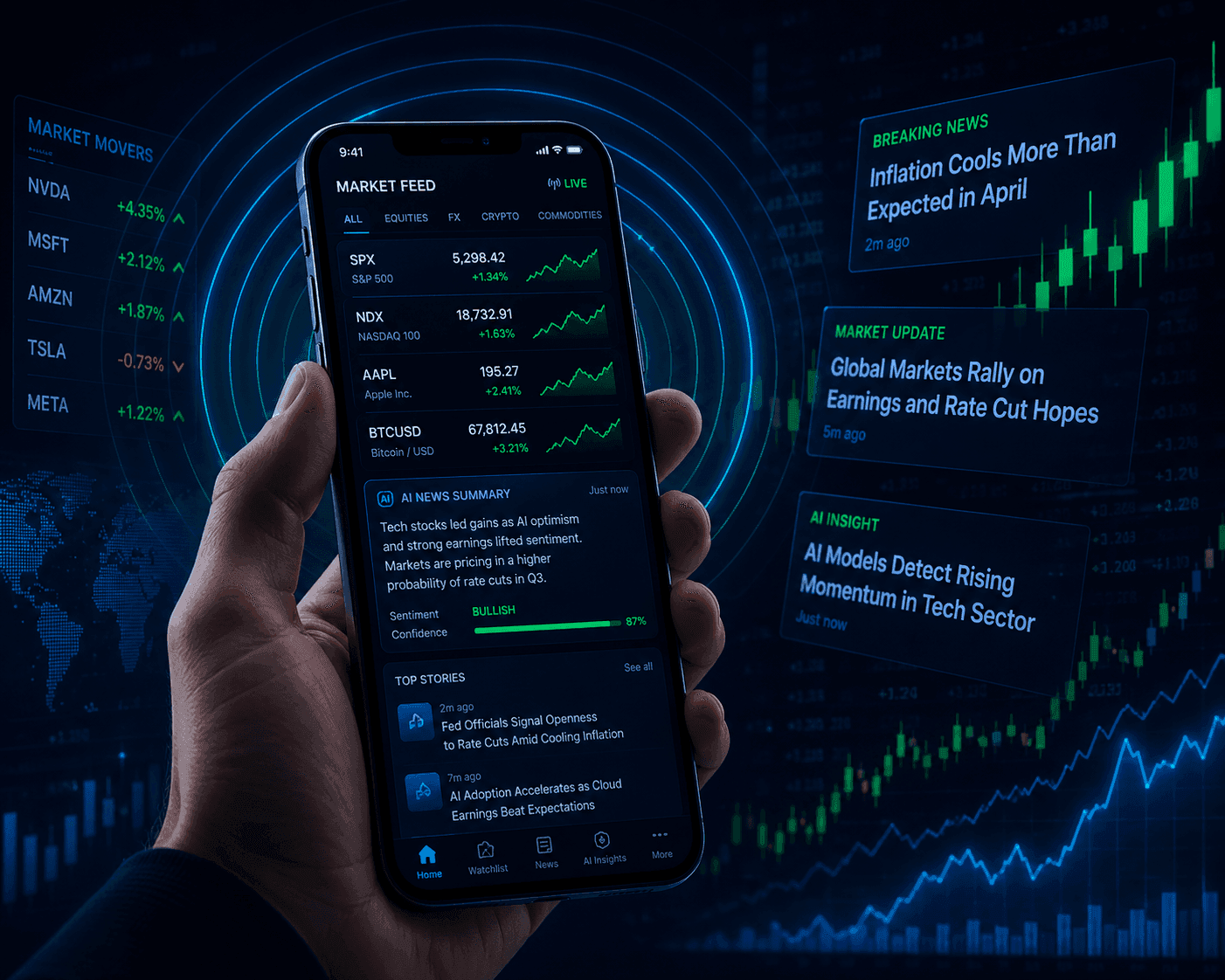
This is the specific gap that AI tools are being positioned to fill. Rather than replacing the analytical process, they are being adopted as front-end filters that process incoming information at scale, identify what is relevant, and deliver it in a form that a trader can act on quickly. The value proposition is not intelligence in the strategic sense but speed and coverage in the informational one.
The distinction that experienced traders are drawing around AI is meaningful and worth examining closely. Describing AI as a market radar rather than a decision-making brain captures something important about where the technology currently adds value and where it falls short.
A radar identifies signals and presents them. It does not determine what to do about them. Applied to trading, this means AI excels at scanning news articles across multiple sources simultaneously, summarizing earnings reports into digestible takeaways, tracking sentiment shifts on platforms ranging from financial forums to social media, and flagging developments that align with a trader's defined areas of interest. What it does not do well is weigh the nuanced second and third-order implications of that information within the context of a specific portfolio, risk tolerance, or broader market thesis. That interpretive layer remains a human function.
No comments yet. Be the first!
One trader's recent account of working with AI tools illustrated this dynamic directly. They noted that while AI could surface and summarize relevant news faster than any manual process, the market had sometimes already priced in the information by the time it was actionable. That observation points to a real constraint: AI-assisted awareness does not automatically translate into a trading edge if the information being surfaced is also available to every other participant with similar tooling.
Among the specific tools gaining traction in trader workflows is TradingNews Press, a real-time news aggregation platform that delivers market information in structured JSON format feeds. The JSON output format is significant because it allows news data to be integrated directly into trading platforms, custom dashboards, and automated alerting systems without requiring manual reformatting or interpretation of unstructured text.
For traders with even basic technical capability, this kind of structured feed transforms how they interact with market news. Rather than monitoring multiple news sources manually and mentally filtering for relevance, they can configure their systems to surface only the categories, tickers, or keywords that matter to their strategies. The result is a more focused information environment that reduces noise without sacrificing coverage of the signals that actually matter.
This approach to information architecture reflects a broader shift in how sophisticated retail and semi-institutional traders are building their workflows, treating data aggregation as an infrastructure problem to be solved with the right tooling rather than a research problem to be solved with more hours of manual monitoring.
The current market environment is providing a particularly active testing ground for AI-assisted trading workflows. Oil price volatility driven by geopolitical tensions around Iran and the Strait of Hormuz, the approach of Federal Reserve policy decisions, and a dense calendar of major technology company earnings reports have created a period where multiple high-impact information streams are running simultaneously.
In conditions like these, the cost of missing or misinterpreting a headline is elevated. A shift in tone from Federal Reserve communications can move fixed income and equity markets within seconds of publication. An unexpected development in a geopolitically sensitive region can reprice energy futures before most individual traders have opened the relevant news tab. AI tools that are already scanning these streams and surfacing structured summaries compress the reaction window for traders who have them configured correctly.
The broader trading community engaging with AI tools is arriving at a consistent conclusion: the technology enhances the informational layer of trading but does not replicate the experiential and intuitive dimensions that shape how skilled traders interpret and act on what they know.
Timing, context, conviction, and risk management all involve judgments that draw on pattern recognition built over years of market participation. An AI tool can tell a trader that a particular headline has historically been associated with a certain type of price movement, but it cannot tell them whether this instance is different, whether the market is already positioned for the outcome, or whether the risk-reward of acting is appropriate given their current exposure. Those calls belong to the trader, and the most effective users of AI tools appear to be those who are clearest about that boundary.
As AI capabilities continue to develop and trading platforms build more sophisticated integrations, the relationship between machine-generated information and human decision-making will continue to evolve. For now, the traders finding the most value in these tools are those using them to be better informed rather than those trying to use them to be less involved.