Laika AI
Last Updated
April 29, 2026

The crypto market saw major headlines this week as USDT reached a new market cap record while Ripple, Solana, and Binance announced significant developments spanning security, ETFs, and exchange flows.
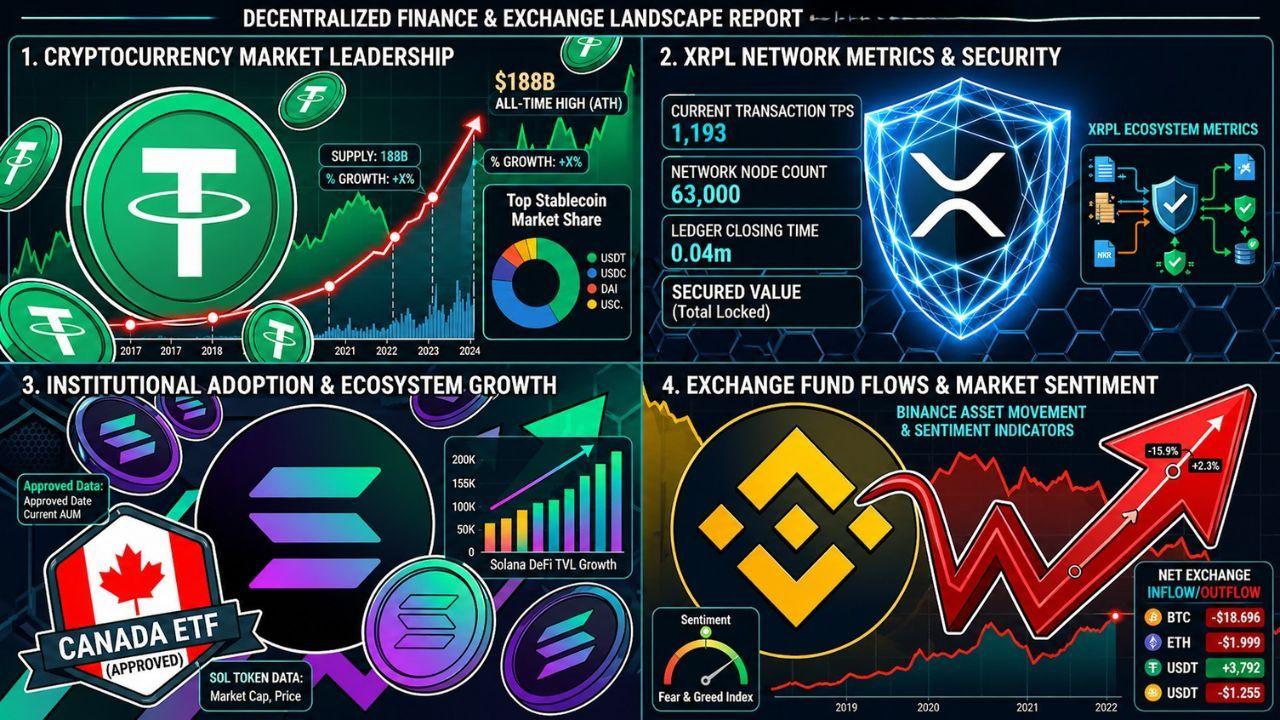
According to a Crypto.com carousel update, USDT market cap climbed to an all-time high of $188B, extending Tether’s dominance in the stablecoin sector. The new ATH comes amid rising on-chain dollar demand and increased usage across DeFi, trading, and cross-border payments. Analysts say the growth reflects both renewed crypto inflows and stablecoin utility as a settlement layer. Institutional allocations continue to expand alongside stablecoins, with recent Fidelity crypto holdings data showing increased exposure to digital assets.
Ripple confirmed that the XRPL ledger is on track to become quantum-safe by 2028. The protocol upgrade aims to future-proof the network against potential threats from quantum computing, which could compromise current cryptographic standards.
Developers plan to integrate post-quantum cryptography into XRPL over the next two years, with full deployment targeted for 2028. The move addresses long-term security event concerns and positions XRP infrastructure for institutional-grade resilience. Ripple said the upgrade will be backwards compatible and require no action from most users. The push mirrors broader industry work on quantum resistance, including the efforts now underway.
No comments yet. Be the first!
Solana secured a regulatory win as Canada approved the first spot SOL ETF, marking a milestone for altcoin investment products in North America. The ETF provides regulated exposure to SOL and is expected to launch on the Toronto Stock Exchange in May 2026.
Separately, several crypto corporate treasury accounts disclosed new SOL acquisitions. The buying activity adds to growing institutional interest in Solana as a high-throughput L1 for DeFi and payments. Market watchers link the ETF approval and treasury buys to rising developer activity and network stability on Solana.
Binance recorded a $931M USDT net outflow in the past 24 hours, according to on-chain data. The large movement follows a week of elevated volatility and shifting capital between exchanges and self-custody wallets.
While Binance remains the largest exchange by volume, the outflow highlights ongoing rotation among stablecoin venues. Some analysts attribute the move to traders seeking yield elsewhere or rebalancing after recent market swings. USDT supply on Binance still exceeds $20B despite the drawdown.
The combination of USDT’s $188B ATH, XRPL’s quantum-safe roadmap, Solana’s ETF approval, and Binance outflow data paints a complex macro-market picture. Stablecoin expansion suggests fresh liquidity entering crypto, while protocol and regulatory upgrades point to maturing infrastructure.
USDT dominance above 70% of the stablecoin market gives Tether outsized influence on market flows. A $931M outflow from Binance is notable but not yet systemic, given USDT’s $188B total market cap. Meanwhile, Solana’s ETF could open new demand channels for SOL, similar to the impact of spot BTC and ETH products.
For Ripple and XRP, the quantum-safe initiative addresses a tail risk that institutions often cite. Completing the protocol upgrade by 2028 would make XRPL one of the first major L1s with post-quantum protections, potentially aiding enterprise adoption. Liquidity metrics are also improving, with XRP institutional liquidity reports showing deeper order books across venues.
With USDT supply at an ATH, liquidity conditions appear strong heading into Q2 2026. Traders will monitor whether Binance outflow stabilizes or accelerates, and if Solana ETF inflows materialize after listing.
XRPL’s 2028 timeline gives developers a clear runway for testing quantum-safe cryptography. Security researchers say early moves on post-quantum standards could become a competitive moat for L1s.
Across the board, the updates reflect a market shifting from speculation to infrastructure. Corporate treasury adoption, regulated ETF products, and security-event planning all point to deeper institutional integration.