Laika AI
Last Updated
March 20, 2026

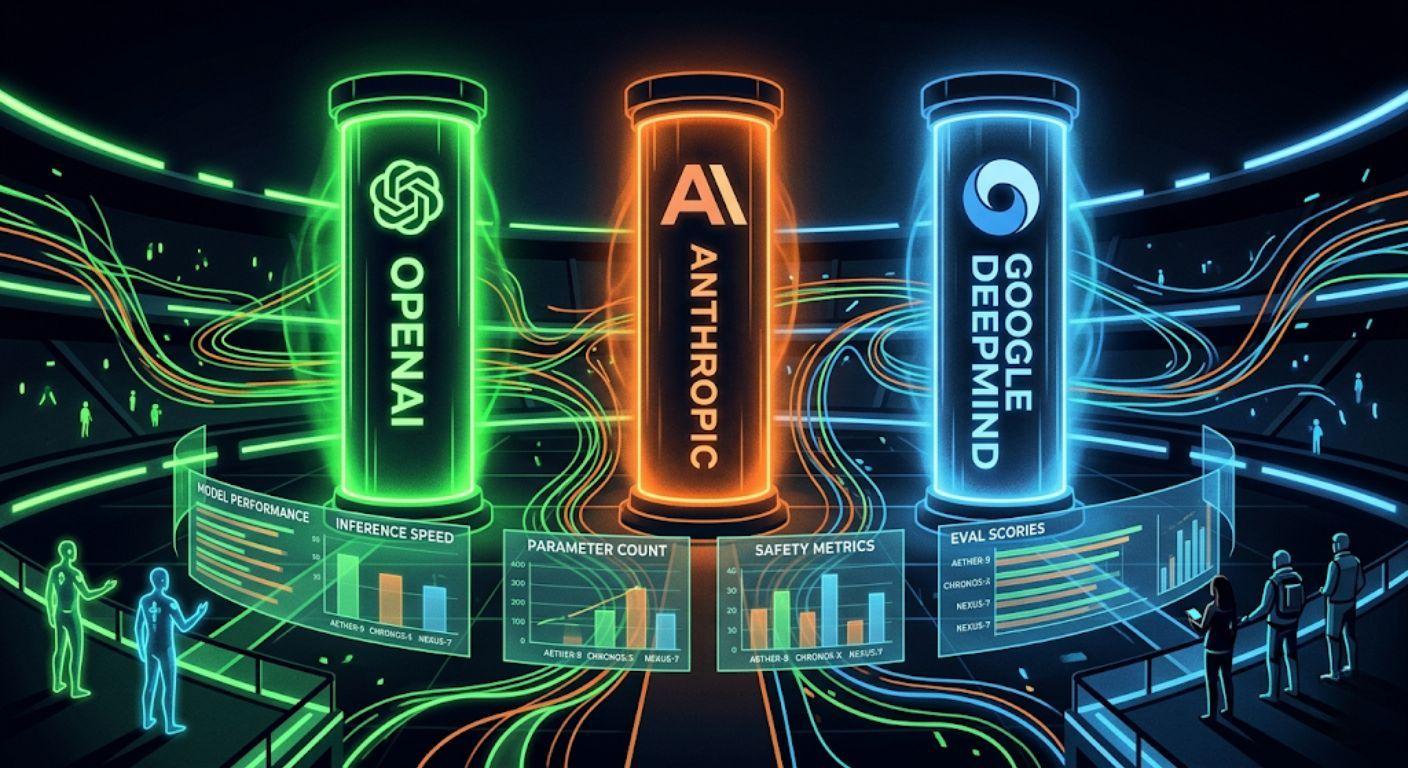
The first quarter of 2026 will be remembered as the moment the frontier AI race truly went into overdrive. OpenAI, Anthropic, and Google have each launched major model upgrades within weeks of one another, setting records for release velocity and sparking fierce debate about which platform now leads the industry.
February alone saw 12 frontier model updates shipped globally, a pace that researchers and analysts are calling the fastest in AI history.
OpenAI's latest release, GPT-5.4, arrives with two headline features that are already turning heads across developer communities.
First, the model supports a 1 million token context window, enabling it to process entire codebases, lengthy legal documents, or book-length research papers in a single prompt. Second, GPT-5.4 ships with native computer-use capabilities built directly into Codex, OpenAI's coding-focused environment.
This means developers can now instruct GPT-5.4 to navigate software interfaces, execute code, and interact with external tools without additional integrations. For enterprise teams and autonomous agent builders, this represents a meaningful step forward in practical AI deployment.
No comments yet. Be the first!
Independent evaluations and developer benchmarks consistently rank Claude Sonnet 4.6 at the top for multi-step coding workflows, code review, and autonomous software development tasks. This positions Anthropic's model as the preferred choice for teams building AI-powered development pipelines and autonomous engineering agents.
Claude Sonnet 4.6 also continues Anthropic's reputation for strong instruction-following and nuanced reasoning, making it a versatile option beyond pure coding applications.
If raw benchmark performance is the measure, Google's Gemini 3.1 Pro currently sits at the top of the leaderboard. The model has topped 13 out of 16 major industry benchmarks, covering areas such as reasoning, multilingual understanding, mathematical problem-solving, and long-context comprehension.
Google's ability to integrate Gemini 3.1 Pro across its broader ecosystem, including Search, Workspace, and Cloud, gives it a distribution advantage that neither OpenAI nor Anthropic can easily match. For organizations already embedded in Google's infrastructure, the upgrade path to Gemini 3.1 Pro is notably seamless.
Beyond the three flagship releases, the broader picture is striking. Twelve frontier model updates were shipped across the industry in February 2026 alone. This release cadence is compressing the traditional product lifecycle and creating new challenges for developers, enterprises, and regulators trying to keep pace.
For businesses building on top of these models, the rapid iteration raises questions about stability, reproducibility, and long-term API support. For researchers, it is accelerating the timeline toward more capable systems faster than many forecasts had anticipated.
The March model sprint is not just a technical story. It reflects deepening capital investment, intensifying competitive pressure, and a fundamental shift in how AI capabilities are delivered and consumed.
Each of the three models addresses a distinct priority: scale and integration for GPT-5.4, coding excellence for Claude Sonnet 4.6, and benchmark breadth for Gemini 3.1 Pro. For users and enterprises, the practical question is no longer which model is best in the abstract, but which model is best for their specific workflow.
The race is far from over.