Laika AI
Last Updated
April 22, 2026

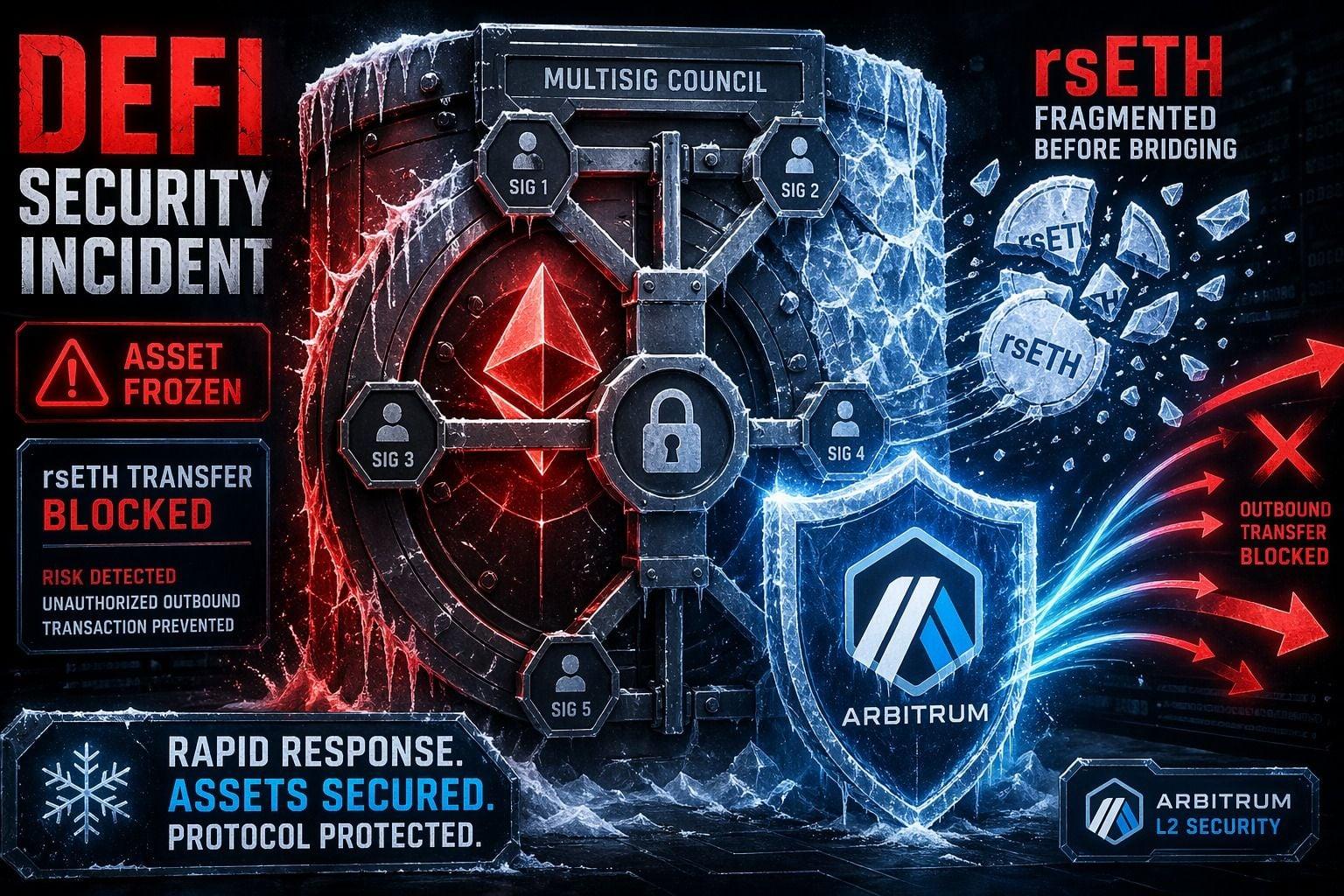
The Arbitrum Security Council has executed an emergency freeze of 30,766 ETH, valued at approximately $71 million, tracing the assets directly to the Kelp DAO exploit that resulted in approximately $292 million in total losses. This stands as one of the most significant Layer 2 security interventions the ecosystem has recorded.
The mechanics of the freeze were enabled by a specific set of circumstances that created a narrow but actionable recovery opportunity. The exploiter had not yet bridged the stolen ETH from Arbitrum One back to the Ethereum mainnet, a step that would typically precede mixing through privacy protocols and make tracing and recovery exponentially more difficult.
That delay gave the Arbitrum Security Council a window that does not remain open indefinitely. Once stolen funds reach the Ethereum mainnet and enter a mixing infrastructure, the cryptographic trail that enables chain-level intervention becomes practically unrecoverable. The Council's ability to act before that transition occurred is the operational factor that made the $71 million recovery possible.
The decision to execute the freeze was informed by input from law enforcement regarding the exploiter's identity, adding an investigative dimension to what might otherwise have been a purely technical intervention. The combination of on-chain tracing, law enforcement coordination, and the Council's emergency authority produced a response that moved the frozen assets to a secure wallet that the exploiter cannot access, with release subject to future governance approval rather than unilateral Council discretion.
To understand the significance of the intervention, the broader context of the Kelp DAO exploit requires framing. The attack compromised Kelp DAO's rsETH liquid restaking token, a protocol that sits within the increasingly complex stack of liquid restaking infrastructure built on top of Ethereum's proof-of-stake architecture. Liquid restaking tokens represent claims on staked that can simultaneously be deployed across DeFi protocols, creating capital efficiency but also interconnected risk exposure.
No comments yet. Be the first!
The total losses from the exploit reached approximately $292 million, a figure that places it among the larger DeFi security incidents in recent memory. The rsETH compromise carried downstream risk across DeFi protocols that had integrated the token as collateral or liquidity, with native Aave deployments on Arbitrum facing particular exposure to bad debt accumulation if the stolen collateral backing rsETH positions could not be recovered.
The $71 million recovered through the emergency freeze represents approximately 25% of the total stolen amount, a partial but materially significant recovery that reduces the bad debt exposure across affected protocols and provides a measurable offset against the total economic damage of the exploit.
The downstream concern that gave the Arbitrum Security Council's intervention its urgency was the risk of contagion spreading through DeFi lending protocols, particularly Aave's native deployments on Arbitrum. When a liquid restaking token at the scale of rsETH is compromised, the protocols that accepted it as collateral face the prospect of undercollateralized positions that cannot be liquidated at full value, creating bad debt that must ultimately be absorbed somewhere in the system.
By freezing 30,766 ETH before it could leave the chain, the Security Council preserved assets that can potentially be used to backstop affected positions through governance-directed remediation once the release process is approved. The governance requirement for release is not merely procedural. It ensures that the distribution of recovered assets follows a transparent, community-approved process rather than being directed unilaterally, a distinction that matters considerably for the protocols and users who sustained losses.
Cross-chain tracing complexities featured prominently in the intervention's technical narrative. Attributing specific funds on a Layer 2 network to a specific exploit event, coordinating with law enforcement across jurisdictions, and executing a freeze before the exploiter completes a bridging transaction requires a combination of on-chain forensics capability and operational speed that most protocol-level security architectures cannot deliver. The Arbitrum Security Council's structure, specifically its multisig composition and emergency authority framework, was the enabling mechanism.
The intervention's success has not insulated it from criticism. The ability of the Arbitrum Security Council to unilaterally freeze assets on the network, even assets confirmed to be stolen, raises fundamental questions about what decentralization means in the context of Layer 2 networks built on multisig governance structures.
Proponents of the intervention argue that the ability to respond to confirmed theft within the window before funds are laundered is precisely the kind of capability that a responsible Layer 2 governance architecture should maintain. The alternative, a network so decentralized that no recovery mechanism exists, produces a system where protocol exploiters operate with complete impunity regardless of the evidence trail they leave.
Critics counter that multisig councils capable of freezing any wallet, regardless of the justification, represent a meaningful centralization of power that distinguishes Layer 2 networks from the credible neutrality that the Ethereum mainnet aims to maintain. The governance approval requirement for release addresses some of that concern but does not eliminate it entirely, since the initial freeze decision was made by the Council without prior community vote.
That debate will continue well beyond this specific incident, shaping how future Layer 2 governance frameworks balance the operational capacity to respond to security events against the decentralization principles that define the broader Ethereum ecosystem's values.